Geography · Ch 18 — Water (Oceans)
Hydrological Cycle
Hydrological Cycle
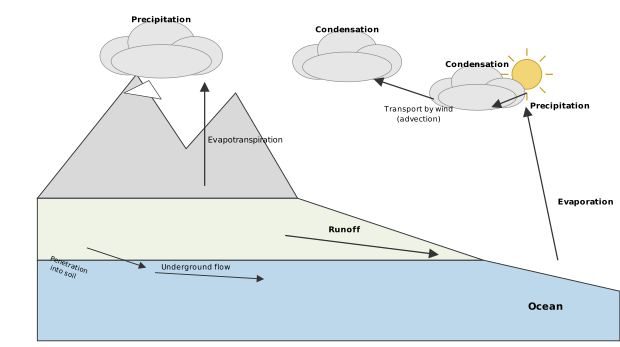
The diagram is a cross-section of a landscape that runs from a mountain range on the left to the open ocean on the right, with the sky above and the land and sea below. It is built around a single idea: water is constantly moving between the ocean, the atmosphere, and the land, and every arrow in the picture is one leg of that journey.
Start at the left. Over the mountains sit clouds labelled Precipitation. A double-headed arrow rises from the land surface up to these clouds; one end of the arrow is labelled Condensation and the other Evapotranspiration. The double head matters — it shows that water vapour moves upward from the land (through evaporation from soil and water bodies plus transpiration from plants, together called evapotranspiration), and that this same rising vapour condenses into cloud droplets. The precipitation label on the clouds tells you what happens next: the condensed water falls back to the land as rain or snow.
Move to the right side of the sky. There is a sun, and over the ocean beneath it sit clouds labelled Condensation. An upward arrow from the ocean surface to these clouds is labelled Evaporation — this is the primary engine of the whole cycle, since most evaporation on Earth happens over the sea. From these ocean clouds, a horizontal arrow labelled Transport by wind (advection) carries the moisture-laden air leftward toward the mountain clouds. A downward arrow from these same right-hand clouds is labelled Precipitation, showing that the ocean also receives rain directly.
Back on the land surface, the diagram closes the loop. An arrow labelled Runoff flows from the land toward the ocean, carrying surface water downhill into the sea. Diagonal arrows entering the ground are labelled Penetration into soil and Underground flow — these show infiltration and the slower subsurface movement of water that eventually also reaches the ocean or re-emerges. The right portion of the diagram is labelled Ocean, anchoring the whole scene. …
| Components | Processes |
|---|---|
| Water storage in oceans | Evaporation, Evapotranspiration, Sublimation |
| Water in the atmosphere | Condensation, Precipitation |
| Water storage in ice and snow | Snowmelt runoff to streams |
| Surface runoff | Stream flow, freshwater storage, infiltration |
Water is the most important element for life after air. Every living form on Earth’s surface depends on it, and the planet is fortunate to have it in abundance. In fact, Earth is the only place in the solar system with significant surface water — there is none on the Sun or anywhere else in the solar system. This is why our planet is called the ‘Blue Planet’.
The hydrological cycle describes the movement of water on, in, and above the Earth. It is the circulation of water within the Earth’s hydrosphere in different forms — liquid, solid, and gaseous. The cycle also refers to the continuous exchange of water between the oceans, the atmosphere, the land surface, the subsurface, and organisms. It has been working for billions of years, and all life on Earth depends on it.
Water is a cyclic resource, meaning it can be used and re-used. The distribution of water on Earth, however, is quite uneven. Some locations have plenty of water while others have very limited quantities.
About 91 per cent of the planetary water is found in the oceans. The remaining water is held as freshwater in:
- glaciers and icecaps
- groundwater sources
- lakes
- soil moisture
- the atmosphere
- streams
- within life forms
Nearly 59 per cent of the water that falls on land returns to the atmosphere through evaporation — from the oceans as well as from other places. The remainder runs off on the surface, infiltrates into the ground, or a part of it becomes glacier. …
Water is a cyclic resource. It can be used and re-used. Water also undergoes a cycle from the ocean to land and land to ocean. The hydrological cycle describes the movement of water on, in, and above the earth. The water cycle has been working for billions of years and all the life on earth depends on it. Next to air, water is the most important element required for the existence of life on earth. The distribution of water on earth is quite uneven -- many locations have plenty of water while others have very limited quantity. The hydrological cycle is the circulation of water within the earth's hydrosphere in different forms, i.e. the liquid, solid and the gaseous phases. It also refers to the continuous exchange of water between the oceans, atmosphere, land surface and subsurface and the organisms.
About 91 per cent of the planetary water is found in the oceans. The remaining is held as freshwater in glaciers and icecaps, groundwater sources, lakes, soil moisture, atmosphere, streams and within life. Nearly 59 per cent of the water that falls on land returns to the atmosphere through evaporation from over the oceans as well as from other places. The remainder runs off on the surface, infiltrates into the ground or a part of it becomes glacier. …