Sociology · Ch 4 — Culture and Socialisation
Defining Culture
Defining Culture
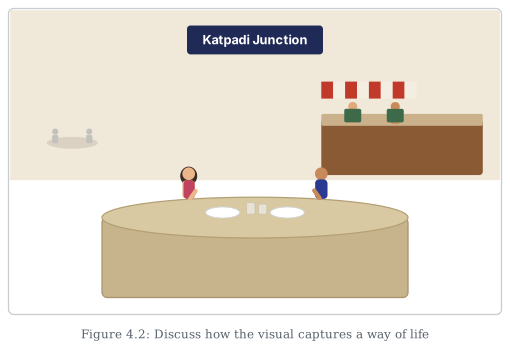
Drawn by us to help you understand the concept clearly, and verified to make sure it's accurate. For exams, practice from your NCERT textbook's own diagram.
Two young people at a café table near a signed city junction, with a food stall in the background, is a deliberately unremarkable, everyday scene -- exactly the point. The chapter uses ordinary moments like this to argue that culture is not confined to 'high' or 'refined' activities like classical music or fine art; it is the whole, ordinary way of life a group of people shar …
Ordinary usage often treats 'culture' as a mark of refinement -- knowing classical music, appreciating a particular dance form or painting -- something that separates 'cultured' people from everyone else, sometimes right down to trivial preferences like coffee over tea. Sociology rejects this narrower sense. For a sociologist, culture is not what distinguishes a refined minority from the rest; it is the entire way of life shared by every member of a society or group, since every social organisation, from a family to a nation, develops a culture of its own.
One of the earliest and most influential definitions comes from the British anthropologist Edward Tylor (1871), who described culture as 'that complex whole which includes knowledge, belief, art, morals, law, custom and any other capabilities and habits acquired by man as a member of society.' Notice how wide this net is cast -- it covers ideas and beliefs quite as much as art or custom, and treats culture as something learned through membership in society rather than inherited biologically. A generation later, the Polish-British anthropologist Bronislaw Malinowski added a dimension Tylor's list leaves largely implicit: he described culture as comprising 'inherited artifacts, goods, technical processes, ideas, habits and values' -- explicitly naming material objects and technical processes alongside the non-material elements Tylor had emphasised. Other thinkers pushed the definition further still. Clifford Geertz argued that human action should be read the way we read a text, as something that carries meaning -- famously calling culture the 'webs of significance' that people themselves spin and are then suspended in, so that studying culture becomes a search for meaning rather than for cause-and-effect explanation. Leslie White made a related point using a simple example: people can treat water from a particular source as holy, which shows how culture adds meaning on top of the plain physical fact of the water itself. …
| # | Culture is... |
|---|---|
| (a) | a way of thinking, feeling, believing. |
| (b) | the total way of life of a people. |
| (c) | an abstraction from behaviour. |
| (d) | learned behaviour. |
| (e) | a storehouse of pooled learning. |
| (f) | the social legacy the individual acquires from his group. |