Sociology · Ch 2 — Terms, Concepts and their use in Sociology
Types of Groups
Types of Groups
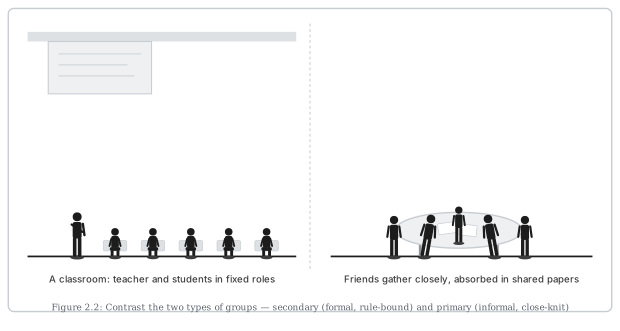
Drawn by us to help you understand the concept clearly, and verified to make sure it's accurate. For exams, practice from your NCERT textbook's own diagram.
A classroom, with a teacher and rows of students facing the board, illustrates a formal SECONDARY group -- organised around an impersonal, role-based purpose. A cluster of people seated closely around a table illustrates an informal PRIMARY group -- built on face-to-face, personal, and emotionally close ties. Placing the two side by side makes the primary/secondary distinction concrete: it is about the QUALITY …
Sociologists and social anthropologists have proposed several overlapping ways of classifying social groups, but nearly all of them follow the same underlying pattern: they contrast the close, intimate, face-to-face way people relate to each other in small traditional societies with the more impersonal, formal and distant way they relate in large modern ones. This traditional-versus-modern contrast is a useful starting point, though it is too neat to capture the full complexity of real social life — many modern relationships remain intimate, and many traditional ones are formal. The sections below work through five such classificatio …