Applied Mathematics · Ch 8 — Calculus
Signum Function
8.5(g)
Signum Function
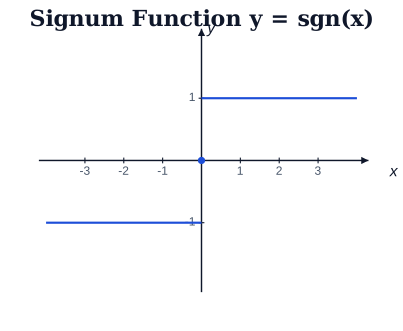
The signum function is a compact way to capture the sign of a real number — whether it is positive, negative, or zero. It is defined piecewise: for , for , and . This function is a classic example of a discontinuous function at , making it a perfect tool for understanding limits and one-sided behaviour. You will often see it used to model switching phenomena or …
Figure 8.6The graph of the signum function, equal to minus one for negative x, zero at x = 0, and plus one for positive x
Drawn by us to help you understand the concept clearly, and verified to make sure it's accurate. For exams, practice from your NCERT textbook's own diagram.
The signum function: −1 for x<0, 0 at x=0, and +1 …