Applied Mathematics · Ch 7 — Mathematical and Logical Reasoning
Applications of Reasoning -- Categorical Syllogism
Applications of Reasoning -- Categorical Syllogism
A categorical syllogism is a structured argument made of three statements: two premises and a conclusion, each built from categories (sets) linked by words like all, no, or some. The goal is to test whether the conclusion follows necessarily from the premises — not whether it is factually true, but whether the reasoning is airtight. For example, if all are and all are , then all must be ; this is valid. Understanding this form sharpens your ability to spot logical g …
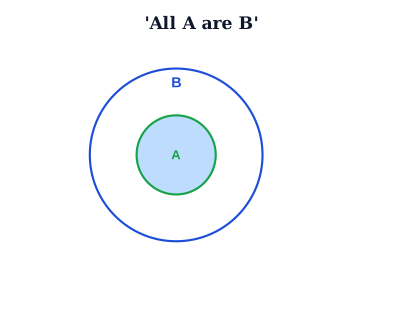
Drawn by us to help you understand the concept clearly, and verified to make sure it's accurate. For exams, practice from your NCERT textbook's own diagram.
'All A are B': A's circle lies entirely wit …
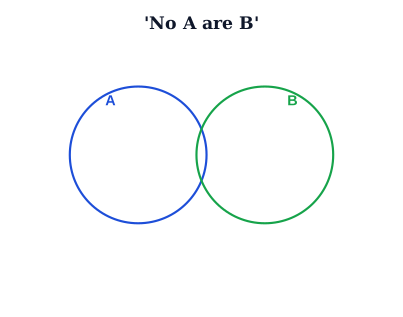
Drawn by us to help you understand the concept clearly, and verified to make sure it's accurate. For exams, practice from your NCERT textbook's own diagram.
'No A are B': the two circles are di …