Computer Science · Ch 5 — Getting Started with Python
Data Types
Data Types
Every value in Python belongs to a specific data type. A data type does two jobs at once: it identifies what kind of data values a variable can hold, and it determines which operations can be performed on that data. An integer can be divided; a string can be concatenated; a set refuses duplicates — the type is what grants and limits these abilities.
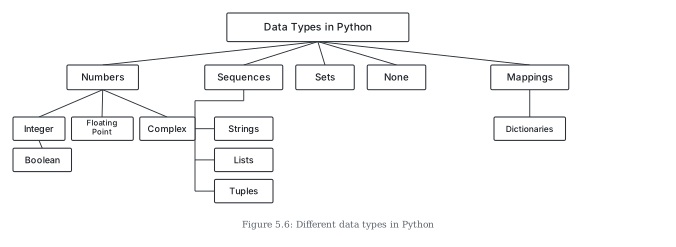
Figure 5.6 lays out the full family of data types available in Python, and the sub-sections that follow walk through each branch:
- 5.7.1 Number —
int,floatandcomplex, plus the boolean subtypebool. - 5.7.2 Sequence — the ordered, integer-indexed collections: strings, lists and tuples.
- 5.7.3 Set — an unordered collection with no duplicate entries.
- 5.7.4 None — the special type whose single value signifies the absence of a value.
- 5.7.5 Mapping — key-value storage; Python's one standard mapping type is the dictionary. …
Drawn by us to help you understand the concept clearly, and verified to make sure it's accurate. For exams, practice from your NCERT textbook's own diagram.
This figure is a hierarchy (tree) diagram laying out every data type available in Python — the map for the whole of Section 5.7.
At the root sits a box labelled "Data Types in Python". From it, five branches descend, one for each top-level family:
- Numbers — this branch splits further into Integer, Floating Point and Complex, the three numeric types of Section 5.7.1. Attached below Integer is Boolean, drawn as its child — a visual reminder that
boolis a subtype of integer. - Sequences — branching into Strings, Lists and Tuples, the three ordered, integer-indexed collection types of Section 5.7.2.
- Sets — the unordered, duplicate-free collection of Section 5.7.3, with no further subdivision.
- None — the special "absence of value" type of Section 5.7.4, also a leaf on its own.
- Mappings — leading to Dictionaries, Python's single standard mapping type (Section 5.7.5). …