Computer Science · Ch 4 — Introduction to Problem Solving
Steps for Problem Solving
Steps for Problem Solving
Solving a problem rarely happens in one leap; it usually unfolds as a series of steps. A real-life analogy makes this clear. Imagine that a vehicle you are driving begins to make an odd noise. You may not know the remedy immediately, so the first job is to work out where the noise is coming from. If the fault is beyond you, the vehicle goes to a mechanic. The mechanic does not start unscrewing parts at random — he first analyses the problem to locate the source of the noise, then plans what work needs to be done, and only then repairs the vehicle so that the noise disappears.
The lesson carries over directly to computing:
- Finding a solution can involve multiple distinct steps, not one action.
- When a problem is small and straightforward, the solution may be obvious.
- A complex problem, however, demands a methodical approach — in other words, deliberate problem solving techniques — to arrive at the right solution.
Where problem solving begins and ends
Problem solving with a computer spans the whole journey from question to working answer:
- It begins with the precise identification of the problem.
- It ends with a complete working solution in the form of a program or software.
The key steps
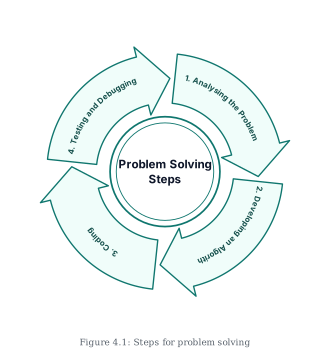
The key steps for solving a problem using a computer are shown as a cycle in Figure 4.1, and each is taken up in its own subsection:
- Analysing the problem (section 4.2.1) — understand exactly what has to be solved, and what the inputs and outputs are.
- Developing an algorithm (section 4.2.2) — devise the step-by-step solution in natural language. …
Drawn by us to help you understand the concept clearly, and verified to make sure it's accurate. For exams, practice from your NCERT textbook's own diagram.
Figure 4.1 presents the steps of problem solving not as a flowchart but as a circular cycle diagram. At the centre sits a circle labelled "Problem Solving Steps", and around it four curved arrow segments form a ring that flows clockwise. Each curved segment carries one numbered step:
- Analysing the Problem (top-right)
- Developing an Algorithm (bottom-right)
- Coding (bottom-left)
- Testing and Debugging (top-left)
Each segment's arrowhead points to the next step clockwise, so the ring reads 1 → 2 → 3 → 4 → and then back to 1. …