Computer Science · Ch 11 — Societal Impact
Social Media Etiquettes
Social Media Etiquettes
Most of us hold accounts on one or more social media platforms — Facebook, Google+, Twitter, Instagram, Pinterest, or a YouTube channel. Social media are websites or applications that enable their users to participate in social networking by creating and sharing content with others in a community. These platforms encourage users to share thoughts and experiences through posts and pictures, letting them interact with other online users of the same apps or channels. This is why the impact and outreach of social media has grown exponentially — it has begun to shape the outcomes of politics, business, culture, education and more.
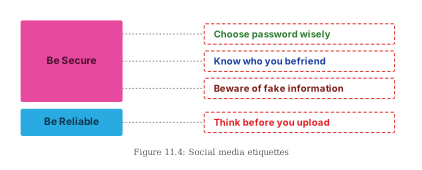
With that reach comes a set of etiquettes of its own (Figure 11.4), organised under two heads: be secure, and be reliable.
(A) Be Secure
- Choose password wisely. A strong password is vital for social network users. Breaches and leaks of user data from social networks regularly make headlines, so users must know how to safeguard themselves and their accounts. The minimum:
- keep a strong password and change it frequently;
- never share personal credentials such as username and password with others.
- Know who you befriend. Social networks encourage connecting with users — "making friends" — sometimes with people we do not know and have never met. Be careful before befriending unknown people: their intentions could be malicious and unsafe.
- Beware of fake information. Fake news, fake messages and fake posts are common on social networks. Do not blindly believe everything you come across on these platforms. With experience you should be able to judge whether a news item, message or post is genuine or fake — apply your knowledge and experience to validate it before accepting or forwarding it.
(B) Be Reliable
- Think before uploading. You can upload almost anything to a social network — but once uploaded, it remains on the remote server even if you delete the files on your side. So be cautious before uploading or sending sensitive or confidential files that have a bearing on your privacy.
Safety warnings the book attaches here …
Drawn by us to help you understand the concept clearly, and verified to make sure it's accurate. For exams, practice from your NCERT textbook's own diagram.
This figure lays out the social media etiquettes of Section 11.3.3 as a left-to-right leader-line diagram: two category boxes on the left, connected by dotted lines to the individual etiquettes they contain on the right.
On the left stand two solid coloured rectangles:
- a pink box labelled "Be Secure" at the top, and
- a blue box labelled "Be Reliable" below it.
Grey dotted leader lines run from these boxes across to four bold labels on the right, each sitting inside a dashed red-outlined strip:
- From "Be Secure", three dotted lines fan out to its three practices:
- "Choose password wisely" (in green text) — keep passwords strong, change them often, and never share credentials;
- "Know who you befriend" (in blue text) — be cautious about connecting with people you have never met, whose intentions could be malicious;
- "Beware of fake information" (in dark red text) — don't blindly believe news, messages or posts; validate them with your own knowledge and experience.
- From "Be Reliable", a single dotted line runs to "Think before you upload" (in red text) — once something is uploaded it stays on the remote server even if you later delete it, so be careful with sensitive or private material. …