Physical Education · Ch 7 — Fundamentals of Anatomy and Physiology in Sports
Functions of the Skeletal System
Functions of the Skeletal System
The human skeleton is divided into two functional parts:
- The axial skeleton - the central axis of the body, consisting of the vertebral column, the rib cage, the skull and the hyoid bone, totalling around 80 bones.
- The appendicular skeleton - attached to the axial skeleton, formed by the shoulder girdle, the pelvic girdle and the bones of the upper and lower limbs, totalling around 126 bones.
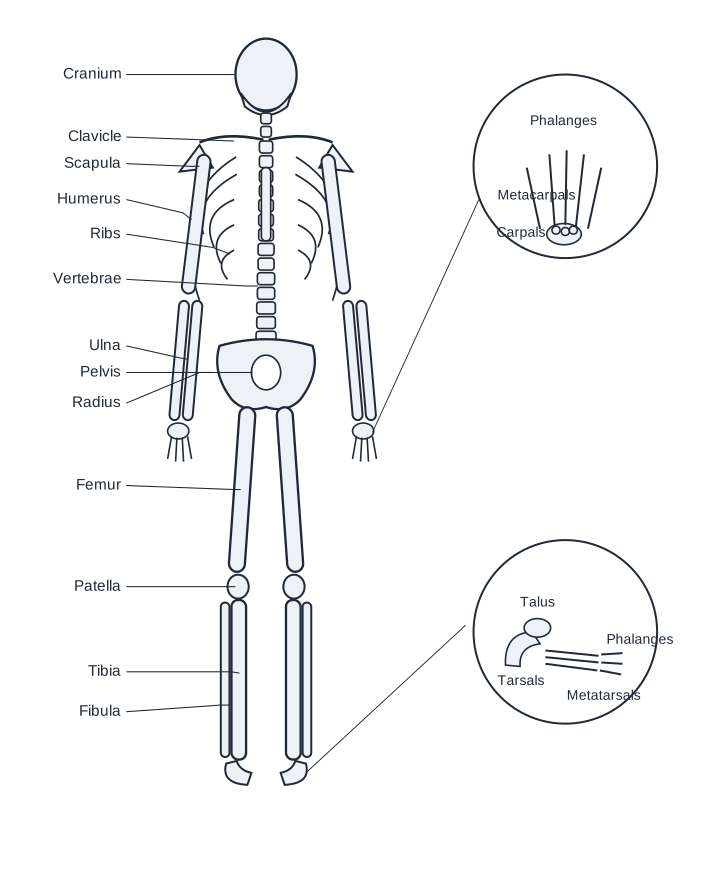
Drawn by us to help you understand the concept clearly, and verified to make sure it's accurate. For exams, practice from your NCERT textbook's own diagram.
A clean front-view line drawing of the full human skeleton with its main bones labelled - cranium, clavicle, scapula, humerus, ribs, vertebrae, ulna, radius, pelvis, femur, patella, tibia and fibula - together with two circular close-ups: the hand (carpals, metacarpals, phalanges) and …
Functions of the skeleton
The skeleton performs five main functions:
- Shape and support. The skeletal system gives the body its shape and holds it up, providing the firm framework on which the soft tissues rest.
- Movement. The skeleton forms the framework to which the muscles are attached, and so allows the body to create movement. The movement itself happens because of the contraction and relaxation of the muscles pulling on the bones.
- Protection. The skeletal system protects the soft internal organs - the ribcage protects the heart and lungs, and in the same way the skull protects the brain.
- Storage of minerals. The hard substance of the bones also serves as a store-house of minerals for the body.
- Production of blood cells. Blood cells are formed within the cavities of the skeleton, a process known as haemopoiesis (haematopoiesis).
Bones as levers
The movement function above is the basis of a simple but important idea used throughout kinesiology: a bone acts as a rigid lever, the joint it moves around acts as the fulcrum, and the pulling muscle supplies the force needed to move a load - the weight of a limb, or an external resistance such as a ball or a barbell. The same lever arrangement can place the fulcrum, force and load in different orders, which is why some joints are built for speed and range of movement (like the elbow, moving a light forearm quickly) while others are built for raw strength (like the ankle, lifting the whole body's weight onto the toes). …