Physical Education · Ch 9 — Psychology and Sports
Adolescent Problems and their Management
Adolescent Problems and their Management
Adolescence, as defined by the World Health Organization (WHO), covers individuals aged 10-19 years — a period of transition from childhood to adulthood marked by the onset of puberty (which now, on average, begins earlier than in the past). This age group is considered critical because it involves major physical, psychological, social and neuro-developmental change.
Raman, aged 14, has just entered Class 9. He has noticed his body changing and has become self-conscious about how he looks. He now wants more privacy, locks the bathroom door and takes phone calls in his room. He values his friends and his freedom, and gets irritated when family members restrict him. His parents understand these changes — they give him space, listen to his ideas, and involve him in sport and outdoor activity to channel his energy. Raman's behaviour and physical changes are completely normal for adolescence.
Adolescence is a critical time: a child transforms into an independent individual, forms new relationships, builds social skills and acquires behaviours that can last a lifetime. Because of all this change, adolescents need clear attention and support. Physical growth in adolescence brings changes in height, weight, body composition, skeletal mass and sexual maturation; the growth spurt of puberty is also accompanied by shifts in energy, a stronger sense of personal identity, and the formation of moral and ethical values. The hormonal changes are linked to cognitive and psycho-social changes — stronger reasoning, more abstract thinking and more rational judgement — but they can also create dissatisfaction and turbulence, reflected in behaviour and emotions. Adolescents may be exposed to substance abuse (tobacco, drugs), greater risk of violence, and emotional drainage that can lead to depression and even suicidal tendencies.
The three sub-stages of adolescence
- Early adolescence (10-14 years). The young person begins adjusting to rapid bodily and sexual changes. It is a very suitable stage for cognitive development: the child develops concrete thinking and the ability to understand another's point of view, though problem-solving skills for changing behaviour are still limited. Early moral concepts form (the idea that there is no single 'right' view), and peer influence becomes strong.
- Middle adolescence (14-17 years). Puberty has largely passed, raising consciousness about appearance and attractiveness. This critical stage brings emotional separation from parents and a desire for independence and space. Abstract thinking, effective verbal communication and conventional morality develop, and the importance of peer pressure and approval increases. Wanting to match behaviour with beliefs, individuals may try things they consider 'undesirable', making them prone to problems such as smoking and drug abuse.
- Late adolescence (17-19 years). The adolescent develops a personal sense of identity as biological development concludes for most. He or she copes better with peer pressure, body image and impulses, moves from concrete to abstract thinking, and begins setting personal moral guidelines without needing social approval. The stage is marked by greater behavioural control, consistency and stability.
Adolescence problems
Drawn by us to help you understand the concept clearly, and verified to make sure it's accurate. For exams, practice from your NCERT textbook's own diagram.
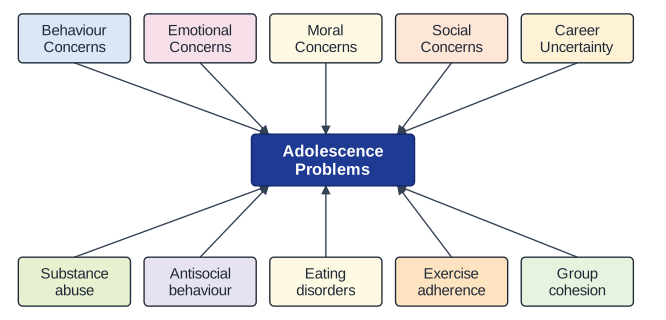
A hub-and-spoke diagram with 'Adolescence Problems' at the centre and ten surrounding boxes, each linked to the centre: Behaviour Concerns, Emotional Concerns, Moral Concerns, Social Concerns, Career Uncertainty, Substance abuse, Antisocial behaviour, Eating disorders, Exercise adherence and Group cohesion. It shows how many kinds …
When behavioural, emotional, moral and social concerns combine with career uncertainty, they create behaviour deviations in adolescents and raise concerns at home, at school and in sports teams. These deviations can lead to substance abuse, eating disorders, anti-social behaviour and non-adherence to sport and exercise. Such problems must be understood and supported by family, friends, teachers, coaches and relatives according to the needs of the individual. A few major problems, with their management, are discussed below.
1. Substance abuse is one of the major concerns of adolescence — behaviour that is neither ethical nor socially acceptable. Drugs are addictive and have lethal effects on health, and alcohol, smoking and drugs attract this age group through peer pressure and other factors.
Management combines cognitive and behaviour techniques:
- Cognitive techniques: coaches and parents expressing concern for the individual, setting limits on unacceptable behaviour, and developing behaviour policies for the class, team or group.
- Behaviour techniques: involving peers to transfer accepted behaviours, and engaging individuals during free time through sport, exercise, recreation and other activities for constructive change.
2. Eating disorders result from psychological factors such as anxiety and depression. They include:
- (a) Anorexia nervosa — bizarre eating patterns such as unusual starvation, driven by social or body-image anxiety about weight loss;
- (b) Bulimia nervosa — binge-eating patterns driven by depression and other psychological fluctuations.
Eating disorders can also appear among addicted exercisers who, on stopping exercise, begin dieting and develop anorexia or bulimia through depression — especially in females conscious of appearance.
Management works through two processes:
- Diet awareness: promoting awareness of healthy dietary habits at school, home, residential organisations and community events.
- Promotion of fitness: encouraging exercise and participation in sport and outdoor activity, together with a healthy diet, at all levels.
3. Anti-social behaviour is a prominent pattern during adolescence, arising from psychological turbulence and sudden physical change when the young person is not adequately supported. Aggression has a larger impact because of changing cognitive abilities.
Management:
- Catharsis: aggression can be regulated through the discharge of negative feelings. Individuals should be given opportunities to speak and express their emotions, rather than suppressing them, and to share their thoughts with their peer group.
- Circular effect: aggression tends to breed more aggression (one act leads to another), so the cycle must be broken — ideally through positive reinforcement. Practically: break the violence cycle as soon as frustration appears (for example, when seniors' aggression is passed on to juniors, or one player's to another), and give players space to speak while the coach listens positively. …