Biology · Ch 6 — Anatomy of Flowering Plants
Epidermal Tissue System
Epidermal Tissue System
The epidermal tissue system forms the outermost covering of the whole plant body. It is made up of epidermal cells, stomata and the epidermal appendages known as trichomes and hairs. The epidermis is the outermost layer of the primary plant body. It consists of elongated, compactly arranged cells that form a single continuous layer, so the epidermis is usually single-layered. Epidermal cells are parenchymatous, containing only a small amount of cytoplasm lining the cell wall and a large vacuole. The outside of the epidermis is often covered by a waxy thick layer called the cuticle, which checks the loss of water; the cuticle is absent in roots.
Stomata are structures present in the epidermis of leaves that regulate the processes of transpiration and gaseous exchange. Each stoma is composed of two bean-shaped cells known as guard cells which enclose the stomatal pore. In grasses the guard cells are dumb-bell shaped instead of bean-shaped. The outer walls of the guard cells, that is the walls away from the stomatal pore, are thin, while the inner walls towards the pore are highly thickened. The guard cells possess chloroplasts and, by changing their shape, they regulate the opening and closing of the stomata. Sometimes a few epidermal cells lying in the vicinity of the guard cells become specialised in shape and size and are then known as subsidiary cells. The stomatal aperture, the guard cells and the surrounding subsidiary cells are together called the stomatal apparatus.
The cells of the epidermis also bear a number of hairs: …
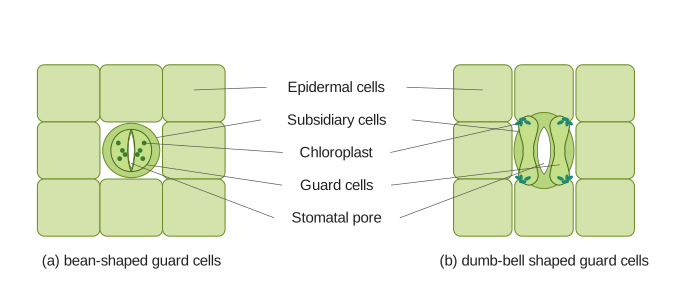
Drawn by us to help you understand the concept clearly, and verified to make sure it's accurate. For exams, practice from your NCERT textbook's own diagram.
This figure shows a surface view of a stoma and its surrounding cells, illustrating the two shapes that guard cells can take. In part (a) the two guard cells are bean-shaped and enclose the central stomatal pore; this is the common type seen in most dicot leaves. In part (b) the guard cells are dumb-bell shaped, the form typical of grasses. The labels point to the epidermal cells that make up the general covering layer, the specialised subsidiary cells that lie next to the guard cells, the chloroplasts present within the guard cells, the guard cells themselves that border the pore, and the stomatal pore or aperture through which transpir …