Biology · Ch 6 — Anatomy of Flowering Plants
Isobilateral (Monocotyledonous) Leaf
Isobilateral (Monocotyledonous) Leaf
The anatomy of the isobilateral (monocotyledonous) leaf is similar in many ways to that of the dorsiventral leaf, but it shows the following characteristic differences:
- In an isobilateral leaf the stomata are present on both surfaces of the epidermis, and
- the mesophyll is not differentiated into palisade and spongy parenchyma; it is uniform throughout.
A special feature is found in grasses. In grass leaves, certain adaxial epidermal cells lying along the veins modify themselves into large, empty, colourless cells called bulliform cells. When these bulliform cells have absorbed water and are turgid, the leaf surface is exposed and remains flat. When they are flaccid due to water stress, they cause the leaves to curl inwards, which helps to minimise water loss. …
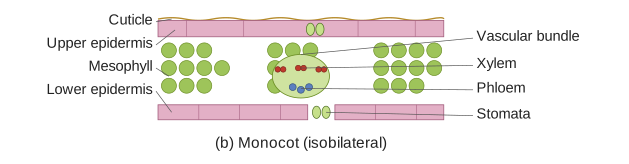
Drawn by us to help you understand the concept clearly, and verified to make sure it's accurate. For exams, practice from your NCERT textbook's own diagram.
This figure shows a transverse section of an isobilateral (monocot) leaf. Mesophyll is undifferentiated (not split into palisade and spongy layers) and is similar on both faces, with stomata and vascular bundles (xylem and phloem) present on both the upper and lower epidermis -- which is what "isobilate …