Biology · Ch 4 — Animal Kingdom
Coelom
Coelom
The coelom, or body cavity, is another feature of great importance in classification, and it depends on the third germ layer. The coelom is a cavity that lies between the body wall and the gut wall. What matters is whether this cavity is present and, if present, whether it is lined by mesoderm. On this basis three conditions are distinguished.
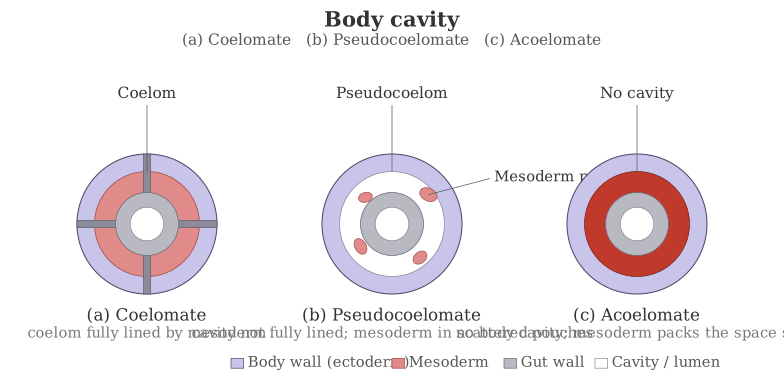
Coelomates. In these animals a true body cavity is present, and it is lined by mesoderm. This mesoderm-lined cavity is the coelom in the strict sense. Annelids, molluscs, arthropods, echinoderms, hemichordates and chordates are all coelomates.
Pseudocoelomates. Here a body cavity is present, but it is not lined by mesoderm. Instead of forming a continuous lining, the mesoderm occurs only as scattered pouches lying between the ectoderm and the endoderm. Such a cavity, being only partly bounded by mesoderm, is called a pseudocoelom, and the animals that have it are pseudocoelomates. Aschelminthes are the example.
Acoelomates. In these animals there is no body cavity at all between the body wall and the gut. Such animals are acoelomates, of which Platyhelminthes are the example. …
Drawn by us to help you understand the concept clearly, and verified to make sure it's accurate. For exams, practice from your NCERT textbook's own diagram.
These cross-sections show the three grades of body cavity used to classify triploblastic animals. In a coelomate, a true body cavity called the coelom lies within the mesoderm and is completely lined on all sides by mesodermal tissue; annelids, arthropods, molluscs, echinoderms and chordates have this. In a pseudocoelomate, there is a cavity between the gut and body wall, but it is not fully lined by mesoderm, which occurs only as scattered pouches; roundworms show this. In an acoelomate, there is no body cavity at all, the spa …