Biology · Ch 8 — Cell: The Unit of Life
Prokaryotic Cells
Prokaryotic Cells
Living things are all made of cells: some are unicellular, existing as a single cell, while others — such as human beings — are multicellular, made of many cells. Prokaryotic cells represent the simpler of the two grand types of cellular organisation.
Which organisms are prokaryotic
Prokaryotic cells are found in bacteria, blue-green algae (cyanobacteria), mycoplasma and PPLO (Pleuro Pneumonia Like Organisms). Compared with eukaryotic cells, they are generally smaller and multiply more rapidly. They vary greatly in both shape and size.
The four basic shapes of bacteria
- Bacillus — rod-like
- Coccus — spherical
- Vibrio — comma-shaped
- Spirillum — spiral
Even though prokaryotes show a wide variety of shapes and functions, the basic organisation of the prokaryotic cell is fundamentally the same across the group.
Internal organisation
- All prokaryotes have a cell wall surrounding the cell membrane, with the exception of mycoplasma.
- The cell is filled with a semi-fluid cytoplasm.
- There is no well-defined nucleus; the genetic material lies essentially naked, not wrapped in a nuclear membrane.
- In addition to the genomic DNA — the single chromosome, a circular DNA molecule — many bacteria also carry small circular DNA molecules separate from the genomic DNA, called plasmids. Plasmid DNA gives such bacteria certain distinctive traits; one well-known example is resistance to antibiotics. Plasmids are also later used as tools to introduce and monitor foreign DNA in bacteria.
- Apart from ribosomes, prokaryotic cells contain none of the membrane-bound organelles seen in eukaryotes. …
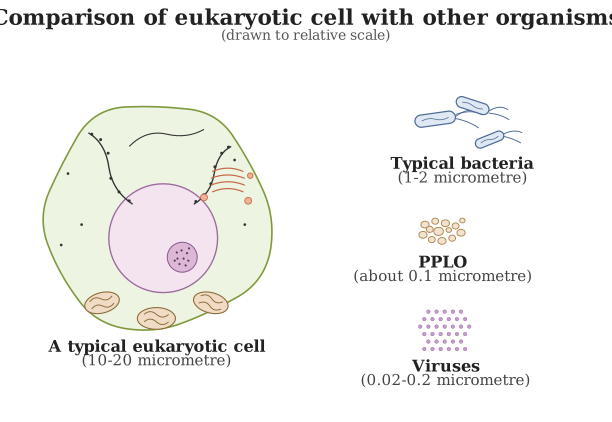
Drawn by us to help you understand the concept clearly, and verified to make sure it's accurate. For exams, practice from your NCERT textbook's own diagram.
This diagram sets living forms side by side to reveal the enormous range in cell size. A typical eukaryotic cell measures roughly 10 to 20 micrometre across. A bacterium is far smaller, about 1 to 2 micrometre. Smaller still are the PPLO, or mycoplasma, near 0.1 micrometre and among the tiniest cells known. Viruses are smaller again, around 0.02 to 0.2 micrometre, and are not counted as full cells. Placed together at the same scale, they show that life spans several orders of magnitude in size. The lesson is that size alone does not define what is alive, and that the eukaryotic cel …