Biology · Ch 11 — Photosynthesis in Higher Plants
The C4 Pathway
The C4 Pathway
Plants that are adapted to dry tropical regions have the C4 pathway mentioned earlier. Though these plants form the C4 acid oxaloacetic acid as the first CO2 fixation product, they still use the C3 pathway (the Calvin cycle) as the main biosynthetic pathway.
C4 plants are special in several ways:
- They have a special type of leaf anatomy.
- They tolerate higher temperatures.
- They show a response to high light intensities.
- They lack photorespiration.
- They have a greater productivity of biomass.
The distinctive anatomy is the key to identifying them. If you study vertical sections of a C3 leaf and a C4 leaf, you notice differences in the mesophyll and, especially, in the cells around the vascular bundle sheath. The particularly large cells around the vascular bundles of C4 plants are called bundle sheath cells, and leaves with such anatomy are said to have 'Kranz' anatomy. 'Kranz' means 'wreath' and reflects the arrangement of the cells. The bundle sheath cells have these features:
- They may form several layers around the vascular bundles.
- They have a large number of chloroplasts.
- They have thick walls impervious to gaseous exchange.
- They have no intercellular spaces.
To observe Kranz anatomy and the distribution of mesophyll cells, one may cut a section of the leaves of C4 plants such as maize or sorghum. The presence of the bundle sheath, seen by cutting vertical sections of leaves and viewing them under a microscope, helps identify C4 plants.
The pathway itself has been named the Hatch and Slack Pathway and is a cyclic process. Its steps are:
- The primary CO2 acceptor is a 3-carbon molecule, phosphoenol pyruvate (PEP), present in the mesophyll cells. The enzyme responsible for this fixation is PEP carboxylase (PEPcase). It is important to note that the mesophyll cells lack the RuBisCO enzyme. The C4 acid OAA is formed in the mesophyll cells.
- OAA then forms other 4-carbon compounds like malic acid or aspartic acid in the mesophyll cells, which are transported to the bundle sheath cells.
- In the bundle sheath cells these C4 acids are broken down to release CO2 and a 3-carbon molecule.
- The 3-carbon molecule is transported back to the mesophyll, where it is converted to PEP again, thus completing the cycle. …
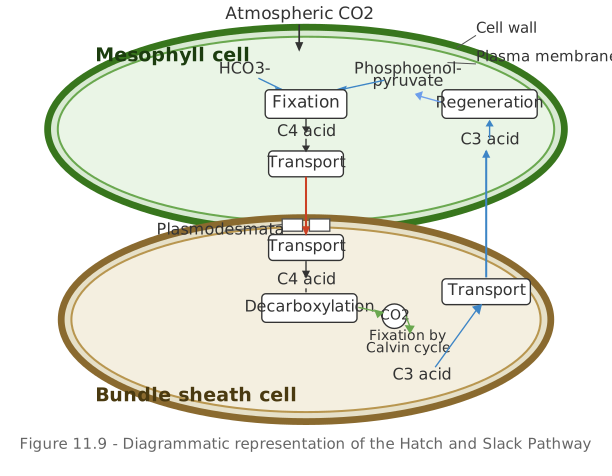
Drawn by us to help you understand the concept clearly, and verified to make sure it's accurate. For exams, practice from your NCERT textbook's own diagram.
This figure shows the C4 or Hatch and Slack pathway spread across two cell types, the mesophyll cell and the bundle sheath cell, joined by plasmodesmata. In the mesophyll cell, atmospheric CO2 (as HCO3-) is fixed onto the 3-carbon phosphoenolpyruvate by PEP carboxylase, forming a 4-carbon (C4) acid. This C4 acid is transported into the bundle sheath cell, where it is decarboxylated to release CO2 and a 3-carbon (C3) acid. The released CO2 is then fixed by the Calvin cycle inside the bundle sheath cell to make sugars. The C3 acid returns to the meso …