Biology · Ch 12 — Respiration in Plants
Glycolysis
Glycolysis
The term glycolysis originates from the Greek words glycos (sugar) and lysis (splitting). The scheme of glycolysis was given by Gustav Embden, Otto Meyerhof and J. Parnas, and is often referred to as the EMP pathway. In anaerobic organisms it is the only process in respiration. Glycolysis occurs in the cytoplasm of the cell and is present in all living organisms. In this process glucose undergoes partial oxidation to form two molecules of pyruvic acid.
In plants, this glucose is derived from sucrose, the end product of photosynthesis, or from storage carbohydrates. Sucrose is converted into glucose and fructose by the enzyme invertase, and these two monosaccharides readily enter the glycolytic pathway. Glucose and fructose are phosphorylated to give glucose-6-phosphate by the activity of the enzyme hexokinase. This phosphorylated form of glucose then isomerises to produce fructose-6-phosphate. Subsequent steps of metabolism of glucose and fructose are the same. Glycolysis is a chain of ten reactions, under the control of different enzymes, producing pyruvate from glucose.
While studying the steps, note where utilisation or synthesis of ATP and NADH + H+ take place:
- ATP is utilised at two steps: first in the conversion of glucose into glucose-6-phosphate, and second in the conversion of fructose-6-phosphate to fructose 1,6-bisphosphate.
- Fructose 1,6-bisphosphate is split into dihydroxyacetone phosphate and 3-phosphoglyceraldehyde (PGAL).
- There is one step where NADH + H+ is formed from NAD+: this is when 3-phosphoglyceraldehyde (PGAL) is converted to 1,3-bisphosphoglycerate (BPGA). Two redox-equivalents are removed (as two hydrogen atoms) from PGAL and transferred to a molecule of NAD+. PGAL is oxidised and, with inorganic phosphate, gets converted into BPGA.
- The conversion of BPGA to 3-phosphoglyceric acid (PGA) is an energy-yielding process, and this energy is trapped by the formation of ATP.
- Another ATP is synthesised during the conversion of phosphoenolpyruvate (PEP) to pyruvic acid. …
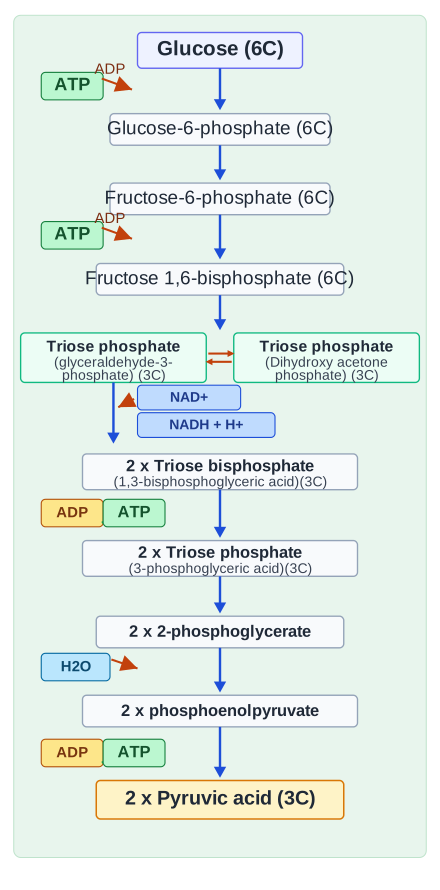
Drawn by us to help you understand the concept clearly, and verified to make sure it's accurate. For exams, practice from your NCERT textbook's own diagram.
This figure traces the ten-reaction EMP pathway that occurs in the cytoplasm. Glucose (6C) is phosphorylated using ATP to glucose-6-phosphate (6C), which isomerises to fructose-6-phosphate (6C). A second ATP converts it to fructose 1,6-bisphosphate (6C), which is split into two three-carbon triose phosphates: glyceraldehyde-3-phosphate and dihydroxyacetone phosphate (which interconvert). Note where energy currency is handled: ATP is used at the two early phosphorylation steps, NAD+ is reduced to NADH + H+ as triose phosphate becomes 1,3-bisphosphoglyceric acid, and ATP is synthesised twice (at 3-phosphoglyceric acid formation and at the phosph …