Chemistry · Ch 7 — Redox Reactions
The Paradox of Fractional Oxidation Number
The Paradox of Fractional Oxidation Number
You already know from §7.3 that oxidation numbers count whole electrons — an atom gains,
loses or shares whole electrons, never a fraction of one. So it looks like a contradiction
when a handful of real compounds are printed with a fractional oxidation number for
one of their elements: carbon in C₃O₂ works out to , bromine in Br₃O₈ to
, and sulphur in Na₂S₄O₆ to — none of these are whole numbers.
The resolution is that a fractional oxidation number is never the true state of any single
atom. It is an average taken across several atoms of the same element that sit at
different positions in the molecule, each in its own whole-number state. The formula
alone can't see this — only the actual bonded structure can, because the structure shows
which atom is bonded to what.
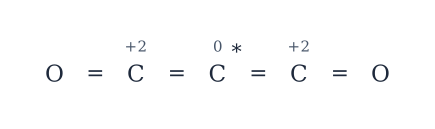
Carbon suboxide, C₃O₂ is linear: O=C=C=C=O. The two terminal carbons are each in the
state and the middle carbon (starred in the structure) is in the state — the
average is .
Drawn by us to help you understand the concept clearly, and verified to make sure it's accurate. For exams, practice from your NCERT textbook's own diagram.
…
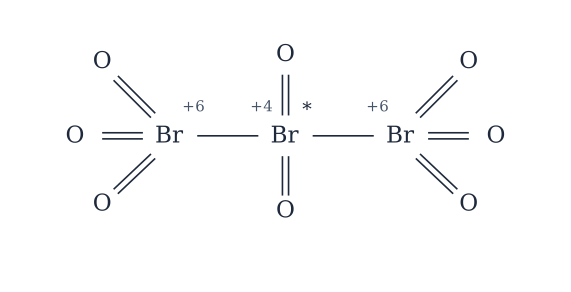
Tribromooctaoxide, Br₃O₈ has two end bromines each carrying three oxygens (the
state) around a middle bromine in the state (starred) — the average is
.
Drawn by us to help you understand the concept clearly, and verified to make sure it's accurate. For exams, practice from your NCERT textbook's own diagram.
BrO has two terminal bromine atoms, each bonded to three oxygen atoms (one bridging to the central bromine, two terminal — like a perbromate-type BrO group), and one central bromine atom bonded to the two bridging oxygens and one additional terminal oxygen. Assigning oxidation numbers atom by atom: each terminal bromine is in the state, while the central bromine (marked with an asterisk) is in the state. The bare molecular formula, BrO, would suggest a single fractional oxidation number of for bromine — but that number is really just the ave …
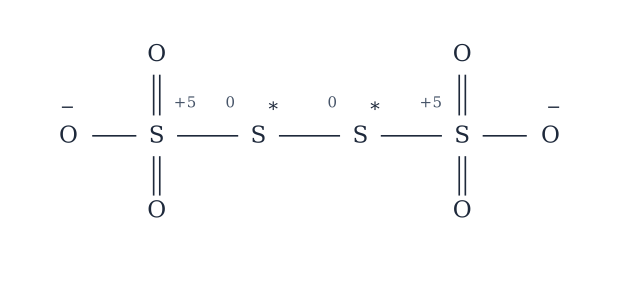
Tetrathionate ion, S₄O₆²⁻ is a four-sulphur chain: the two outer sulphurs (each
bonded to three oxygens) are in the state, the two inner sulphurs (starred, bonded
only to sulphur) are in the state — the average is .
Drawn by us to help you understand the concept clearly, and verified to make sure it's accurate. For exams, practice from your NCERT textbook's own diagram.
The tetrathionate ion, SO, has a chain of four sulphur atoms: two terminal sulphur atoms, each bonded to three oxygen atoms (an -SO-type group), and two central sulphur atoms bonded only to each other and to the terminal sulphurs (an S–S–S–S backbone, no oxygen on the two middle atoms). Assigning oxidation numbers atom by atom: each terminal sulphur is in the state, while the two middle sulphur atoms (marked with asterisks) are each in the state. The bare molecular formula would suggest a single fractional oxidation number of for sulphur — but that is really just t …
This isn't a one-off oddity of these three species. Several mixed oxides show the
identical pattern — Fe₃O₄, Mn₃O₄ and Pb₃O₄ are the standard examples, each one really a
combination of the metal in two different whole-number oxidation states packed into one
formula (Pb₃O₄, for instance, behaves as if it were 2 parts PbO — lead at — fused
with 1 part PbO₂ — lead at ; see Problem 7.7 in §7.3.1 for exactly this reaction
chemistry playing out).
The one genuine exception: in O₂⁺ (dioxygenyl) and O₂⁻ (superoxide), the oxidation
numbers really are and — not an average of two …