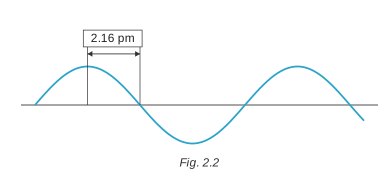
Q.A hypothetical electromagnetic wave is shown in the figure below. Find out the wavelength of the radiation.
🔒You're viewing a preview — the full solution, concept, methods & PYQ mapping are locked.
🔒 Start your 14-day free trial to unlock the full solution →Concept understanding — Energy Level Quantization
Energy Level Quantization: From Intuition to Precision
Imagine you're climbing a smooth ramp. You can stop at any height — 1 metre, 1.5 metres, 2.1 metres — anywhere you like. That's how we intuitively think about energy in everyday life: continuous, like a slide.
Now imagine a staircase. You can stand on step 1, step 2, or step 3 — but you cannot stand halfway between step 2 and step 3. There's no such place. The steps are discrete, not continuous.
Energy level quantization is the idea that in the microscopic world of atoms and molecules, energy behaves like a staircase, not a ramp. Electrons in an atom cannot have just any energy — they can only occupy specific, allowed energy levels. Everything else is forbidden.
Why does this happen? The core intuition
In the classical world, an electron orbiting a nucleus would continuously radiate energy, spiral inward, and crash — atoms would be unstable. But atoms are stable. Nature solved this problem by imposing a rule: the electron's angular momentum (and therefore its energy) can only take certain discrete values.
Think of a guitar string. It can only vibrate at specific frequencies — its fundamental and harmonics. You can't pluck it to produce a frequency halfway between two harmonics. The string's vibration is quantized by its boundaries. Similarly, an electron bound to a nucleus is confined in space, and that confinement forces its energy to be quantized.
Quantization is not a mysterious extra rule — it emerges naturally whenever a wave (like an electron's matter wave) is confined. Confinement creates standing waves, and standing waves only exist at specific frequencies.
The precise statement
For a bound system (like an electron in an atom), the total energy E of the system can only take certain discrete values:
E=E1,E2,E3,…
where each En is a specific, fixed number. The integer n (1, 2, 3, …) is called the principal quantum number. The lowest energy level (n=1) is the ground state; higher levels (n>1) are excited states.
For the hydrogen atom, the allowed energies are given by:
En=−n213.6 eV
So:
- n=1: E1=−13.6 eV (ground state)
- n=2: E2=−3.4 eV
- n=3: E3=−1.51 eV
- and so on, approaching 0 eV as n→∞ (the ionization limit)
The negative sign means the electron is bound to the nucleus. Zero energy corresponds to the electron being free (ionized). The more negative the energy, the more tightly bound the electron.
How do we know this is real?
The most direct evidence comes from atomic spectra. When an electron jumps from a higher energy level to a lower one, it emits a photon of light with energy exactly equal to the difference:
ΔE=Ehigher−Elower=hf
where h is Planck's constant and f is the frequency of the emitted light. …
The key concept here is Wave Properties, specifically the definition of wavelength in a sinusoidal wave.
For a sinusoidal wave, the distance from a crest (maximum displacement) to the immediately following node (point of zero displacement) represents one-quarter of a full wavelength.
- The given distance from a crest to the immediately following node is 2.16 pm.
- This distance corresponds to 41 of the wavelength (λ). …
The distance from a crest to an immediately following node in a sinusoidal wave represents one-quarter of its full wavelength. Given this distance as 2.16 pm, the wavelength is 8.64 pm.
Electromagnetic waves, like all waves, exhibit a periodic pattern. When we represent them as a smooth sinusoidal wave, certain points on the wave have specific names and relate directly to the wave's fundamental length scale: its wavelength. Understanding these basic anatomical features of a wave is crucial for solving problems involving wave properties.
-
Understanding Wave Anatomy:
A sinusoidal wave oscillates around a central equilibrium position (the horizontal axis in this case).
- A crest is a point on the wave where its displacement from the equilibrium position is maximum in the positive direction.
- A trough is a point where its displacement is maximum in the negative direction.
- A node (or zero-crossing point) is a point where the wave crosses the equilibrium axis, meaning its displacement is zero.
- The wavelength (λ) is the spatial period of the wave, which is the distance over which the wave's shape repeats. It can be measured, for example, from one crest to the next adjacent crest, or from one trough to the next adjacent trough.
-
Relating Crest-to-Node Distance to Wavelength:
Consider a full cycle of a sinusoidal wave.
- From a crest to the next trough is half a wavelength (λ/2).
- From a crest to the immediately following node (where the wave crosses the axis going downwards) is exactly one-quarter of a wavelength (λ/4).
- Similarly, from a node to the immediately following crest (where the wave crosses the axis going upwards) is also one-quarter of a wavelength (λ/4). …
Showing the 12 most recent of 132 on this concept.
- TG EAPCET 2026Set eng-2026-05-09-FN1 markMCQQ.Match the following
[!FORMULA] List-1 (Element)A HfB RaC AmD AtList-2 (Block)I s-blockII p-BlockIII d-BlockIV f-Block
(A) A – IV, B – III, C – I, D – II (B) A – II, B – III, C – IV, D – I (C) A – III, B – IV, C – I, D – II (D) A – III, B – I, C – IV, D – II›Reveal solutionSolution
The problem asks to match each element (Hf, Ra, Am, At) to its block in the periodic table (s, p, d, f). The correct matches are: Hf (d-block), Ra (s-block), Am (f-block), At (p-block), so the answer is option (D).
The periodic table is organized into blocks based on which subshell (s, p, d, or f) the element’s outermost electrons occupy. This is determined by the element’s electron configuration, which follows the Aufbau principle. The key is to know the position of each element in the periodic table, or to deduce its block from its group and period.
Let’s match each element step by step:
-
Hf (Hafnium)
- Hafnium is element 72. It lies in period 6, group 4.
- Group 4 elements are transition metals, which are always in the d-block.
- Its electron configuration ends in 5d26s2, confirming it’s a d-block element.
- So A matches III (d-block).
-
Ra (Radium)
- Radium is element 88, in period 7, group 2.
- Group 2 elements are alkaline earth metals, which are in the s-block (the last electron enters the s subshell).
- Configuration: [Rn]7s2.
- So B matches I (s-block).
-
Am (Americium)
- Americium is element 95, an actinide.
- Actinides are part of the f-block (the 5f subshell is being filled).
- Configuration: [Rn]5f77s2.
- So C matches IV (f-block).
-
At (Astatine)
- Astatine is element 85, in period 6, group 17 (halogens).
- Group 17 elements are in the p-block (the last electron enters a p subshell).
- Configuration: [Xe]4f145d106p5. …
-
- TG EAPCET 2026Set eng-2026-05-11-FN1 markMCQQ.The energy of orbit X of Li2+ (Z = 3) is −2.18×10⁻¹⁸ J. What is the radius of the same orbit (in A˚)? (A) 2.116 (B) 2.105 (C) 1.587 (D) 2.645
›Reveal solutionSolution
The key idea is to use the Bohr model for hydrogen-like ions: energy depends on n2/Z2 and radius on n2/Z. Given the energy of Li2+, we first find the principal quantum number n, then compute the radius. The radius comes out to 1.587A˚, so the correct option is (C).
We are dealing with a hydrogen-like ion (Li2+ has only one electron, so the Bohr model applies exactly). In the Bohr model, the energy of an electron in orbit n for a nucleus of charge Z is:
En=−n2Z2⋅13.6eV
But here the energy is given in joules. The ground-state energy of hydrogen (Z=1, n=1) is −13.6eV=−2.18×10⁻¹⁸J. So we can write:
En=−n2Z2×(2.18×10−18J)
For Li2+, Z=3, and we are told En=−2.18×10⁻¹⁸J. That means:
−n232×(2.18×10−18)=−2.18×10⁻¹⁸
Cancelling the common factor:
n29=1⇒n2=9⇒n=3
So the electron is in the third Bohr orbit.
Now, the radius of the nth orbit for a hydrogen-like ion is:
rn=Zn2a0
where a0=0.529A˚ is the Bohr radius.
Plug in n=3, Z=3:
- TG EAPCET 2026Set ap-2026-05-04-FN1 markMCQQ.The atomic numbers of four elements A, D, E, G are 4, 7, 8, 12 respectively. The decreasing order of electronegativity of these elements is (A) E, D, A, G (B) E, A, D, G (C) D, G, E, A (D) G, A, D, E
›Reveal solutionSolution
Electronegativity increases across a period and decreases down a group. Using the periodic table positions of elements with atomic numbers 4 (Be), 7 (N), 8 (O), and 12 (Mg), the decreasing order is E, D, A, G, which corresponds to option (A).
The key to ordering electronegativity is understanding the periodic trends. Electronegativity — the ability of an atom to attract shared electrons in a bond — increases as you move from left to right across a period (because nuclear charge increases while atomic radius decreases) and decreases as you move down a group (because the valence shell gets farther from the nucleus, reducing attraction). So the first step is to identify each element from its atomic number and place it in the periodic table.
-
Identify the elements.
Atomic number 4 is beryllium (Be, group 2, period 2).
Atomic number 7 is nitrogen (N, group 15, period 2).
Atomic number 8 is oxygen (O, group 16, period 2).
Atomic number 12 is magnesium (Mg, group 2, period 3).
So A = Be, D = N, E = O, G = Mg.
-
Compare elements in the same period.
Be, N, and O are all in period 2. Across a period, electronegativity increases from left to right. The order in period 2 (lowest to highest) is: Be < B < C < N < O < F. So among these three:
Be (A) has the lowest, then N (D), then O (E) has the highest.
So far: E > D > A.
-
Place the element from the next period. …
-
- TG EAPCET 2026Set ap-2026-05-05-FN1 markMCQQ.A metal was irradiated separately with radiation of wavelengths(a) 400 nm(b) 500 nm and(c) 600 nm respectively. Identify the wavelength(s) corresponding to which electrons are emitted from the surface of that metal (Work function of metal = 2.25 eV, h=6.6×10⁻³⁴ Js, c=3×10⁸ ms−1, 1eV =1.6×10⁻¹⁹ J) (A)(a) only (B)(c) only (C) (a),(b) &(c) (D)(a) &(b) only
›Reveal solutionSolution
The photoelectric effect requires the incident photon energy to exceed the metal’s work function. Only wavelengths shorter than the threshold wavelength cause emission. Here, only 400 nm and 500 nm satisfy this, so the answer is (D).
The core idea is the photoelectric effect: an electron is ejected from a metal surface only if the energy of an incident photon is at least equal to the work function ϕ of the metal. The photon energy is E=λhc, so for a given work function, there is a maximum wavelength (threshold wavelength λ0) beyond which no emission occurs. Any wavelength shorter than λ0 will cause emission; any longer will not.
We are given ϕ=2.25 eV, h=6.6×10⁻³⁴ Js, c=3×10⁸ m/s, and 1 eV =1.6×10⁻¹⁹ J. The three wavelengths are 400 nm, 500 nm, and 600 nm. We need to compare each photon’s energy to ϕ.
- Find the threshold wavelength λ0. Set the photon energy equal to the work function:
λ0hc=ϕ
Convert ϕ to joules:
ϕ=2.25×1.6×10−19=3.6×10⁻¹⁹ J
Then
λ0=ϕhc=3.6×10⁻¹⁹(6.6×10⁻³⁴)(3×10⁸)
Calculate:
λ0=3.6×10−1919.8×10−26=5.5×10⁻⁷ m=550 nm
So the threshold wavelength is 550 nm. Any wavelength shorter than 550 nm will eject electrons; any longer will not.
- Compare each given wavelength to λ0. …
- AP EAPCET 2026Set eng-2026-05-12-FN1 markMCQQ.In an atomic spectrum of hydrogen, a series of lines with wavelengths at 656.46, 486.27, x and 410.29 nm was obtained. What is the value of x (in nm)? (RH=1.097×10⁷m−1) (A) 453.15 (B) 449.32 (C) 434.17 (D) 428.37
›Reveal solutionSolution
This tests the Rydberg formula for the Balmer series of hydrogen to find the missing wavelength (ni=5→nf=2 transition) in a listed sequence of visible spectral lines. Answer: 434.17 nm.
Concept and Intuition
The Balmer series consists of hydrogen emission lines that end on the n=2 level, and these fall in the visible range — they are the most famous hydrogen lines (H-alpha, H-beta, H-gamma, H-delta at 656.3, 486.1, 434.1, 410.2 nm respectively, as commonly tabulated). The listed wavelengths 656.46, 486.27, x, 410.29 nm are exactly this sequence for ni=3,4,5,6, so x corresponds to the ni=5→nf=2 transition (H-gamma).
Step-by-Step Solution
- Rydberg formula: λ1=RH(nf21−ni21).
- Recognize the series: with nf=2, ni=3 gives 656.46 nm, ni=4 gives 486.27 nm, ni=6 gives 410.29 nm — matching the given data confirms nf=2 (Balmer) and that x is the ni=5 line.
- For ni=5: λ1=RH(41−251)=RH(10025−4)=RH×10021=0.21RH. …
- AP EAPCET 2026Set eng-2026-05-12-AN1 markMCQQ.Wavelength of a photon emitted during electron transition from n=4 state to n=2 state in the hydrogen atom is x nm. Wavelength of a photon emitted during electron transition from n=4 state to n=1 state in the same atom is y nm. xy is equal to (A) 0.4 (B) 0.2 (C) 0.5 (D) 0.3
›Reveal solutionSolution
This tests the Rydberg/Bohr formula for hydrogen-spectrum wavelengths; the ratio of the two transition wavelengths works out to 0.2.
Concept and Intuition
For the hydrogen atom, the energy released (and hence the wavenumber 1/λ of the emitted photon) during a transition from a higher level n2 to a lower level n1 is given by the Rydberg formula. A bigger energy jump means a shorter wavelength, so a transition all the way down to n=1 releases more energy (and gives a shorter wavelength) than one landing at n=2.
Step-by-Step Solution
- Rydberg formula: λ1=R(n121−n221), with n1<n2.
- For n=4→n=2 (wavelength x): x1=R(221−421)=R(41−161)=R⋅163. …
- AP EAPCET 2026Set eng-2026-05-13-FN1 markMCQQ.The energy of spectral line of lowest frequency in Lyman series of Li2+ spectrum is x J. The energy of second spectral line in Balmer series of He+ spectrum is y J. The ratio of x and y is (A) 3:1 (B) 1:3 (C) 1:9 (D) 9:1
›Reveal solutionSolution
Both are hydrogen-like ions, so the Rydberg-type energy formula with Z2 scaling applies; identifying the correct transitions (lowest-frequency Lyman line, second Balmer line) and computing gives x:y=9:1.
Concept and Intuition
For any hydrogen-like species (single electron, nuclear charge Ze), the energy released in a transition from level n2 to n1 (n2>n1) is
E=13.6Z2(n121−n221) eV.
Within a series (fixed lower level n1), the lowest-frequency (least energetic) line corresponds to the smallest jump, i.e. the transition from the level immediately above n1. The Lyman series has n1=1, so its lowest-frequency line is 2→1. The Balmer series has n1=2; its lines in increasing energy (and frequency) order are 3→2 (first/weakest), 4→2 (second), 5→2 (third), etc. — so the second Balmer line is 4→2.
Step-by-Step Solution
- Lyman, lowest-frequency line of Li2+ (Z=3): transition 2→1.
x=13.6×32(121−221)=13.6×9×43=13.6×6.75=91.8 eV (in energy units, up to a common constant)
- Balmer, second line of He+ (Z=2): second line means 4→2 (first is 3→2). …
- AP EAPCET 2026Set eng-2026-05-13-FN1 markMCQQ.Quantum number sets of four electrons I, II, III, IV are given below. The correct order of the energy of these electrons is I. n=3, l=1, ml=−1, ms=+21 II. n=4, l=1, ml=0, ms=+21 III. n=4, l=2, ml=−2, ms=+21 IV. n=3, l=2, ml=−1, ms=−21 The correct answer is (A) I > IV > II > III (B) III > II > I > IV (C) III > IV > II > I (D) III > II > IV > I
›Reveal solutionSolution
Applying the (n+l) (Aufbau) rule with the n+l tie-breaker gives the energy order III > II > IV > I — testing whether the tie-break (lower n wins for equal n+l) is applied correctly.
Concept and Intuition
In multi-electron atoms, orbital energy is not determined by n alone (as in hydrogen) but follows the empirical (n+l) rule: orbitals with a lower value of n+l have lower energy. When two orbitals share the same n+l value, the one with the smaller n (and hence larger l) has lower energy — because a larger l means the electron is, on average, farther from the nucleus in angular terms but the radial penetration effects work out so that lower-n/higher-l combinations of equal n+l sit lower in energy (e.g. 3d fills before 4p... more precisely 4s before 3d, but the classic comparison here is between 4p (n+l=5) and 3d (n+l=5), where 3d is lower).
Step-by-Step Solution
- Compute n+l for each electron (the ml,ms values don't affect orbital energy, only n,l do):
- I: n=3,l=1 (3p) ⇒n+l=4
- II: n=4,l=1 (4p) ⇒n+l=5
- III: n=4,l=2 (4d) ⇒n+l=6
- IV: n=3,l=2 (3d) ⇒n+l=5
- Order by n+l ascending (lower = lower energy): I(4) < {II, IV}(5) < III(6). …
- Compute n+l for each electron (the ml,ms values don't affect orbital energy, only n,l do):
- AP EAPCET 2026Set eng-2026-05-15-AN1 markMCQQ.The wavelength of spectral line (X) of hydrogen spectrum is same as that of spectral line of He+ spectrum corresponding to n=4→n=2 electron transition. The correct electron transition corresponding to X is (A) n=2→n=1 (B) n=3→n=2 (C) n=4→n=2 (D) n=3→n=1
›Reveal solutionSolution
This tests the Rydberg formula scaled by Z2 and matching two different hydrogenic spectra to the same photon energy/wavelength. The transition is n=2→n=1.
Concept and Intuition
Every hydrogen-like ion (H, He+, Li2+, …) has energy levels En=−n213.6Z2 eV. Two hydrogenic transitions emit the same wavelength exactly when their Z2(n121−n221) values are equal — the Z2 scaling is what lets a lower-Z atom's low-lying transition mimic a higher-Z ion's higher-lying one.
Step-by-Step Solution
- For He+ (Z=2), transition n=4→n=2:
λHe+1=R(2)2(221−421)=4R(41−161)=4R⋅163=0.75R
- For hydrogen (Z=1), we need a transition n1→n2 with
λH1=R(1)2(n121−n221)=0.75R
- Test n=2→n=1: R(1−41)=0.75R. This matches exactly. …
- AP EAPCET 2026Set eng-2026-05-15-FN1 markMCQQ.If the energy required to remove an electron from the ground state of He+ is x J, the energy (in J) required to remove an electron from the ground state of Li2+ is (A) 23x (B) 32x (C) 49x (D) 94x
›Reveal solutionSolution
Both He+ and Li2+ are hydrogen-like (one electron); their ground-state ionization energies scale purely as Z2, giving a factor of 9/4. Answer: (C).
Concept and Intuition
He+ (Z=2) and Li2+ (Z=3) are both single-electron (hydrogen-like) species, so the Bohr-model ionization energy formula En=13.6n2Z2 eV applies directly to each. For the ground state (n=1), the energy is simply proportional to Z2.
Step-by-Step Solution
- Ionization energy of He+ (Z=2, n=1): EHe+=13.6×22=13.6×4=x (given).
- Ionization energy of Li2+ (Z=3, n=1): ELi2+=13.6×32=13.6×9.
- Ratio: EHe+ELi2+=13.6×413.6×9=49.
- So ELi2+=49x. …
- AP EAPCET 2026Set ap-2026-05-19-FN1 markMCQQ.Which of the following set of quantum numbers represent the electron with highest energy? (A) n=3, l=0, m=0, s=+21 (B) n=3, l=1, m=1, s=−21 (C) n=3, l=2, m=1, s=+21 (D) n=4, l=0, m=0, s=−21
›Reveal solutionSolution
Comparing orbital energies from quantum numbers uses the (n+l) rule (Aufbau/Madelung ordering): the set with the largest (n+l) sum (and, on a tie, the larger n) is highest in energy.
Concept and Intuition
For multi-electron atoms, orbital energy isn't decided by n alone — the (n+l) rule says orbitals with a lower (n+l) sum fill first (are lower in energy); when two orbitals share the same (n+l), the one with smaller n is lower. This is why 4s (n+l=4) fills before 3d (n+l=5), even though 3d has a smaller n.
Step-by-Step Solution
- (A) n=3,l=0 (3s): n+l=3.
- (B) n=3,l=1 (3p): n+l=4.
- (C) n=3,l=2 (3d): n+l=5.
- (D) n=4,l=0 (4s): n+l=4. …
- AP EAPCET 2026Set eng-2026-05-18-AN1 markMCQQ.Wavelength of a particular line in Balmer series of atomic spectrum of hydrogen is 656.4 nm. What is the wavelength (in nm) of corresponding line in the spectrum of He+? (A) 328.2 (B) 164.1 (C) 492.3 (D) 246.1
›Reveal solutionSolution
The same Balmer transition in the hydrogen-like He+ ion has wavelength scaled down by Z2=4 from hydrogen's, giving 164.1 nm.
Concept and Intuition
The Rydberg formula for any hydrogen-like (single-electron) species is λ1=RZ2(n121−n221). For the same pair of energy levels n1,n2 (the "corresponding line"), everything is identical between hydrogen and He+ except the nuclear charge Z. Since λ1∝Z2, the wavelength itself is inversely proportional to Z2: a higher-charge nucleus pulls electrons in more tightly, so transition energies are larger and wavelengths shorter.
Step-by-Step Solution
- For H (Z=1): λH1=R(n121−n221).
- For He+ (Z=2): λHe+1=R(2)2(n121−n221)=4×λH1. …
🎓Unlock everything free for 14 days
- ✓Full step-by-step solutions
- ✓Concept-first explanations
- ✓Methods, shortcuts & mistakes
- ✓PYQ mapping + timed mock tests
Full access for 14 days. No credit card required.