Chemistry · Ch 2 — Structure of Atom
Thomson Model of Atom
Thomson Model of Atom
2.2.1 Thomson Model of Atom
In 1898, J. J. Thomson proposed the first serious model of the atom's internal structure. He imagined the atom as a sphere of positive charge, roughly m in radius, within which the negative electrons were embedded. The positive charge was spread uniformly throughout the entire volume of the sphere, like a continuous jelly or pudding. The electrons were placed inside this positive sphere in such a way that the electrostatic forces between them produced the most stable arrangement possible.
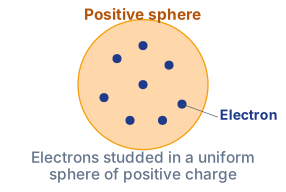
Drawn by us to help you understand the concept clearly, and verified to make sure it's accurate. For exams, practice from your NCERT textbook's own diagram.
What Fig. 2.4 Actually Shows
The figure is a simple schematic — no axes, no curves, no data. It shows a single large sphere, coloured light orange, labelled Positive sphere. Scattered uniformly throughout this sphere are many small dark circles, one of which is explicitly labelled Electron. The visual is meant to be immediately intuitive: the atom is a blob of positive charge with negative electrons dotted inside it like seeds in a fruit.
This is the plum pudding model (also called the raisin pudding or watermelon model). The positive charge is spread evenly across the entire volume of the sphere, and the electrons are embedded at positions that give the most stable electrostatic arrangement. The key physical idea is that the atom is not mostly empty space — it is a continuous, uniform distribution of mass and charge, with electrons merely sprinkled in.
The figure has no scale, but the textbook states the atomic radius is roughly . In this model, the entire atom is that sphere — there is no separate nucleus.
The Physical Idea the Figure Teaches
Thomson’s model was the first serious attempt to describe the internal structure of the atom after the discovery of the electron. The figure captures three essential claims:
- The atom is spherical — a smooth, featureless ball of positive charge.
- Positive charge is uniformly distributed — there is no concentrated centre; the charge density is the same everywhere inside the sphere.
- Electrons are embedded like plums in pudding — they sit at fixed positions within the positive cloud, held there by electrostatic attraction.
The model successfully explains why atoms are electrically neutral overall: the total positive charge exactly balances the total negative charge of the electrons. It also accounts for the fact that atoms can be ionised (electrons can be knocked out), because the electrons are not rigidly fixed — they can be removed if enough energy is supplied.
A common mistake is to think Thomson’s model predicted that electrons move inside the sphere. The original model treated them as stationary in their most stable arrangement. It was later experiments that forced the idea of moving electrons.
Why This Figure Matters — and Why It Failed
The figure is not just a historical curiosity. It sets up the central tension that drives the rest of the chapter. Thomson’s model makes a very specific prediction about how alpha particles should behave when fired at a thin gold foil:
If the positive charge is spread uniformly over the entire atom, then alpha particles (themselves positively charged) should experience only a weak, diffuse repulsion. They should pass through the foil with at most small-angle deflections.
Rutherford’s scattering experiment (described immediately after this figure in the textbook) shattered that prediction. The actual results — most particles undeflected, a few deflected by large angles, and about 1 in 20,000 bouncing back — were impossible to explain with a uniform positive sphere. The only conclusion was that the positive charge must be concentrated in a tiny, dense nucleus of radius roughly , while the rest of the atom is mostly empty space.
The contrast between Fig. 2.4 (Thomson’s model) and the results of Rutherford’s experiment is one of the most dramatic moments in the history of physics. It shows how a single experiment can overturn an entire picture of the atom.
The Key Formula That Emerges from This Figure
While the figure itself has no formula, the chapter soon introduces (in Section 2.2.3, after Rutherford's model) the definitions of atomic number and mass number — quantities that only make sense once we abandon Thomson's model and accept Rutherford's nuclear model. …
This model has been given several colourful names. It is called the plum pudding model (after a British dessert containing plums scattered through a pudding), the raisin pudding model, or the watermelon model — in each case, the positive material is the bulk substance and the electrons are the embedded seeds or fruits.
An essential feature of Thomson's model is that the mass of the atom was assumed to be uniformly distributed over the entire atom. This assumption would later prove to be the model's critical weakness.
Explanation of Electrical Neutrality
The model could explain one fundamental observation: atoms are electrically neutral. Since the total negative charge of all the electrons exactly balanced the total positive charge spread throughout the sphere, the atom as a whole had no net charge. This was consistent with what was known at the time.
The Discovery of New Radiations
The late nineteenth century saw a burst of discoveries about radiation, which provided the experimental tools that would eventually test Thomson's model.
X-rays: Wilhelm Röntgen (1845–1923) discovered in 1895 that when electrons strike a material inside a cathode ray tube, they produce rays that can cause fluorescence in materials placed outside the tube. Not knowing the nature of this radiation, he named them X-rays. These rays are produced most effectively when electrons strike a dense metal anode (called the target). X-rays are not deflected by electric or magnetic fields, have very high penetrating power through matter, and possess very short wavelengths (about nm). They are electromagnetic in nature.
Radioactivity: Henri Becquerel (1852–1908) observed that certain elements emit radiation spontaneously. He named this phenomenon radioactivity, and the elements that do this are called radioactive elements. This field was developed further by Marie Curie, Pierre Curie, Ernest Rutherford, and Frederick Soddy. Three kinds of rays were identified:
- -rays: Rutherford found that -rays consist of high-energy particles carrying two units of positive charge and four units of atomic mass. When -particles combined with two electrons, they yielded helium gas — so -particles are helium nuclei.
- -rays: These are negatively charged particles similar to electrons.
- -rays: These are high-energy radiations like X-rays, neutral in nature, and do not consist of particles.
Regarding penetrating power, -particles are the least penetrating, followed by -rays (about 100 times more penetrating than -particles), and -rays (about 1000 times more penetrating than -particles).