Mathematics · Ch 4 — Complex Numbers and Quadratic Equations
Argand Plane and Polar Representation
Argand Plane and Polar Representation
4.5 Argand Plane and Polar Representation
The Argand Plane: A Geometric Home for Complex Numbers
You already know that every ordered pair of real numbers corresponds to exactly one point in the XY-plane, and vice versa. The complex number — which is itself an ordered pair in disguise — can therefore be represented geometrically as the unique point in the plane.
Consider these examples:
| Complex number | Ordered pair | Point in plane |
|---|---|---|
| A | ||
| B | ||
| C | ||
| D | ||
| E | ||
| F |
Each complex number finds its unique place in the plane. The plane itself, when every point carries a complex number, is called the complex plane or the Argand plane (after the Swiss mathematician Jean-Robert Argand).
The name "Argand plane" honours Argand's 1806 work on the geometric interpretation of complex numbers, though the Norwegian-Danish surveyor Caspar Wessel had published the same idea earlier in 1799.
The Real Axis and the Imaginary Axis
In the Argand plane, the horizontal axis (the x-axis) carries points of the form — that is, purely real numbers. This axis is called the real axis.
The vertical axis (the y-axis) carries points of the form — purely imaginary numbers. This axis is called the imaginary axis.
Every point in the plane is the intersection of a real coordinate and an imaginary coordinate, just as every complex number is the sum of a real part and an imaginary part.
Modulus as Distance
For a complex number , the modulus is defined as . In the Argand plane, this quantity has a clear geometric meaning:
The modulus is the distance from the point to the origin .
This follows directly from the distance formula in coordinate geometry: the distance between and is .
Conjugate as Mirror Image
The conjugate of is . In the Argand plane, if is represented by the point , then is represented by the point .
Geometrically, is the mirror image of across the real axis. The real axis acts like a mirror: the real part stays the same, while the imaginary part changes sign. This is exactly what reflection across the x-axis does in coordinate geometry.
Whenever you need to visualise a conjugate, think of flipping the point vertically across the real axis. The distance from the origin (the modulus) stays the same — only the sign of the imaginary coordinate changes.
Polar Representation
Every point in the Argand plane can be described not only by its Cartesian coordinates , but also by its polar coordinates , where:
- is the distance from the origin — that is, the modulus
- is the angle measured from the positive real axis (counterclockwise) — called the argument of
From the geometry of a right triangle:
Therefore, any non-zero complex number can be written in polar form as:
where and satisfies .
The equation does not uniquely determine . Two angles differing by have the same tangent. You must choose the quadrant that matches the signs of and — that is, the quadrant in which the point actually lies.
Argument and Its Principal Value
The argument of a complex number is not unique: if is an argument, then (for any integer ) is also an argument, because adding a full rotation brings you back to the same point.
To get a unique value, we define the principal argument (or principal value of the argument), denoted by , as the unique angle such that: …
Drawn by us to help you understand the concept clearly, and verified to make sure it's accurate. For exams, practice from your NCERT textbook's own diagram.
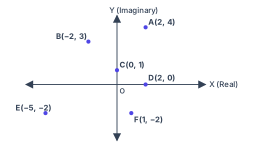
The figure is a direct visual translation of the definition of a complex number. Every complex number is represented as a single point on a plane. The horizontal axis is the real axis (labelled 'Real'), and the vertical axis is the imaginary axis (labelled 'Imaginary'). This coordinate system is called the Argand plane (or the complex plane). The origin corresponds to the complex number .
Six specific points are plotted, each labelled with a capital letter and its coordinates. Point is at , representing . Point is at , representing . Point is at — lying on the positive imaginary axis — representing (since ). Point is at on the positive real axis, representing the purely real number . Point is at in the third quadrant, representing . Point is at in the fourth quadrant, representing .
The figure makes a critical point: a complex number is not a vector, but it is plotted exactly like one. The coordinates are the Cartesian coordinates of the point. There is no third axis or hidden dimension — every complex number lives in this two-dimensional plane.
The physical idea the figure teaches is that a complex number has two independent components: a real part and an imaginary part. You cannot collapse them onto a single number line. This is why the set of complex numbers is denoted and is fundamentally two-dimensional over the real numbers.
The key formula the textbook develops directly from this figure is the modulus (or absolute value) of a complex number. For a point representing , the distance from the origin to is given by the Pythagorean theorem:
This is the length of the line segment . For example, the modulus of is . The modulus is always a non-negative real number, and it is zero only when .
A common mistake is to think is the same as or . It is not. The modulus uses both coordinates. For , which is , the modulus is , not . …
Drawn by us to help you understand the concept clearly, and verified to make sure it's accurate. For exams, practice from your NCERT textbook's own diagram.
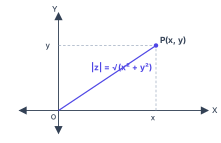
The figure shows the standard Argand plane — a flat coordinate system where the horizontal axis (X) represents the real part of a complex number and the vertical axis (Y) represents the imaginary part. The origin O is at . A point is plotted in the first quadrant, meaning both and are positive.
A straight line segment is drawn from O to P. This segment is the geometric representation of the complex number itself — it is the vector from the origin to the point. Two dashed guide lines complete the picture: one drops vertically from P down to the X-axis, landing at the point ; the other runs horizontally from P to the Y-axis, landing at . Together with the axes, these guide lines form a right triangle whose legs are the real part (along the X-axis) and the imaginary part (along the Y-axis). The hypotenuse of that triangle is the segment OP.
The physical idea is simple but powerful: every complex number corresponds to a point in a plane, and its distance from the origin is a real number that measures its "size" or magnitude. That distance is called the modulus of , denoted . Because the triangle is right-angled, the Pythagorean theorem gives the length of the hypotenuse directly.
Here, is the real part of (written ) and is the imaginary part (written ). The modulus is always a non-negative real number. It is zero only when and , i.e., when .
The figure also teaches a deeper idea: the modulus is the same as the Euclidean distance from the origin to the point in the coordinate plane. This is why the Argand plane is sometimes called the complex plane — it lets us use geometry to understand algebra. For example, the set of all complex numbers with a fixed modulus forms a circle of radius centred at the origin. The dashed guide lines are not just decoration; they make explicit that the legs of the triangle are the real and imaginary parts, so the formula is not memorised but seen as a direct consequence of the right triangle. …
Drawn by us to help you understand the concept clearly, and verified to make sure it's accurate. For exams, practice from your NCERT textbook's own diagram.
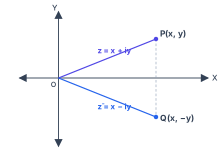
The figure shows the standard Argand plane — a flat coordinate system where the horizontal axis is the real axis (labelled X) and the vertical axis is the imaginary axis (labelled Y). The origin is marked O. Two points are plotted. The first point, labelled P, sits above the real axis at coordinates . This point represents the complex number . The second point, labelled Q, sits directly below P at coordinates . This point represents the conjugate .
A solid line segment connects O to P, and another solid segment connects O to Q. A dashed vertical line runs from P straight down to Q, crossing the real axis at a right angle. This dashed line makes the geometry explicit: the real axis acts like a mirror. The distance from P to the real axis is ; the distance from Q to the real axis is also , but on the opposite side. So Q is the mirror image (reflection) of P across the real axis.
The conjugate of a complex number is its reflection across the real axis in the Argand plane. If , then is the mirror image of in the real axis.
The figure teaches a physical idea: conjugation is a geometric transformation — a reflection. It is not just an algebraic trick of flipping the sign of the imaginary part. Every time you see , you should picture the point dropping straight down across the real axis to the same horizontal coordinate.
The key formula the textbook develops with this figure is the definition of the conjugate itself:
where , and . Here is the real part of , written , and is the imaginary part, written . The figure also leads naturally to the relationship between a number and its conjugate for the modulus:
…