Mathematics · Ch 10 — Conic Sections
Standard Equation of Hyperbola
Standard Equation of Hyperbola
The Standard Equation of a Hyperbola
The simplest equation for a hyperbola arises when we place its centre at the origin and align its foci along one of the coordinate axes. There are two natural orientations: the foci on the x‑axis, or the foci on the y‑axis. We will derive the equation for the first case — foci on the x‑axis — and then state the corresponding result for the y‑axis orientation.
Setting Up the Coordinate System
Let and be the two foci, and let be the midpoint of . Place at the origin. Let the line through and be the positive x‑axis, and the line through and be the negative x‑axis. The y‑axis is the line through perpendicular to the x‑axis.
Choose coordinates so that and , where . The distance between the foci is .
Let be any point on the hyperbola. The defining property of a hyperbola is that the absolute difference of the distances from to the two foci is constant. We denote this constant by , where . For the orientation we are considering, the farther focus is (on the left) and the closer focus is (on the right), so we write
The constant is the difference of the distances, not the sum. For a hyperbola, always. The value is half the length of the transverse axis, which we will define shortly.
Deriving the Equation
Using the distance formula, the condition becomes
Isolate one square root:
Square both sides:
Expand the squares:
Cancel , , and from both sides:
Bring the terms together:
Divide through by :
Square again:
Expand both sides:
Cancel the term on both sides:
Bring all terms to one side:
Factor on the left and on the right:
Now define a new positive constant by
Since , . Substituting gives
Divide both sides by :
This is the standard equation of a hyperbola with centre at the origin and transverse axis along the x‑axis.
Verifying the Converse
We have shown that any point on the hyperbola satisfies . Now we must show the converse: if a point satisfies this equation (with ), then it lies on the hyperbola — i.e., .
From the equation, we can write
Now compute :
Substitute :
The terms cancel: . The terms also cancel: . We are left with
Factor the expression inside the square root:
Since for points on the right branch (we will discuss this shortly), , so
Similarly, compute :
Following the same substitution and simplification:
For , , so . Hence
Therefore
If lies to the left of the line , then a similar calculation gives . In either case, the absolute difference is , confirming that the point lies on the hyperbola.
The converse proof uses the fact that or for points on the hyperbola. This restriction emerges naturally from the equation itself, as we will see next.
Domain and Shape of the Hyperbola
From the equation , we can write
Thus , which implies . In other words, or .
This means that no part of the hyperbola lies between the vertical lines and . The curve consists of two separate branches: one to the right of and one to the left of . The hyperbola has no real y‑intercept (no point where satisfies the equation).
The Standard Equation for the Other Orientation
If the foci lie on the y‑axis instead of the x‑axis, a completely analogous derivation (interchanging the roles of and ) yields the standard equation
Here the transverse axis is along the y‑axis, and the foci are at with .
These two equations — and — are called the standard equations of a hyperbola. In both cases, the centre is at the origin and the transverse and conjugate axes are the coordinate axes.
Special Case: Equilateral Hyperbola
A hyperbola in which is called an equilateral hyperbola. Its standard equation becomes
…
Drawn by us to help you understand the concept clearly, and verified to make sure it's accurate. For exams, practice from your NCERT textbook's own diagram.
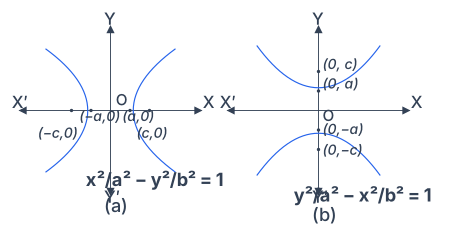
Fig. 10.29 shows the two standard orientations of a hyperbola centred at the origin. In both panels, the coordinate axes are drawn, and the curve consists of two separate, mirror-image branches (shown in blue). The key idea the figure teaches is that a hyperbola has two possible orientations depending on which axis the foci lie on — the transverse axis.
Panel (a) — transverse axis along the x-axis. The two branches open left and right. The vertices are at and the foci are at , with . The conjugate axis (the y-axis) has no real intercepts. The standard equation derived from this orientation is
where . The positive term is , so the transverse axis is the x-axis.
Panel (b) — transverse axis along the y-axis. The branches open upward and downward. The vertices are at and the foci at . The conjugate axis is now the x-axis. The standard equation is
with the same relation . Here the positive term is , so the transverse axis is the y-axis.
In both cases, the foci always lie on the transverse axis. The denominator of the positive term tells you which axis is the transverse axis. For example, has transverse axis along x-axis of length , while has transverse axis along y-axis of length .
The figure also makes clear a geometric property: no part of the curve lies between the lines (in panel a) or between (in panel b). This is because from the equation, , so — the hyperbola exists only outside the strip between the vertices.
The textbook uses panel (a) to derive the standard equation. Starting from the definition , with and , the distance formula and two squarings lead to , and then gives the compact form. The derivation for panel (b) is identical in structure, swapping and . …
Drawn by us to help you understand the concept clearly, and verified to make sure it's accurate. For exams, practice from your NCERT textbook's own diagram.
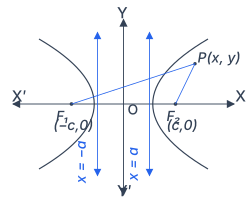
What Fig. 10.30 Shows
The figure places a hyperbola on a standard Cartesian plane with the origin at its centre. The x‑axis runs horizontally, the y‑axis vertically. Two foci are marked: at and at , both lying on the x‑axis symmetrically about the origin. Two vertical dashed lines are drawn at and — these are the guide lines that mark the vertices of the hyperbola. The hyperbola itself consists of two separate, mirror‑image curves: the right branch opens to the right of , the left branch opens to the left of . No part of the curve exists between and .
A generic point is shown on the right branch, with line segments drawn from to each focus: and . The lengths of these segments are the key to the definition.
The Physical Idea
A hyperbola is defined by a constant difference of distances, not a constant sum as in an ellipse. For every point on the curve, the absolute difference between its distances to the two foci is fixed and equal to . In the figure, because is on the right branch, is the farther focus and the nearer one, so
If were on the left branch, the roles would reverse: . The constant is the length of the transverse axis — the distance between the two vertices of the hyperbola, which lie at and .
A common mistake is to think the constant difference is itself. It is , just as the constant sum in an ellipse is . The in the hyperbola equation is half the transverse axis length.
The Key Formula Developed from This Figure
Starting from the distance condition and applying the distance formula, the textbook derives the standard equation of a hyperbola with centre at the origin and transverse axis along the x‑axis:
where . Here:
- is half the length of the transverse axis (the distance from the centre to either vertex).
- is the distance from the centre to each focus.
- is half the length of the conjugate axis; it is not a distance to any point on the curve but defines the asymptotes and the shape of the opening.
The relationship holds, but note the plus sign — this is the same relation as for an ellipse, though the hyperbola equation has a minus sign between the and terms. …