Mathematics · Ch 3 — Trigonometric Functions
Trigonometric Functions
Trigonometric Functions
Trigonometric Functions: Extending Ratios to Functions
In earlier classes, you studied trigonometric ratios for acute angles — those were ratios of sides in a right-angled triangle. Now we take a fundamentally different approach. Instead of ratios, we define trigonometric functions for any real number (or any angle, measured in radians) using the unit circle. This shift from ratios to functions is what makes trigonometry powerful for describing periodic phenomena like waves and oscillations.
The Unit Circle Definition
Consider a circle of radius 1 (a unit circle) centred at the origin of the coordinate plane. Let be any point on this circle. Draw the radius and let radians. By definition, the radian measure equals the length of the arc along the circle.
We now define the two fundamental trigonometric functions:
That is, the -coordinate of is and the -coordinate is .
Since lies on the unit circle, its distance from the origin is 1. In right triangle (where is the foot of the perpendicular from to the -axis), we have , , and . By the Pythagorean theorem:
This gives us the most fundamental identity in trigonometry:
This identity holds for every real number .
Quadrantal Angles
One complete revolution around the circle subtends an angle of radians at the centre. The points where the circle meets the axes are special. Let's label them:
- at corresponds to angle (or )
- at corresponds to angle
- at corresponds to angle
- at corresponds to angle
Angles that are integral multiples of are called quadrantal angles. From the coordinates of these points, we read off the function values directly:
| Angle | ||
|---|---|---|
Periodicity
If we start at point and travel one complete revolution ( radians), we return to the same point . The same happens if we travel any integer multiple of in either direction. Since the coordinates of determine and , these functions repeat their values every radians.
For any integer :
This property — that the function repeats after a fixed interval — is called periodicity. The period of both sine and cosine is .
When Do Sine and Cosine Vanish?
From the unit circle, we can see exactly when each function equals zero.
Sine vanishes when the -coordinate of is zero. This happens at and — that is, at angles
Cosine vanishes when the -coordinate of is zero. This happens at and — at angles
A common mistake is to think at multiples of . It's actually at odd multiples of . The formula generates — never an integer multiple of .
Defining the Other Trigonometric Functions
Using sine and cosine as our foundation, we define four more functions. Each has restrictions on its domain where the denominator would be zero.
Notice the symmetry: and are undefined where (at ), while and are undefined where (at odd multiples of ).
Two More Fundamental Identities
From , we can derive two other important identities.
Divide the identity by (provided ):
Now divide the original identity by (provided ):
These three identities — , , and — are the Pythagorean identities of trigonometry. They are not three separate facts but one fact expressed in three ways, depending on which function you want to eliminate.
Standard Values Table
The values for the commonly used angles are the same as those you learned for trigonometric ratios. Here they are, now understood as function values: …
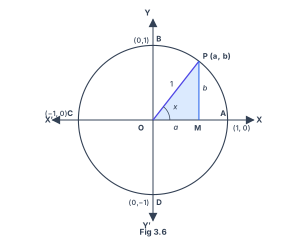
Drawn by us to help you understand the concept clearly, and verified to make sure it's accurate. For exams, practice from your NCERT textbook's own diagram.
What Fig. 3.6 Actually Shows
The figure places a unit circle — a circle of radius exactly 1 — centred at the origin of the coordinate axes. The four quadrantal points are marked: on the positive -axis, on the positive -axis, on the negative -axis, and on the negative -axis. These are the points where the circle meets the axes.
A point lies on the circle in the first quadrant. The angle is labelled radians — this is the angle swept from the positive -axis (ray ) to the ray , measured anticlockwise. From , a perpendicular is dropped to the -axis, meeting it at . The right triangle is shaded, with as the hypotenuse, along the -axis as one leg, and vertical as the other leg.
Because the circle is a unit circle, the hypotenuse has length exactly 1. The horizontal leg has length , and the vertical leg has length . The angle at in this right triangle is exactly radians, and an arc from to along the circle also has length (since radius = 1, arc length = radius × angle = ).
The Core Idea: Coordinates as Trigonometric Functions
The figure teaches a single, powerful idea: the coordinates of a point on the unit circle are the cosine and sine of the angle. Specifically:
The horizontal coordinate is ; the vertical coordinate is . This is not a coincidence — it is the definition being introduced. The right triangle gives the familiar ratio interpretation: in , , and . The unit circle simply makes the hypotenuse 1, so the ratios become the coordinates themselves.
The single most important result from this figure is the Pythagorean identity. Applying Pythagoras' theorem to :
Substituting and gives:
This holds for every point on the unit circle, and therefore for every real angle .
What the Quadrantal Points Teach
The four points , , , correspond to angles that are multiples of — these are called quadrantal angles. Reading their coordinates directly from the figure:
| Point | Angle | Coordinates |
|---|---|---|
These values are not memorised — they are read from the figure. The -coordinate gives cosine, the -coordinate gives sine.
The Periodic Nature
The figure also makes periodicity obvious. If you start at and travel a full revolution ( radians) around the circle, you return to the same point . This means:
More generally, for any integer :
The zeros of sine and cosine also become geometrically clear. Sine is zero when — that is, when lies on the -axis, at angles (integral multiples of ). Cosine is zero when — when lies on the -axis, at angles (odd multiples of ).
A common mistake is to think and are defined only for acute angles from right triangles. The unit circle figure shows they are defined for any real angle — the coordinates and exist for every point on the circle, regardless of which quadrant lies in. The right triangle is just a visual aid for the first quadrant; the definition via coordinates works everywhere.