Physics · Ch 7 — Gravitation
Acceleration Due to Gravity of the Earth
Acceleration Due to Gravity of the Earth
Acceleration Due to Gravity of the Earth
When we drop a stone, it falls toward the Earth. The force causing this motion is gravity. But what exactly is the acceleration that this force produces? That is the question this section answers.
Newton's universal law of gravitation tells us that the Earth exerts a force on every object near its surface. If the Earth is treated as a sphere of mass and radius , and the object of mass is on or very near the surface, the distance between the object and the Earth's centre is approximately . The gravitational force on the object is:
This force is what we call the weight of the object. From Newton's second law, , where is the acceleration of the object. Equating the two expressions for force:
The mass cancels out — a crucial point. The acceleration does not depend on the object's mass. This acceleration is given a special symbol, , and is called the acceleration due to gravity of the Earth.
This is the fundamental expression for at the Earth's surface. It tells us that depends only on the Earth's mass and radius, and on the universal gravitational constant .
Numerical Value of
We can compute using known values:
Substituting:
…
Drawn by us to help you understand the concept clearly, and verified to make sure it's accurate. For exams, practice from your NCERT textbook's own diagram.
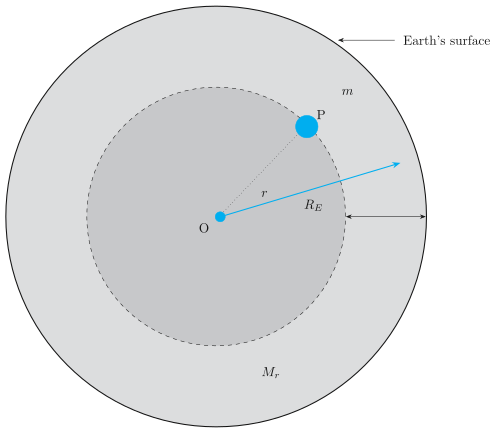
The figure shows a cross-section of the Earth as two concentric circles. The outer solid circle represents the Earth’s surface, radius . Inside, a dashed circle of radius represents a spherical surface at some depth below the surface. The centre of both circles is labelled O. A point P is marked on the dashed circle, and a small mass sits at P. A dotted line runs from O to P, showing the radius . A double-headed arrow labelled spans the distance between the outer surface and the dashed circle — this is the depth of the mine.
The physical idea is simple but powerful. When you go underground — into a mine, for example — you are no longer feeling the gravitational pull of the entire Earth. The mass of the Earth that lies outside your depth (the spherical shell between radius and the surface) exerts zero net gravitational force on you. This is a consequence of the shell theorem: for a point inside a uniform spherical shell, the shell’s gravity cancels out completely. So the only mass that matters is the mass of the sphere of radius that lies beneath you.
That inner sphere has radius . Its mass is not the full — it is smaller, because you have removed the outer shell. If the Earth has uniform density , then
Dividing one by the other gives
Now, the acceleration due to gravity at depth is the force per unit mass from this inner sphere alone. Treating the inner sphere as if all its mass were concentrated at the centre O (which the shell theorem also allows), we get
Substitute :
Since , this becomes
But is just the surface value . So the key result is
where is the acceleration due to gravity at the Earth’s surface, is the depth below the surface, and is the Earth’s radius. …