Physics · Ch 13 — Oscillations
Displacement
Displacement
The Meaning of Displacement in Oscillatory Motion
When we talk about displacement in the context of oscillations, we are not just talking about how far something has moved from where it started. In oscillatory motion, displacement has a very specific meaning: it is the distance of the oscillating particle from its mean position (or equilibrium position) at any given instant.
Think of a simple pendulum. The mean position is the point where the bob hangs vertically downwards, at rest. If you pull the bob to one side and release it, the displacement at any moment is the distance of the bob from that central, vertical line. This displacement can be positive (to the right of the mean position) or negative (to the left), depending on which side the bob is on.
The key idea is that displacement in an oscillation is always measured from the equilibrium point, not from the starting point of the motion. This is a crucial distinction from the displacement you might calculate in kinematics problems.
The Mathematical Description of Displacement
For the simplest kind of oscillation — simple harmonic motion (SHM) — the displacement varies sinusoidally with time . The most general way to write this is:
Here, each symbol has a precise physical meaning:
- is the displacement of the particle from its mean position at time .
- is the amplitude of the motion. It is the maximum magnitude of displacement. The particle oscillates between and .
- is the angular frequency of the motion. It tells you how fast the oscillation is happening in terms of radians per second. It is related to the time period and frequency by .
- is the initial phase (or phase constant). It determines the displacement of the particle at time . If , then , meaning the particle starts at its maximum positive displacement.
This single equation is the foundation for describing the position of any particle executing SHM.
Why Use a Cosine Function?
You might wonder why we use a cosine and not a sine. The answer is that both are valid, and the choice simply affects the value of the phase constant . A sine function is just a cosine function shifted in time:
So, if you prefer to write , you can, and it will describe the same physical motion, just with a different phase constant. The textbook uses the cosine form as its standard representation, and we will stick with that for consistency.
The Four Key Quantities of SHM
From the displacement equation , we can derive everything else about the motion. The textbook lists four fundamental quantities that completely define a simple harmonic motion:
- Amplitude (): The maximum displacement from the mean position. It is always a positive constant.
- Angular Frequency (): A measure of how rapidly the oscillations occur. It is a positive constant for a given system.
- Phase (): The argument of the cosine function. It tells you the current "state" of the oscillation — where the particle is in its cycle.
- Initial Phase (): The phase at time . It sets the initial conditions of the motion.
Properties of the Displacement Function
The textbook then examines the mathematical properties of the cosine function to understand the physical behaviour of the oscillating particle. Let's go through them one by one.
›Proof
Property (I): The motion is periodic.
A function is periodic with period if for all . For our displacement function , we need to find a such that:
We know that the cosine function repeats its value when its argument increases by :
Therefore, we require:
Simplifying:
Cancelling and from both sides gives:
So the time period is:
This proves that is a periodic function with a period . The particle repeats its motion after every interval .
›Proof
Property (II): The motion is oscillatory about the mean position.
An oscillatory motion is one in which the particle moves back and forth about a fixed point (the mean position). The displacement function clearly shows this. The cosine function oscillates between and . Therefore, oscillates between and . The value (the mean position) is crossed twice in every cycle. This back-and-forth motion about is the very definition of oscillation.
›Proof
Property (III): The amplitude is the maximum displacement.
The maximum value of is . Therefore, the maximum value of is:
The minimum value of is . Therefore, the minimum value of is:
The magnitude of the maximum displacement from the mean position is . Since amplitude is defined as this maximum magnitude, it is (taking to be positive).
›Proof
Property (IV): The phase determines the state of motion.
…
Drawn by us to help you understand the concept clearly, and verified to make sure it's accurate. For exams, practice from your NCERT textbook's own diagram.
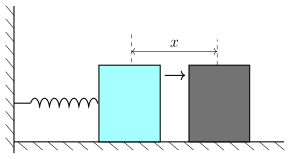
This figure is the starting point for understanding simple harmonic motion (SHM). It shows the simplest possible oscillator: a single block attached to a spring, with the other end of the spring fixed to a rigid wall. The surface is frictionless, so the only horizontal force on the block comes from the spring.
The diagram has two key parts. On the left is the equilibrium position — the block is drawn in blue, sitting where the spring is neither stretched nor compressed. On the right, a second block is drawn in grey, displaced to the right by a distance from equilibrium. A double-headed arrow labelled spans the gap between the two block positions, making it clear that measures the displacement from equilibrium, not the total length of the spring. The wall is hatched to show it is rigid and fixed; the surface is hatched to indicate it is frictionless.
The physical idea is straightforward: when you pull the block to the right (or push it to the left) and release it, the spring exerts a restoring force that tries to bring the block back to equilibrium. For a spring that obeys Hooke's law, that restoring force is proportional to the displacement and opposite in direction:
Here is the force exerted by the spring on the block, is the spring constant (a measure of the spring's stiffness), and is the displacement from equilibrium. The negative sign is crucial — it tells you the force always points opposite to the displacement. If the block is to the right (), the force pulls left; if the block is to the left (), the force pushes right.
From this force law, Newton's second law () gives the equation of motion:
or, rearranged:
This is the differential equation for simple harmonic motion. Its solution is a sinusoidal function of time:
where is the amplitude (maximum displacement), is the angular frequency, and is the initial phase (determined by where the block starts). The period of the oscillation is . …
Drawn by us to help you understand the concept clearly, and verified to make sure it's accurate. For exams, practice from your NCERT textbook's own diagram.
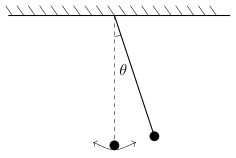
The figure shows a simple pendulum hanging from a fixed support at the ceiling. A dashed vertical line marks the equilibrium position — where the pendulum hangs straight down when at rest. The string is drawn at an angle to this vertical, with the bob at the end of the string. A curved double-headed arrow arcs between the vertical line and the string, indicating that is the angular displacement from equilibrium. The bob is shown at one extreme of its swing, so the arrow captures the full range of motion the pendulum covers as it oscillates.
The physical idea is that a simple pendulum, when displaced by a small angle and released, undergoes periodic motion. The restoring force comes from gravity: the component of the bob's weight tangent to the arc, , always pulls it back toward the vertical. For small (typically less than about ), in radians, which makes the motion simple harmonic.
…