Q.The electrical resistance in ohms of a certain thermometer varies with temperature according to the approximate law:
[!FORMULA]
R=R0[1+α(T−T0)]
The resistance is 101.6 Ω at the triple-point of water 273.16 K, and 165.5 Ω at the normal melting point of lead (600.5 K). What is the temperature when the resistance is 123.4 Ω?
Concept understanding — Linear Temperature Dependence
Linear Temperature Dependence – First Encounter
You've probably noticed that many things change when you heat them up. A metal rail expands on a hot day. The resistance of a wire increases when current makes it hot. The pressure in a sealed tyre rises after a long drive.
The simplest way this happens is linear temperature dependence — the property changes in direct proportion to the change in temperature. Double the temperature rise, double the change in the property. No surprises, no sudden jumps.
The Intuition
Imagine a rubber band. If you pull it gently, it stretches a little. Pull twice as hard, it stretches twice as much — that's a linear relationship between force and stretch.
Now replace "force" with "temperature change" and "stretch" with "some physical quantity" (length, resistance, pressure, volume). That's linear temperature dependence: equal increments of temperature produce equal increments of the quantity.
This is the first approximation for most materials over a limited temperature range. It's never perfectly true forever, but it's remarkably accurate for small temperature changes.
The Precise Statement
If a physical quantity Q depends linearly on temperature T, then:
Q(T)=Q0+α(T−T0)
Where:
- Q0 is the value at some reference temperature T0 (often 0∘C or 25∘C)
- α is the temperature coefficient — the rate of change per degree
- T is the current temperature
The change ΔQ=Q−Q0 is directly proportional to the change ΔT=T−T0:
ΔQ=αΔT
Q(T)=Q0[1+β(T−T0)]
where β=α/Q0 is the fractional temperature coefficient (units: ∘C−1 or K−1)
Real Examples You'll Meet in Exams
| Quantity | Symbol | Typical behaviour | Common β value |
|---|---|---|---|
| Length of a metal rod | L | Expands on heating | ≈1.2×10⁻⁵∘C−1 (steel) |
| Resistance of a copper wire | R | Increases with temperature | ≈3.9×10⁻³∘C−1 |
| Volume of an ideal gas (constant pressure) | V | Increases linearly with T (in Kelvin) | 1/273.15∘C−1 |
| Pressure of an ideal gas (constant volume) | P | Increases linearly with T (in Kelvin) | 1/273.15∘C−1 |
For gases, the linear law works only when temperature is measured in Kelvin, not Celsius. The formula becomes V=V0(1+273.15T) where T is in °C — but this is just a disguised version of V∝T (Kelvin).
Why This Matters
Linear temperature dependence is the foundation of:
- Thermometers (mercury in glass, resistance thermometers, thermocouples)
- Thermal expansion calculations in bridges and railway tracks
- Temperature compensation in electronic circuits
- Charles's Law and Gay-Lussac's Law for ideal gases
The key insight: when you see a straight-line graph of a physical quantity against temperature, you're looking at linear temperature dependence. The slope of that line is α, and the intercept at T=0 (or T=T0) gives you Q0.
Linear temperature dependence is not a law of nature — it's an approximation that works well for small temperature ranges. For large temperature changes, higher-order terms (T2, T3, ...) become important, and the relationship becomes non-linear.
Students preparing for boards often pair a search for "Linear Temperature Dependence class 11 physics" with "NCERT Physics syllabus" — Linear Temperature Dependence is a syllabus-aligned topic under Thermal Properties of Matter in NCERT Class 11 Physics, making it a natural fit for both board exams and JEE/NEET practice sets. Working through the worked examples above alongside the official NCERT Physics textbook is the most reliable way to turn this understanding into exam-ready recall.
Since R=R0[1+α(T−T0)] is linear, resistance changes are proportional to temperature changes between the calibration points (273.16 K,101.6Ω) and (600.5 K,165.5Ω):
R1−R0R−R0=T1−T0T−T0⇒63.921.8=327.34T−273.16.
T−273.16≈111.7⇒T≈384.9 K.
The temperature is approximately 384.9 K (≈385 K, or 111.7∘C).
Treating the resistance-temperature relation as linear between the two known calibration points, interpolation gives T≈384.9 K (about 385 K, or 111.7∘C) for a resistance of 123.4 Ω.
The relation R=R0[1+α(T−T0)] says resistance changes in direct proportion to temperature above the reference point T0=273.16 K (the triple point of water), where R0=101.6 Ω. Since it's linear, the ratio of resistance changes equals the ratio of temperature changes between any two points on the line.
Setting up the ratio
We know two points on the line: (273.16 K,101.6 Ω) and (600.5 K,165.5 Ω). For the unknown point (T,123.4 Ω):
R1−R0R−R0=T1−T0T−T0.
Substituting values
165.5−101.6123.4−101.6=600.5−273.16T−273.16
63.921.8=327.34T−273.16
Solving for T
T−273.16=63.921.8×327.34≈111.7 K
T≈273.16+111.7≈384.9 K.
Rounding to match the precision of the data, T≈385 K, or equivalently about 111.7∘C.
This linear-interpolation method sidesteps solving for α explicitly - dividing the two known ratios directly is faster and less error-prone than computing α first and then re-solving.
The temperature is approximately 384.9 K (≈385 K, or 111.7∘C).
As a cross-check, solve for α explicitly instead of using the ratio shortcut, and confirm both routes agree. From the two calibration points: α=T1−T0R1/R0−1=600.5−273.16165.5/101.6−1≈1.921×10−3 K−1. Then for R=123.4 Ω: T=T0+αR/R0−1≈273.16+111.7≈384.9 K — the same result reached a different way. The physical caveat worth flagging: this linear resistance law is only approximate; real platinum-type thermometers deviate slightly from a straight line over wide ranges, which is exactly why a constant-volume gas thermometer (extrapolated to zero pressure) is treated as the true calibration standard rather than any single resistance thermometer.
Showing the 12 most recent of 16 on this concept.
- TG EAPCET 2026Set eng-2026-05-11-FN1 markMCQQ.If the errors in the measurements of diameter, length and electrical resistance of a wire are 1%, 0.5% and 2% respectively, then percentage error in the determination of the resistivity of material of the wire is (A) 3.5 (B) 4 (C) 4.5 (D) 2.5
›Reveal solutionSolution
The percentage error in resistivity is the sum of the percentage errors in resistance, length, and twice the diameter error, giving 2% + 0.5% + 2×1% = 4.5%. The correct option is (C).
The key idea is that resistivity ρ is not measured directly but calculated from other measured quantities: resistance R, length L, and diameter d (which gives cross-sectional area). When each measurement has an uncertainty, those uncertainties propagate into the final result. For multiplication and division, percentage errors simply add.
Why this works:
If a quantity Q=CA⋅B, then the relative error in Q is the sum of the relative errors in A and B minus the relative error in C (but since errors are usually given as positive magnitudes, we add absolute values). For powers, the error is multiplied by the exponent. Here, area depends on d2, so the diameter error gets doubled.
- Write the formula for resistivity Resistivity ρ is given by
ρ=LR⋅A
where A is the cross-sectional area. For a wire of diameter d,
A=4πd2
So
ρ=4LR⋅πd2
The constant π/4 has no error, so it doesn’t affect the percentage error.
- Apply the rule for error propagation For a product/quotient, the percentage error in ρ is the sum of the percentage errors in each factor, with each error multiplied by the power of that factor:
ρΔρ×100%=RΔR×100%+2⋅dΔd×100%+LΔL×100%
(Note: L is in the denominator, but we still add the magnitude of its error.)
-
Insert the given percentage errors
- Error in resistance: RΔR×100%=2%
- Error in diameter: dΔd×100%=1% → multiplied by 2 gives 2%
- Error in length: LΔL×100%=0.5%
So total percentage error in ρ is:
2%+2%+0.5%=4.5%
TipA common mistake is to forget that the diameter appears squared. If you only add 1% for diameter instead of 2%, you get 3.5% — which is option (A), a tempting distractor.
Watch outDo not subtract the length error because it’s in the denominator. In error propagation, we always add absolute relative errors for multiplication and division — the sign of the operation doesn’t matter for the magnitude of uncertainty.
- Match with the options The result 4.5% corresponds to option (C).
✓Final answerThe correct option is (C).
ANSWER: C
- AP EAPCET 2026Set ap-2026-05-19-AN1 markMCQQ.If the pressure of the gas in a constant volume gas thermometer at ice point is 91 kPa, then the pressure of the gas in the thermometer at steam point is nearly (A) 144.3 kPa (B) 138.6 kPa (C) 172.6 kPa (D) 124.3 kPa
›Reveal solutionSolution
Using the constant-volume gas law P∝T between the ice point (273 K) and steam point (373 K) gives a pressure of about 124.3 kPa.
Concept and Intuition
A constant-volume gas thermometer relies on the ideal-gas relation PV=nRT: with volume and moles fixed, pressure is directly proportional to absolute temperature. Measuring pressure at two known reference temperatures (ice point and steam point) lets us relate them directly through this proportionality.
Step-by-Step Solution
- Ice point temperature: T1=0∘C=273 K, with P1=91 kPa.
- Steam point temperature: T2=100∘C=373 K.
- At constant volume, T1P1=T2P2⟹P2=P1×T1T2.
- Substitute: P2=91×273373=91×1.3663≈124.3 kPa.
Common Mistakes
- Using Celsius temperatures directly in the ratio instead of converting to Kelvin (absolute temperature) first — this proportionality only holds for absolute temperature.
- Rounding errors in the 373/273 ratio leading to a value that doesn't match any option closely; keeping enough decimal places is needed to land near 124.3 kPa.
✓Final answerThe correct option is (D) — 124.3 kPa.
ANSWER: D
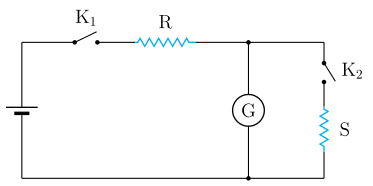
- KCET 2025Set D-41 markMCQQ.In an experiment to determine the figure of merit of a galvanometer by half deflection method, a student constructed the following circuit. He unplugged a resistance of 5200Ω in R. When K1 is closed and K2 is open, the deflection observed in the galvanometer is 26 div. When K2 is also closed and a resistance of 90Ω is removed in S, the deflection between 13 div. The resistance of galvanometer is nearly
 (A) 45.0 Ω
(B) 103.0 Ω
(C) 91.6 Ω
(D) 116.0 Ω
(A) 45.0 Ω
(B) 103.0 Ω
(C) 91.6 Ω
(D) 116.0 Ω›Reveal solutionSolution
Apply the standard half-deflection result G=R−SRS, with R=5200 Ω (the series resistance) and S=90 Ω (the shunt that halves the deflection).
Step 1 — What happens with K2 open.
Only the series resistance R and the galvanometer G carry the current. If the cell emf is E (internal resistance negligible), the current through the galvanometer is
Ig=R+GE
This produces the full deflection, θ=26 divisions. Since deflection ∝ current through the coil,
26∝R+GE(1)
Step 2 — What happens when K2 is closed.
The shunt S=90 Ω is now in parallel with the galvanometer. Because R≫ the parallel combination (5200 Ω versus at most 90 Ω), the total current drawn from the cell is essentially unchanged:
I≈RE
That current now splits between G and S. By the current-divider rule the fraction through the galvanometer is
Ig′=I⋅G+SS
The observed deflection is halved, to 13 divisions.
Step 3 — Impose the half-deflection condition.
Deflection halves ⇒ the coil current halves:
IgIg′=2613=21
G+SS=21 (of the near-unchanged total)⟹RE⋅G+SS=21⋅R+GE
Working this through (the standard derivation) yields the well-known result
G=R−SRS
Why this form? In the ideal limit the shunt must carry exactly as much current as the coil for the coil current to halve — which requires S=G if the total were fixed. The finite R correction produces the R/(R−S) factor, and because R≫S that factor is only slightly above 1, so G comes out slightly larger than S. We should therefore expect an answer a little above 90 Ω — a useful check before computing.
Step 4 — Substitute the numbers.
G=5200−905200×90=5110468000
G=91.585…≈91.6 Ω
This sits just above S=90 Ω, exactly as anticipated.
Rejecting the distractors: (A) 45.0 Ω is S/2 (halving the wrong quantity); (B) 103 Ω and (D) 116 Ω do not follow from RS/(R−S) with these values.
✓Final answerThe correct option is (C) — 91.6 Ω.
ANSWER: C
- TG EAPCET 2025Set eng-2025-05-04-AN1 markMCQQ.A metal metre scale that is accurate up to 0.5 mm is made at a temperature of 25°C. The range of temperatures within which it can be used is (Coefficient of linear expansion of the metal =10−5/∘C) (A) +25∘C to +75∘C (B) +25∘C to +50∘C (C) −25∘C to +75∘C (D) 0∘C to +50∘C
›Reveal solutionSolution
The scale is accurate to 0.5 mm over 1 m, so the allowed expansion or contraction is ±0.5 mm. Using ΔL=L0αΔT, the allowable temperature change is ±50°C, giving a range from –25°C to +75°C. The correct option is (C).
The key idea is that the scale is “accurate up to 0.5 mm” — meaning that over its full length of 1 metre, the error due to thermal expansion or contraction must not exceed 0.5 mm in either direction. Since the scale was made at 25°C, it reads correctly only at that temperature. At any other temperature, the metal expands or contracts, so the markings shift. We need the range of temperatures for which the shift is at most 0.5 mm.
The coefficient of linear expansion α=10−5/∘C tells us how much each metre of the metal changes per degree Celsius. The formula is:
ΔL=L0αΔT
where L0=1 m=1000 mm.
-
Set the maximum allowed change in length.
The scale is accurate to 0.5 mm, so ∣ΔL∣≤0.5 mm.
-
Solve for the maximum temperature change.
0.5=1000×10−5×∣ΔT∣
0.5=0.01×∣ΔT∣
∣ΔT∣=0.010.5=50∘C
-
Interpret the sign.
The scale can be used when the temperature is up to 50°C above or below the calibration temperature of 25°C. So:
- Lower bound: 25−50=−25∘C
- Upper bound: 25+50=75∘C
-
Check the options.
The range −25∘C to +75∘C matches option (C).
Watch outA common mistake is to forget that the scale can contract as well as expand, so the range must extend below 25°C, not just above it. Options (A) and (B) only allow heating, which is incomplete.
TipNotice that the 0.5 mm accuracy is tiny compared to 1 m — it’s 0.05% of the length. The coefficient is also small, so the allowable temperature swing ends up being a generous 50°C in each direction.
✓Final answerThe correct option is (C).
ANSWER: C
-
- TG EAPCET 2025Set eng-2025-05-04-FN1 markMCQQ.A metal metre scale that is accurate up to 0.5 mm is made at a temperature of 25∘C. The range of temperatures within which it can be used is (Coefficient of linear expansion of the metal =10−5/∘C) (A) 0∘C to +50∘C (B) +25∘C to +75∘C (C) −25∘C to +75∘C (D) +25∘C to +50∘C
›Reveal solutionSolution
The scale is accurate to 0.5 mm over 1 m, so the allowed expansion or contraction is ±0.5 mm. Using ΔL=L0αΔT, the allowable temperature change is ±50°C from the calibration temperature of 25°C, giving a range of –25°C to +75°C. The correct option is (C).
The key idea here is that a "metre scale" is supposed to read exactly 1 m between its end marks. But if the temperature changes, the metal expands or contracts, so the physical distance between the marks changes. The scale is only accurate if that change stays within the stated tolerance of 0.5 mm.
The coefficient of linear expansion tells you how much length changes per degree per unit length. For a 1 m scale, a temperature change ΔT produces a change ΔL=L0αΔT. We want ∣ΔL∣≤0.5 mm=0.5×10⁻³ m.
Let’s work it through.
- Set up the condition. The scale is calibrated at 25∘C. Let the temperature at which it is used be T. Then ΔT=T−25∘C. The change in length is
ΔL=(1 m)×(10−5/∘C)×(T−25∘C).
- Apply the accuracy limit. We need ∣ΔL∣≤0.5×10⁻³ m. So
∣10−5(T−25)∣≤0.5×10⁻³.
- Solve for the temperature range. Divide both sides by 10−5:
∣T−25∣≤10−50.5×10−3=50.
This means
−50≤T−25≤50,
so
−25∘C≤T≤75∘C.
Watch outA common mistake is to forget that the scale can contract as well as expand. The problem says "accurate up to 0.5 mm", meaning the error in either direction (too long or too short) must not exceed that. So you must consider both positive and negative ΔT, giving a symmetric range around 25°C.
TipNotice that the numbers work out neatly: α=10−5 and the tolerance is 0.5 mm = 5×10⁻⁴ m. Dividing gives ∣ΔT∣≤50∘C directly. This is a quick mental check.
✓Final answerThe correct option is (C), −25∘C to +75∘C.
- TG EAPCET 2024Set ap-2024-05-08-FN1 markMCQQ.The change in moment of inertia of a solid sphere of mass ‘M’, radius ‘R’, for a small change in temperature ‘Δt’ is (α is coefficient of linear expansion) (A) 52MR2αΔt (B) 54MR2αΔt (C) 57MR2αΔt (D) 53MR2αΔt
›Reveal solutionSolution
When a solid sphere undergoes a small temperature change, its radius expands due to thermal expansion. This change in radius directly affects its moment of inertia. The change in moment of inertia is 54MR2αΔt.
The problem asks us to find the change in the moment of inertia of a solid sphere when its temperature changes by a small amount Δt. This involves two key physical concepts: thermal expansion and moment of inertia.
Concept and Intuition
- Thermal Expansion: When the temperature of an object changes, its dimensions (length, area, volume) also change. For a solid sphere, an increase in temperature causes its radius to increase. This is known as linear thermal expansion. The change in radius is directly proportional to the original radius, the change in temperature, and the material's coefficient of linear expansion (α).
- Moment of Inertia: The moment of inertia (I) of an object is a measure of its resistance to angular acceleration. For a solid sphere rotating about an axis passing through its center, the moment of inertia depends on its mass (M) and the square of its radius (R). Specifically, I=52MR2.
- Connecting the Concepts: As the temperature changes, the radius R of the sphere changes. Since the moment of inertia depends on R2, a change in R will lead to a change in I. The mass M of the sphere, however, remains constant with temperature change. We need to calculate this change in I for a small Δt.
Let's work through the steps to find the change in moment of inertia.
-
Initial Moment of Inertia
The moment of inertia of a solid sphere of mass M and radius R about an axis passing through its center is given by:
I=52MR2
-
Change in Radius due to Temperature
When the temperature changes by Δt, the radius R of the sphere changes. The change in radius, ΔR, is given by the formula for linear thermal expansion:
ΔR=RαΔt
The new radius, $R'$, will be the original radius plus the change in radius:R′=R+ΔR=R+RαΔt=R(1+αΔt)
- New Moment of Inertia Now, we can find the new moment of inertia, I′, by substituting the new radius R′ into the formula for the moment of inertia:
I′=52M(R′)2
Substitute $R' = R(1 + \alpha\Delta t)$:I′=52M[R(1+αΔt)]2
I′=52MR2(1+αΔt)2
- Calculate Change in Moment of Inertia The change in moment of inertia, ΔI, is the difference between the new moment of inertia and the initial moment of inertia:
ΔI=I′−I
ΔI=52MR2(1+αΔt)2−52MR2
Factor out $\frac{2}{5}MR^2$:ΔI=52MR2[(1+αΔt)2−1]
-
Apply Small Change Approximation
Since Δt is a small change in temperature, αΔt will be a very small quantity. We can use the binomial approximation (1+x)n≈1+nx for small x. In our case, x=αΔt and n=2.
TipFor a small value x (i.e., ∣x∣≪1), the binomial approximation is (1+x)n≈1+nx.
Here, αΔt is very small, so (1+αΔt)2≈1+2(αΔt).
Substitute this approximation into the expression for ΔI:
ΔI≈52MR2[(1+2αΔt)−1]
ΔI≈52MR2[2αΔt]
ΔI≈54MR2αΔt
This result represents the change in the moment of inertia of the solid sphere due to the small change in temperature Δt.
The correct option is (B).
✓Final answerThe change in moment of inertia of the solid sphere is 54MR2αΔt.
- TG EAPCET 2024Set eng-2024-05-11-FN1 markMCQQ.A pendulum clock loses 10.8 seconds a day when the temperature is 38°C and gains 10.8 seconds a day when the temperature is 18°C. The coefficient of linear expansion of the metal of the pendulum clock is (A) 7×10⁻⁵ ∘C−1 (B) 1.25×10⁻⁵ ∘C−1 (C) 5×10⁻⁵ ∘C−1 (D) 2.5×10⁻⁵ ∘C−1
›Reveal solutionSolution
Equal loss and gain fix the correct-time temperature at 28∘C, and the daily error over Δθ=10∘C gives α=2.5×10⁻⁵ ∘C−1.
The fractional change in the time period of a pendulum with temperature is
TΔT=21αΔθ,
so the time lost or gained per day is
Δt=21αΔθ×86400 s.
The clock loses time at 38∘C and gains time at 18∘C by the same amount (10.8 s), so the temperature θ0 at which it keeps correct time is symmetric between them:
38−θ0=θ0−18⟹θ0=28∘C.
Thus the temperature swing from correct time is Δθ=38−28=10∘C. Substituting:
10.8=21α(10)(86400)
10.8=432000α⟹α=43200010.8=2.5×10⁻⁵ ∘C−1.
✓Final answerThe coefficient of linear expansion is 2.5×10⁻⁵ ∘C−1 — option (D).
- TG EAPCET 2023Set ap-2023-05-10-FN1 markMCQQ.'n' conducting wires of same dimensions but having resistivities 1, 2, 3...n respectively are connected in series. The equivalent resistivity of the combination is (A) 2n(n+1) (B) 2n+1 (C) 2nn+1 (D) n+12n
›Reveal solutionSolution
When wires of equal length and cross-section are connected in series, the total resistance is the sum of individual resistances. Since each wire’s resistance is proportional to its resistivity, the equivalent resistivity becomes the average of the given resistivities — which for 1,2,3,…,n is 2n+1.
The key here is to separate two ideas that students often mix up: resistivity (a material property) and resistance (a property of the whole wire). The wires are identical in length and cross-section — only their resistivities differ. When you connect them in series, you’re adding resistances, not resistivities directly. But because the dimensions are the same, the total resistance can be re-expressed as an equivalent resistivity for the combined wire.
Let’s walk through it.
- Resistance of a single wire For a wire of length L, cross-sectional area A, and resistivity ρ, the resistance is
R=ρAL.
Since all n wires have the same L and A, the resistance of the i-th wire (with resistivity i) is
Ri=i⋅AL.
- Total resistance in series In series, resistances add directly:
Rtotal=R1+R2+⋯+Rn=AL(1+2+3+⋯+n).
The sum of the first n natural numbers is 2n(n+1), so
Rtotal=AL⋅2n(n+1).
- What does “equivalent resistivity” mean? The combination is a single conductor of length nL (since series connection adds lengths) and the same cross-section A. If this combined wire had an equivalent resistivity ρeq, its resistance would be
Rtotal=ρeqAnL.
- Equate and solve Set the two expressions for Rtotal equal:
ρeqAnL=AL⋅2n(n+1).
Cancel AL (non-zero) and divide both sides by n:
ρeq=2n+1.
Watch outA common mistake is to average the resistivities as n1+2+⋯+n=2n+1 and stop there — which gives the same number, but the reasoning is wrong if you don’t account for the change in total length. Here it works because the wires have identical dimensions, so the factor of n in length cancels neatly. In general, always go through resistance first.
TipNotice that the equivalent resistivity is simply the arithmetic mean of the individual resistivities. This happens because each wire contributes equally to the total length and has the same cross-section. If the dimensions differed, the mean would be weighted.
✓Final answerThe equivalent resistivity is 2n+1, which corresponds to option (B).
- TG EAPCET 2023Set eng-2023-05-14-AN1 markMCQQ.A blacksmith fixes circular iron frame on the wooden wheel of a bullock cart. The diameter of wooden wheel and circular iron frame are 5.012m and 5m respectively at 27∘C. The temperature (in ∘C) to which the iron ring must be heated so as to fit the wooden wheel is (Coefficient of linear expansion of iron =1.2×10⁻⁵∘C−1) (A) 200 (B) 227 (C) 254 (D) 300
›Reveal solutionSolution
The iron ring must be heated so its inner diameter expands from 5 m to 5.012 m. Using linear expansion, the required temperature rise is 200 °C, so the final temperature is 227 °C. The correct option is (B).
The key idea is thermal expansion: when a solid is heated, its dimensions increase in proportion to the temperature change. Here, the iron ring (initially too small) must expand enough to slip over the wooden wheel. Since the ring is thin, we treat its diameter expansion using the linear expansion formula.
Why this works:
The coefficient of linear expansion α tells us the fractional change in length per degree. For a diameter D, the change ΔD=αDΔT. We know the initial diameter of the iron ring (5 m) and the required final diameter (5.012 m, the wheel’s diameter). The difference gives ΔD, and we solve for ΔT. Then add the initial temperature.
Step-by-step:
-
Identify given data
- Initial diameter of iron ring: D0=5.000m
- Required final diameter (wheel’s diameter): D=5.012m
- Initial temperature: T0=27∘C
- Coefficient of linear expansion of iron: α=1.2×10⁻⁵∘C−1
-
Find the required expansion
The ring must expand by:
ΔD=D−D0=5.012−5.000=0.012m
- Apply the linear expansion formula For a linear dimension (here diameter):
ΔD=αD0ΔT
Solve for ΔT:
ΔT=αD0ΔD=(1.2×10−5)×50.012
- Calculate First compute denominator:
αD0=1.2×10−5×5=6.0×10⁻⁵
Then:
ΔT=6.0×10−50.012=6.0×10−51.2×10−2=2.0×102=200∘C
- Find the final temperature
T=T0+ΔT=27+200=227∘C
TipNotice that the initial diameter of the ring is smaller than the wheel’s diameter. If you mistakenly used the wheel’s diameter as the initial length, you’d get a different (wrong) answer. Always use the object’s own initial length.
Watch outA common mistake is to forget that the ring must be heated above room temperature, not just to the temperature that gives the exact expansion. The question asks for the temperature to which it must be heated, so add the initial 27 °C.
✓Final answerThe correct option is (B).
ANSWER: B
-
- AP EAPCET 2023Set eng-2023-05-16-AN1 markMCQQ.A rod is found to be 0.05 cm longer at 40 ∘C than it is at 10 ∘C. The length of the rod at 0 ∘C is (coefficient of linear expansion of the material of the rod =1.5×10⁻⁵ ∘C−1) (A) 101.1 cm (B) 120.2 cm (C) 105.1 cm (D) 111.1 cm
›Reveal solutionSolution
Using the linear-expansion relation between lengths at two temperatures, relative to the reference length at 0∘C, gives L0≈111.1 cm.
Concept and Intuition
Linear thermal expansion means length grows linearly with temperature relative to the length at a fixed reference temperature (conventionally 0∘C): L(T)=L0(1+αT). The difference in lengths at two temperatures is therefore proportional to L0, α, and the temperature difference — which lets us solve for L0 even though we're never told it directly.
Step-by-Step Solution
- Let L0 = length of rod at 0∘C. Then L(T)=L0(1+αT).
- L(40)−L(10)=L0α(40)−L0α(10)=L0α(30).
- Given this difference is 0.05 cm: L0α(30)=0.05.
- Substitute α=1.5×10⁻⁵∘C−1: L0(1.5×10⁻⁵)(30)=0.05⇒L0(4.5×10⁻⁴)=0.05.
- L0=4.5×10−40.05=111.11 cm.
Common Mistakes
- Using the length at 10∘C or 40∘C (rather than 0∘C) as the reference L0 in the expansion formula — the formula L=L0(1+αT) specifically references 0∘C.
✓Final answerThe correct option is (D) — 111.1 cm.
ANSWER: D
- TG EAPCET 2022Set ap-2022-07-31-FN1 markMCQQ.At constant pressure, the temperature and volume of a gas are increased by 2∘C and 0.5% respectively. Find the initial temperature. (A) 400K (B) 200K (C) 100K (D) 150K
›Reveal solutionSolution
Using Charles’s law (volume proportional to absolute temperature at constant pressure), the given fractional change in volume equals the fractional change in absolute temperature. Solving yields an initial temperature of 400 K, so option (A) is correct.
The key idea is that at constant pressure, the volume of an ideal gas is directly proportional to its absolute temperature (Kelvin). This is Charles’s law:
T1V1=T2V2
When we are told the volume increases by 0.5%, that is a fractional change. The temperature increase is given in Celsius degrees, but we must work in Kelvin because the proportionality holds only for absolute temperature. The trick is to convert the Celsius change into a fractional change in Kelvin and equate it to the fractional change in volume.
-
Set up the relation
Let the initial absolute temperature be T (in Kelvin) and initial volume be V.
After the change, the new temperature is T+2 (since a change of 2∘C is exactly a change of 2 K).
The new volume is V+0.5% of V=V(1+1000.5)=1.005V.
-
Apply Charles’s law
TV=T+21.005V
Cancel V (nonzero):
T1=T+21.005
- Solve for T Cross-multiply:
T+2=1.005T
2=1.005T−T=0.005T
T=0.0052=400 K
Watch outA common mistake is to treat the 2∘C as a fractional change of the Celsius temperature. But Charles’s law requires absolute temperature. If you mistakenly used Celsius values, you would get a different (wrong) answer.
TipNotice that a 0.5% increase corresponds to a factor of 1.005. The 2 K increase is exactly 0.5% of 400 K. This kind of “percentage = fraction of the whole” reasoning gives a quick mental check.
✓Final answerThe correct option is (A).
ANSWER: A
-
- TG EAPCET 2022Set ap-2022-07-31-AN1 markMCQQ.An object cools down from 90∘C to 70∘C in 10 minutes, when room temperature is 30∘C. The time taken by the object to cool from 70∘C to 50∘C is (A) 10 min (B) 20.3 min (C) 16.7 min (D) 14.5 min
›Reveal solutionSolution
Newton's Law of Cooling says the rate of cooling is proportional to the excess temperature over the surroundings. Using the standard mean-temperature form of the law, the time taken to cool from 70∘C to 50∘C works out to 16.7 minutes, so option (C) is correct.
Concept and intuition
Newton's Law of Cooling states that the rate of loss of heat (and hence the rate of fall of temperature) is proportional to the difference between the body's temperature and the surrounding temperature. For problems that compare two finite time intervals, the standard practical form used is:
tT1−T2=k(2T1+T2−Tr),
where T1 and T2 are the temperatures at the start and end of the interval, t is the time taken, Tr is the room temperature, and k is a constant for the given body. This treats the average of the two temperatures as representative of the excess temperature driving the cooling over that interval. Since the body's excess temperature keeps falling as it cools, covering the same 20∘C drop takes longer the second time, because the average excess temperature during the second interval is smaller.
Step-by-step solution
- Use the first interval to find k. T1=90∘C, T2=70∘C, t=10 min, Tr=30∘C.
1090−70=k(290+70−30)
2=k(80−30)=50k⇒k=0.04 per min
- Apply the same law to the second interval. Now T1=70∘C, T2=50∘C, and we want the time t′.
t′70−50=k(270+50−30)=0.04×(60−30)=0.04×30=1.2
t′20=1.2⇒t′=1.220=16.67 min≈16.7 min
Watch outA common mistake is to assume equal temperature drops take equal time (which would give option A, 10 min). Newton's Law of Cooling is not linear in time — as the object approaches room temperature, its excess temperature (and hence its cooling rate) falls, so later intervals with the same temperature drop always take longer.
TipThis mean-temperature form of Newton's Law of Cooling is the standard way to compare two finite cooling intervals without solving the full exponential differential equation — accurate enough for the modest temperature ranges typical of these problems.
✓Final answerThe time taken is 16.7 minutes, so the correct option is (C).
🎓Unlock everything free for 14 days
- ✓Full step-by-step solutions
- ✓Concept-first explanations
- ✓Methods, shortcuts & mistakes
- ✓PYQ mapping + timed mock tests
Full access for 14 days. No credit card required.