Physics · Ch 14 — Waves
Period, Angular Frequency and Frequency
Period, Angular Frequency and Frequency
Displacement Relation in a Progressive Wave
A wave travelling through a medium carries energy and momentum, but what exactly do we mean by "the wave" at a given instant? The answer lies in the displacement of each particle of the medium from its equilibrium position. For a wave on a string, this displacement is the vertical distance a point on the string has moved from its rest position. The key is that this displacement depends on two things: which particle you look at (its position ) and when you look at it (the time ).
So the displacement is a function of both and , written as . The specific form of this function determines the shape and behaviour of the wave. For the simplest and most important case — a progressive wave travelling along the positive -direction without changing shape — the displacement relation takes a particularly elegant form.
Here is the constant speed of the wave. The function describes the shape of the wave at (the initial profile). As time increases, the argument remains constant if increases at exactly the rate — meaning the entire waveform slides to the right without distortion. If the wave travels in the negative -direction, the relation becomes .
For a wave that is sinusoidal — the most fundamental periodic wave — the function is a sine or cosine. A sinusoidal wave travelling along the positive -direction can be written as:
where:
- is the amplitude — the maximum displacement from equilibrium.
- is the angular wave number (or propagation constant).
- is the angular frequency.
- is the initial phase (phase constant).
The argument is called the phase of the wave. Two points on the wave that have the same phase (e.g., both at a crest) are separated by an integer number of wavelengths.
Period, Angular Frequency and Frequency
A sinusoidal wave is periodic in both space and time. The time period is the time taken for one complete cycle of oscillation at any fixed point in the medium. If you sit at a fixed , the displacement varies sinusoidally with time, repeating every seconds. The frequency (often denoted in many texts) is the number of cycles per second:
The angular frequency is related to the frequency by:
Why use ? Because the sine function's argument must be in radians, and directly gives the rate of change of phase with time. When time increases by , the phase increases by radians, so:
This is the fundamental link between angular frequency and period.
The angular frequency has units of radians per second (rad/s), while ordinary frequency has units of hertz (Hz) or s. They are related by .
Properties of Sinusoidal Waves
The textbook lists three key properties that follow directly from the displacement relation. Each one is derived step by step below.
›Proof
Property (I): For a fixed position , the displacement varies sinusoidally with time, with angular frequency .
Fix . Then the displacement becomes:
This is a function of alone. Write the constant part as , so:
The form is a standard sinusoidal oscillation with angular frequency . The negative sign just represents a phase shift of (since ), which does not change the frequency. Therefore, every particle in the medium executes simple harmonic motion with the same angular frequency as the source.
›Proof
Property (II): At any fixed time , the shape of the wave is sinusoidal in , with wavelength related to by .
Fix . Then:
This is a function of alone. Write the constant as , so:
This is a sine wave in with angular wave number . The wavelength is the spatial period — the distance over which the sine function completes one full cycle. For a sine wave, repeats when increases by , i.e., when increases by such that . Hence:
The angular wave number has units of radians per metre (rad/m). …
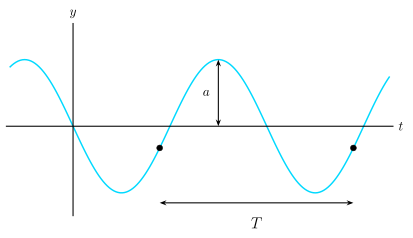
Drawn by us to help you understand the concept clearly, and verified to make sure it's accurate. For exams, practice from your NCERT textbook's own diagram.
The figure is a simple but essential plot: the vertical axis is displacement of a single point on the string, and the horizontal axis is time . The curve is a sine wave that repeats after a time interval labelled . A vertical double-headed arrow runs from the equilibrium line () up to a crest, and its length is marked . A horizontal double-headed arrow spans exactly one complete cycle of the wave, from one crest to the next crest (or from any point to the identical point one cycle later), and its length is marked .
What this plot captures is the local behaviour of a wave. When a progressive wave travels along a string, every fixed point on the string oscillates up and down in simple harmonic motion. The figure shows that oscillation for one such point. The amplitude is the maximum displacement from the mean position — the distance the string element moves from equilibrium to its highest (or lowest) point. The period is the time it takes for that point to complete one full back-and-forth motion.
The key formula that emerges from this picture is the displacement of a point on the string as a function of time. For a wave travelling in the positive -direction, the textbook writes:
But for a fixed location , say , this reduces to:
which is exactly the simple harmonic motion shown in the figure. Here is the angular frequency, and is the initial phase (which determines where on the sine wave the motion starts at ). The figure itself typically shows for simplicity, so the curve passes through the origin.
The period and the angular frequency are related by . The amplitude is the same for every point on the string (assuming no energy loss), but the phase changes with position — that is what makes the wave progressive.
Do not confuse the period shown here with the time period of the wave source. They are the same quantity. But also do not mix up (period) with used for tension in other parts of the chapter — the context makes the meaning clear. …