Geography · Ch 13 — Mineral and Energy Resources
Types of Mineral Resources
Types of Mineral Resources
Minerals are not scattered randomly across the earth. They are grouped into broad categories based on their chemical and physical properties. The most fundamental division is between metallic and non-metallic minerals. This classification is the backbone of how we understand where metals come from and what other useful materials the earth provides.
Metallic Minerals
As the name suggests, metallic minerals are the sources of metals. When you think of iron ore, copper, or gold, you are thinking of metallic minerals — they are the raw materials from which we extract metal.
Metallic minerals are further split into two sub-categories:
- Ferrous Minerals: The word 'ferrous' comes from the Latin word for iron. Any mineral that contains iron content falls into this group. The most obvious example is iron ore itself. Other minerals that contain iron as a key component are also ferrous.
- Non-Ferrous Minerals: These are metallic minerals that do not contain iron. Important examples include copper, bauxite (the ore of aluminium), and gold.
The distinction between ferrous and non-ferrous is critical for industries. Ferrous minerals are the backbone of the steel industry, while non-ferrous minerals are essential for electrical wiring (copper), aircraft manufacturing (aluminium), and electronics (gold).
Non-Metallic Minerals
These minerals do not yield metals. They are classified based on their origin — whether they come from living matter or from purely geological processes.
- Organic Origin (Mineral Fuels): These are also called fossil fuels. They are derived from the buried remains of plants and animals that lived millions of years ago. The key examples are coal and petroleum. Because they are used as sources of energy, they are often grouped separately as 'mineral fuels'.
- Inorganic Origin: These minerals come from non-living geological processes. They do not contain carbon from living organisms. Examples include mica (used in electrical insulators), limestone (used in cement and construction), and graphite (used in pencils and as a lubricant).
Key Characteristics of Minerals
The textbook highlights three essential characteristics that apply to all mineral resources:
- Uneven Distribution: Minerals are not found everywhere in equal amounts. Their occurrence is highly uneven across space. Some regions are rich in iron ore, others in petroleum, and many have very little of either. …
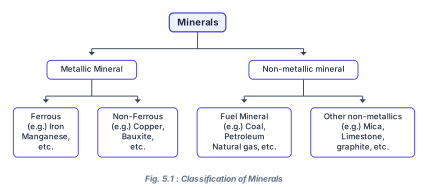
The diagram is a simple tree or flow chart that starts from a single top box labelled Minerals. From that box, two downward arrows branch to two boxes side by side: Metallic Mineral on the left and Non-metallic mineral on the right.
Under Metallic Mineral, two further branches appear. The left branch is Ferrous, with the example list “Iron Manganese, etc.” — meaning minerals that contain iron, like iron ore itself and manganese. The right branch is Non-Ferrous, with examples “Copper, Bauxite, etc.” — these are metallic minerals that do not contain iron.
Under Non-metallic mineral, again two branches. The left one is Fuel Mineral, with examples “Coal, Petroleum Natural gas, etc.” — these are organic in origin, formed from buried plant and animal remains. The right branch is Other non-metallics, with examples “Mica, Limestone, graphite, etc.” — these are inorganic in origin.
The entire chart is a visual summary of the classification given in the textbook text. It shows that the first division is based on whether a mineral is a source of metal (metallic) or not (non-metallic). Then, within metallic minerals, the key distinction is the presence or absence of iron. Within non-metallic minerals, the key distinction is whether the mineral is a fuel (organic) or not (inorganic).
The diagram does not show any further subdivisions beyond these four categories. For example, it does not list precious metals like gold or silver separately — they would fall under non-ferrous metallic minerals. It also does not show any overlap between categories (e.g., graphite is a non-metal but can conduct electricity; the chart treats it purely as an inorganic non-metallic mineral). …