Applied Mathematics · Ch 3 — Differentiation and Its Applications
Maxima and Minima
Maxima and Minima
Beyond knowing where a function rises or falls, it is often just as important to know where it reaches its highest or lowest value overall — its extreme values.
Let be a real function defined on a set . The value , for some , is called the absolute minimum value of on if for every — no value the function takes anywhere else in is smaller. Likewise, is the absolute maximum value of on if for every — no other value is larger.
Absolute minimum at : for all
Absolute maximum at : for all
Whenever attains either its absolute maximum or its absolute minimum at some point in its domain, is said to have an absolute extremum at ; the value itself is called an absolute extremum value, and is called a point of extremum. Locating these points — and telling maxima apart from minima — is what the rest of this chapter's treatment of maxima and minima builds towards, using exactly the derivative tools (critical points, increasing and decreasing behaviour) developed in the previous two sections.
Local maxima and minima
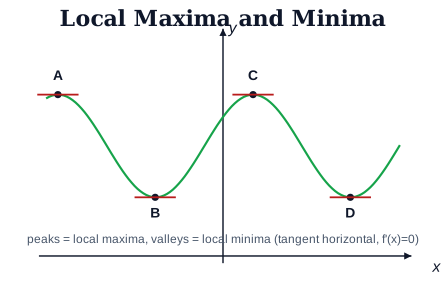
Absolute extrema describe the single highest and lowest values over the whole domain. Very often, though, a function has several "peaks" and "valleys" — points that are highest or lowest only when compared with their immediate surroundings. On the graph of a continuous function these show up as peak-type points (the curve rises to them, then falls) and valley-type points (the curve falls to them, then rises). A point is a local maximum if the curve is increasing just to its left and decreasing just to its right, so is the largest value in a small neighbourhood; it is a local minimum if the curve is decreasing just to its left and increasing just to its right. The tangent at every such peak or valley is parallel to the -axis, so its slope is zero — these are critical points. But not every critical point is an extremum: has and yet is neither a maximum nor a minimum, because the function keeps increasing on both sides (such a point is a point of inflexion).
Formally, let be an interior point of the domain of . Then:
has a local maximum at if there is some with for all ; then is the local maximum value.
has a local minimum at if there is some with for all ; then is the local minimum value.
First derivative test
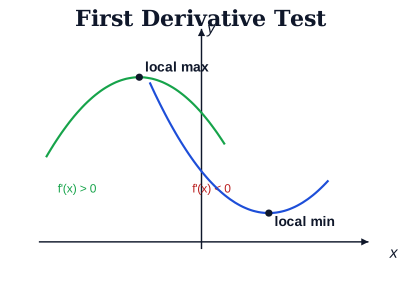
Since the sign of records whether the function is rising or falling, a critical point (at which is continuous) can be classified by watching how changes sign as passes through it:
Local minimum: for and for — changes from negative to positive.
Local maximum: for and for — changes from positive to negative.
Point of inflexion: if does not change sign as increases through , then is neither a maximum nor a minimum.
In words, a sign change from decreasing to increasing marks a valley, a change from increasing to decreasing marks a peak, and no change at all marks an inflexion.
Second derivative test
When the second derivative is easy to compute it gives a quicker test at a critical point where :
If and , then is a point of local minimum and is the local minimum value.
If and , then is a point of local maximum and is the local maximum value.
If the second derivative test fails, and one falls back on the first derivative test to decide whether is a local maximum, a local minimum, or a point of inflexion.
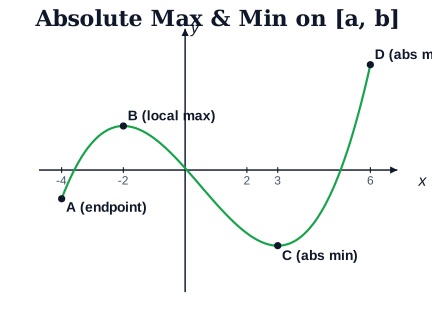
Maximum and minimum values in a closed interval …
Drawn by us to help you understand the concept clearly, and verified to make sure it's accurate. For exams, practice from your NCERT textbook's own diagram.
At each local maximum (peak) and local minimum (valley) the tangent is horizontal, …
Drawn by us to help you understand the concept clearly, and verified to make sure it's accurate. For exams, practice from your NCERT textbook's own diagram.
First derivative test: f' changes + to − at a local maximum and − to + at a …
Drawn by us to help you understand the concept clearly, and verified to make sure it's accurate. For exams, practice from your NCERT textbook's own diagram.
On a closed interval the absolute max/min is the largest/least among the endpoint and local …