Business Studies · Ch 8 — Controlling
Limitations of Controlling
8.3
Limitations of Controlling
Controlling is a necessary function, but it is not a perfect one. Managers must be aware of its built-in weaknesses so they can design control systems that are practical, accepted by people, and worth the money spent. Controlling suffers from four major limitations.
- Difficulty in setting quantitative standards A control system works by comparing actual performance against a standard. The trouble begins when the standard itself cannot be expressed in numbers. Areas like employee morale, job satisfaction, and human behaviour are qualitative — you cannot easily measure them in units or rupees. When standards are vague, measuring performance and judging whether it meets the standard becomes subjective and unreliable. The control system loses much of its effectiveness in such situations.
- Little control on external factors No business operates in a vacuum. External forces — government policies, technological changes, competition, shifts in customer tastes — are entirely outside the manager's control. A control system can only monitor and correct what happens inside the organisation. If a new government regulation suddenly raises costs, or a competitor launches a superior product, the control reports will show the damage but cannot prevent it. This is a fundamental limitation: control is internal, but many threats are external.
- Resistance from employees Employees often see control as a restriction on their freedom, not as a tool for improvement. Being watched — for instance, through CCTV cameras or keystroke monitoring — can feel like a lack of trust. This resistance can take many forms: employees may hide information, follow rules mechanically without using their judgment, or even try to sabotage the control system. For example, employees might object to being kept under a strict watch with the help of Closed Circuit Televisions (CCTVs). When resistance is high, the control system becomes counterproductive.
- Costly affair …
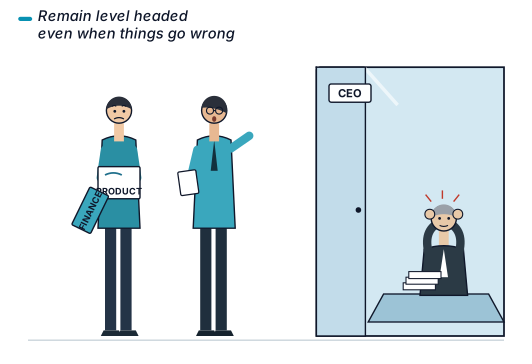
FigureRemain Level Headed Even When Things Go Wrong
Drawn by us to help you understand the concept clearly, and verified to make sure it's accurate. For exams, practice from your NCERT textbook's own diagram.
Our own illustration of why controlling calls for a cool head: when reports reveal that something has gone wrong (a product or finance problem), a level-headed manager studies the deviation calmly instead of panicking — controlling is about correct …