Business Studies · Ch 1 — Nature and Significance of Management
Supervisory or Operational Management
Supervisory or Operational Management
Concept First
Management operates at three levels: top, middle, and lower. The lower level is also called supervisory or operational management. This level is closest to the actual workers and is responsible for directly overseeing day-to-day operations. Without this level, plans made by top management would never be translated into action on the shop floor.
Who Belongs Here?
- Foremen and supervisors are the key positions at this level.
- They form the lowest rung in the management hierarchy.
Key Features
- Direct oversight: Supervisors directly oversee the efforts of the workforce. They are in constant, face-to-face contact with the workers.
- Limited authority: Their authority and responsibility are strictly limited to the plans and instructions drawn up by top management. They do not make broad policy decisions.
- Communication link: They act as a vital bridge — they receive instructions from middle management and pass them on to the workers.
Why Is This Level Important?
Supervisory management plays a very important role in the organisation. Their work directly affects the quality and efficiency of production. Through their efforts, the following are achieved:
- Quality of output is maintained — they ensure work is done correctly.
- Wastage of materials is minimised — they monitor usage and prevent careless loss.
- Safety standards are maintained — they enforce safety rules on the shop floor.
What Depends on the Workers? …
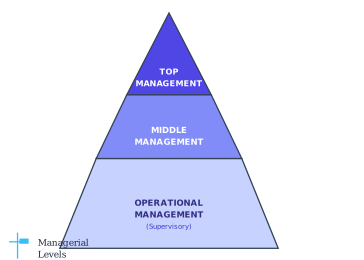
What the Diagram Shows
The diagram is a three-tier pyramid showing the levels of management, arranged from a
narrow apex to a broad base:
- Top Management — the narrow apex (darkest shade): the chairman, CEO, president and other senior-most executives.
- Middle Management — the middle band: division and department heads who link top management to the front line.
- Operational (Supervisory) Management — the broad base (lightest shade): foremen and supervisors who directly oversee the workforce.
What the Shape Means
- The pyramid narrows towards the top and widens towards the base — this is not decorative. The width of each band is proportional to the number of managers at that level.
- Top management has the fewest people, usually a handful of senior executives, but the widest scope of authority and responsibility, since they set goals and strategy for the whole organisation.
- Operational management has the largest number of people, because supervisors are in direct, day-to-day contact with the entire workforce.
- Middle management sits in between on both counts — more managers than the top, fewer than the base — matching its role as the link between the two.
What It Teaches
The pyramid reinforces two ideas together: authority and responsibility increase as you move up the hierarchy (the top has the final say and the ultimate accountability), while
the number of managers decreases as you move up (fewer people are needed to make
organisation-wide decisions than to supervise everyone who carries them out). The narrowing
shape captures both the chain of command — who reports to whom — and the **scalar …