Economics · Ch 13 — Indian Economy 1950-1990
Agriculture
Agriculture
Under colonial rule, Indian agriculture had seen neither growth nor equity. After independence the policy makers tackled these problems mainly through land reforms and the promotion of High Yielding Variety (HYV) seeds, the latter setting off a revolution in Indian farming.
Land reforms
At independence the land tenure system was dominated by intermediaries -- variously called zamindars, jagirdars and so on -- who simply collected rent from the actual tillers of the soil without contributing anything to improving the farm. Productivity was so low that India had to import food from the United States.
Equity in agriculture called for land reforms -- essentially, changes in who owned the land. Just a year after independence, steps were taken to abolish intermediaries and make the tillers the owners. The logic was that ownership gives the tiller an incentive to invest in improvements, provided enough capital is made available, because the owner directly enjoys the profit from higher output. A tenant, by contrast, has little incentive to improve land that mostly benefits the landowner. This incentive effect is illustrated well by a real-world example (see Box 2.5).
Box 2.5: Ownership and Incentives
The policy of 'land to the tiller' is based on the idea that cultivators will take more interest -- have more incentive -- in increasing output if they are the owners of the land, because ownership of land enables the tiller to make a profit from the increased output. Tenants do not have the same incentive to make improvements on land, since it is the landowner who would benefit more from higher output.
The importance of ownership in providing incentives is well illustrated by the carelessness with which farmers in the former Soviet Union used to pack fruits for sale. It was not uncommon to see farmers packing rotten fruits along with fresh fruits in the same box -- even though every farmer knows the rotten fruits will spoil the fresh ones, resulting in a loss since the fruits cannot then be sold. The answer lies in the incentives facing the farmers: since farmers in the former Soviet Union did not own any land, they neither enjoyed the profits nor suffered the losses, so in the absence of ownership there was no incentive on their part to be efficient -- which also helps explain the poor performance of the agricultural sector in the Soviet Union despite the availability of vast areas of highly fertile land.
Source: Thomas Sowell, Basic Economics: A Citizen's Guide to the Economy, New York: Basic Books, 2004, Second Edition.
A second reform was the land ceiling -- fixing the maximum area of land any one individual could own -- aimed at reducing the concentration of ownership in a few hands.
Results and shortcomings of land reforms
Abolishing intermediaries brought about 200 lakh tenants into direct contact with the government, freeing them from exploitation by zamindars, and the ownership they gained encouraged them to increase output, contributing to agricultural growth. But the equity goal was not fully met:
- In some areas former zamindars kept large holdings by exploiting loopholes in the law.
- There were cases of tenants being evicted, with landowners claiming to be self-cultivators.
- Even where tillers did get ownership, the very poorest -- sharecroppers and landless labourers -- gained nothing.
- The land-ceiling law was challenged in court by big landlords, who used the resulting delay to register land in relatives' names and otherwise escape the legislation, which itself had many loopholes.
Land reforms genuinely succeeded only in Kerala and West Bengal, where governments were committed to the policy of 'land to the tiller'. Elsewhere the commitment was weaker, and large inequalities in landholding persist to this day.
The Green Revolution
At independence about 75 per cent of the population depended on agriculture, yet productivity was very low because of old technology and a lack of infrastructure. Farming depended vitally on the monsoon: a poor monsoon spelt trouble for the many farmers without irrigation. The stagnation inherited from colonial times was permanently broken by the Green Revolution -- the large rise in food-grain production that came from using HYV seeds, especially for wheat and rice.
HYV seeds are demanding: they need fertiliser and pesticide in the right amounts and a regular water supply, all applied in correct proportions. So farmers using them needed reliable irrigation and the money to buy inputs.
- First phase (roughly mid-1960s to mid-1970s): HYV use was confined to the more prosperous states such as Punjab, Andhra Pradesh and Tamil Nadu, and mainly benefited wheat-growing regions.
- Second phase (mid-1970s to mid-1980s): the technology spread to more states and to a wider variety of crops.
The Green Revolution let India achieve self-sufficiency in food grains, so it no longer had to depend on America or any other nation for food.
Marketed surplus
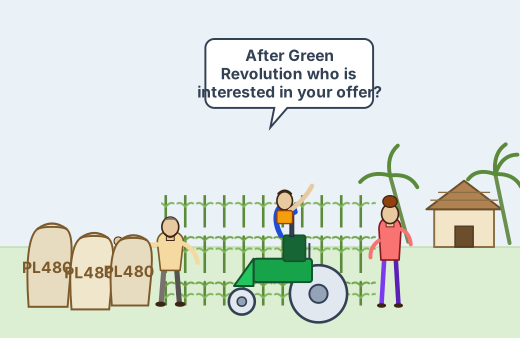
Drawn by us to help you understand the concept clearly, and verified to make sure it's accurate. For exams, practice from your NCERT textbook's own diagram.
Own-drawn recreation of the NCERT cartoon (p.25): dramatises how the Green Revolution's marketed surplus ended India's dependence on US PL-480 food aid. Scene, dialogue and labels are the book's own facts, reproduced from a fact-checklist (older man with 3 PL480 sacks, a young farmer on a two-wheel-front tractor amid crop rows, the exact speech-bubble line, a woman and thatched village house with palms in t …
Growth in output matters only if the extra produce actually reaches the economy. If farmers consume most of the increase themselves, it makes little difference; if a large share is sold, it does. The portion of produce that farmers sell in the market is called the marketed surplus. A good proportion of the rice and wheat of the Green Revolution period was sold, so food-grain prices fell relative to other goods -- which especially helped low-income groups, who spend a large share of their income on food. The larger output also let the government procure and stock food grains to draw on in times of shortage.
Risks and how they were handled
The technology was not risk-free. It threatened to widen the gap between small and big farmers, since only big farmers could easily afford the inputs, and HYV crops were more prone to pest attacks that could ruin a small farmer. These fears were largely averted by government action: low-interest loans to small farmers and fertiliser subsidies gave small farmers access to inputs, so in time small-farm output matched large-farm output and both groups benefited. Government research institutes greatly reduced the risk from pests. The key point is that the Green Revolution would have favoured only the rich farmers had the state not actively ensured that small farmers also gained.
The debate over subsidies
Whether agriculture should be subsidised is hotly debated.
- Against continuing subsidies: subsidies were justified initially to encourage farmers -- especially small ones -- to try the risky new technology; but once the technology is proven and widely adopted, that purpose is served and subsidies should be phased out. Moreover, much of the fertiliser subsidy actually benefits the fertiliser industry, and among farmers it goes largely to those in prosperous regions -- so it fails the target group while burdening government finances (see also Box 2.6).
- For continuing subsidies: farming in India remains risky and most farmers are very poor, so without subsidies they could not afford the required inputs; removing subsidies would worsen inequality and violate equity. If subsidies really are being captured by industry and big farmers, the right response is not to abolish them but to ensure only poor farmers benefit.
Box 2.6: Prices as Signals
Prices are signals about the availability of goods. If a good becomes scarce, its price will rise, and those who use the good will have the incentive to make efficient decisions about its use based on the price. If the price of water goes up because of lower supply, people will have the incentive to use it with greater care -- for example, they may stop watering the garden to conserve water. We complain whenever the price of petrol increases and blame it on the government, but the increase in petrol price reflects greater scarcity, and the price rise is a signal that less petrol is available -- this provides an incentive to use less petrol or look for alternate fuels.
Subsidies do not allow prices to indicate the supply of a good. When electricity and water are provided at a subsidised rate or free, they will be used wastefully without any concern for their scarcity. Farmers will cultivate water-intensive crops if water is supplied free, even where water in that region may be scarce, and such crops will further deplete the already scarce resource. If water is priced to reflect scarcity, farmers will cultivate crops suitable to the region. Fertiliser and pesticide subsidies similarly result in overuse of resources, which can be harmful to the environment. Subsidies provide an incentive for the wasteful use of resources -- worth thinking about in terms of incentives when asking whether it is wise, from the economic viewpoint, to provide free electricity to farmers.
The persistence of agricultural employment …
| Sector | 1950-51 | 1990-91 |
|---|---|---|
| Agriculture | 72.1 | 66.8 |
| Industry | 10.7 | 12.7 |