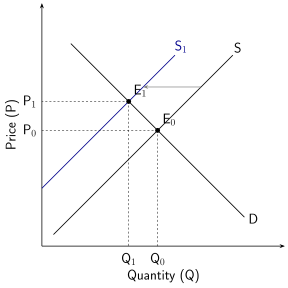
Q.The market for a good is in equilibrium. How would an increase in an input price affect the equilibrium price and equilibrium quantity, keeping other factors constant? Explain using a diagram.
You're viewing a preview — the full solution, concept, methods & PYQ mapping are locked.
Start your 14-day free trial to unlock the full solution →An increase in input price shifts the supply curve leftward (decrease in supply), raising the equilibrium price and lowering the equilibrium quantity, while demand remains unchanged.
The Economic Intuition
Think of input prices as the cost of the ingredients that go into making a good. When an input price rises — say, the cost of steel for car manufacturing or the price of wheat for bread — producers find it more expensive to produce each unit. This directly affects their willingness to supply at any given price.
A firm's supply decision depends on profitability. If input costs go up, the profit margin on each unit shrinks. To maintain the same profit level, producers will now require a higher price to supply the same quantity. Alternatively, at the current market price, they will supply less than before. This is a classic decrease in supply — the entire supply curve shifts to the left.
What Happens to the Curves
The demand curve does not move here. The change is entirely on the supply side. The question explicitly says "keeping other factors constant," which means consumer preferences, income, and prices of related goods remain unchanged. So demand stays exactly where it was.
The leftward shift of the supply curve means that at every price, producers are willing to offer fewer units. Graphically, the supply curve moves inward toward the vertical axis.
The New Equilibrium
At the original equilibrium price, there is now a shortage — quantity demanded exceeds the new, lower quantity supplied. This shortage puts upward pressure on price. As price rises, two things happen:
- Quantity demanded falls (buyers move up along the demand curve, responding to the higher price).
- Quantity supplied increases (producers move up along the new supply curve, responding to the higher price).
The process continues until a new equilibrium is reached where quantity demanded again equals quantity supplied. At this new point:
- Equilibrium price is higher than before.
- Equilibrium quantity is lower than before.
A common mistake is to think that higher input costs make firms "produce less" at the same price, which is correct — but students sometimes confuse this with a movement along the supply curve. It is not. The entire supply curve shifts left. The price change that follows is a consequence of that shift, not the cause of it.
Describing the Diagram
Unlock everything free for 14 days
- Full step-by-step solutions
- Concept-first explanations
- Methods, shortcuts & mistakes
- PYQ mapping + timed mock tests
Full access for 14 days. No credit card required.