Economics · Ch 2 — National Income Accounting
Some Macroeconomic Identities
Some Macroeconomic Identities
2.3 Some Macroeconomic Identities
From GDP to GNP: The Boundary Shifts
Gross Domestic Product measures the aggregate production of final goods and services within a country's domestic territory during a year. But the whole of that output does not necessarily accrue to the citizens of that country. Consider an Indian citizen working in Saudi Arabia. Her wage is part of Saudi Arabia's GDP, not India's. Yet legally, she is an Indian. How do we account for earnings made by Indians abroad, or by factors of production owned by Indians?
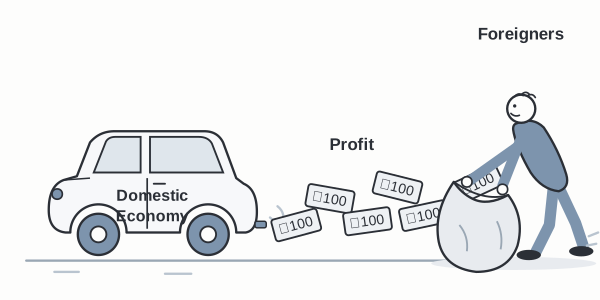
To maintain symmetry, we must also deduct the earnings of foreigners working within our domestic economy, and the payments to factors of production owned by foreigners. For instance, the profits earned by the Korean-owned Hyundai car factory in India must be subtracted from India's GDP when calculating what Indians actually earn.
Drawn by us to help you understand the concept clearly, and verified to make sure it's accurate. For exams, practice from your NCERT textbook's own diagram.
Profit produced inside the domestic economy can flow out to foreigners — for example, the profit of a foreign-owned factory in India accrues to owners abroad. That is why, to move from GDP to GNP, we add what our residents earn abroad and subtract what forei …
This is where Gross National Product (GNP) enters the picture. GNP is defined as:
Where Net factor income from abroad (NFIA) is:
So the full identity is:
The key distinction: GDP is location-based (within the country's borders), while GNP is citizenship-based (what the country's residents earn, regardless of where they earn it).
From GNP to NNP: Accounting for Depreciation
A part of the capital stock gets consumed during the year due to wear and tear — this is called depreciation. Depreciation does not become part of anybody's income; it represents the using up of existing capital. If we deduct depreciation from GNP, we obtain Net National Product (NNP).
All these variables — GDP, GNP, NNP — are evaluated at market prices. So the NNP we get from the above expression is NNP at market prices.
From Market Prices to Factor Cost: The Role of Indirect Taxes and Subsidies
Market prices include indirect taxes. When the government imposes indirect taxes on goods and services, their prices rise. These indirect taxes accrue to the government, not to the factors of production. To find the income that actually reaches the factors of production, we must deduct indirect taxes from NNP at market prices.
Similarly, the government may grant subsidies on some commodities (in India, petrol is heavily taxed while cooking gas is subsidised). Subsidies lower the market price below what producers actually receive. So we need to add subsidies to NNP at market prices.
The measure we obtain is called Net National Product at factor cost, or simply National Income (NI).
The term is called Net indirect taxes.
So we can also write:
A common mistake is to forget that subsidies are subtracted from indirect taxes, not added. Net indirect taxes = Indirect taxes − Subsidies. If subsidies exceed indirect taxes, net indirect taxes become negative, and National Income would be larger than NNP at market prices.
From National Income to Personal Income
National Income can be further subdivided. Let us find the expression for the part of NI that is actually received by households — this is called Personal Income (PI).
Out of NI, which is earned by firms and government enterprises, a part of profit is not distributed among the factors of production. This is called Undistributed Profits (UP). Since UP does not accrue to households, we must deduct it from NI.
Similarly, Corporate Tax, imposed on the earnings of firms, must also be deducted from NI because it does not reach households.
Households receive interest payments from private firms or the government on past loans they advanced. But households may also have to pay interest to firms and the government if they borrowed money. So we deduct the net interest payments made by households to firms and the government.
Households also receive transfer payments from government and firms — pensions, scholarships, prizes, for example. These must be added to calculate Personal Income.
From Personal Income to Personal Disposable Income
Even Personal Income is not the income over which households have complete control. They must pay taxes from PI. If we deduct Personal Tax Payments (such as income tax) and Non-tax Payments (such as fines) from PI, we obtain Personal Disposable Income (PDI).
Personal Disposable Income is the part of aggregate income that belongs to households. They may decide to consume a part of it and save the rest.
Diagrammatic Representation
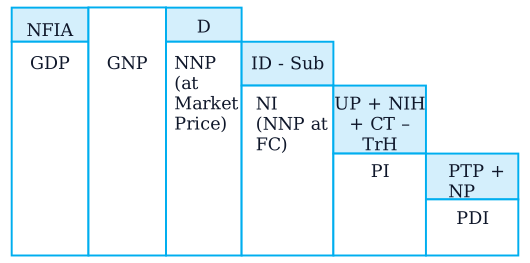
The textbook presents Figure 2.3, which shows the relationships between these major macroeconomic variables in a flow diagram. The diagram traces the following path:
Starting from GDP, we add NFIA (Net Factor Income from Abroad) to get GNP. From GNP, we subtract D (Depreciation) to reach NNP at Market Prices. From NNP at market prices, we subtract Net Indirect Taxes (Indirect Taxes minus Subsidies) to obtain NI (NNP at Factor Cost). From NI, we subtract UP (Undistributed Profits), NIH (Net Interest Payments by Households), and CT (Corporate Tax), and add TrH (Transfers received by Households) to get PI (Personal Income). Finally, from PI we subtract PTP (Personal Tax Payments) and NP (Non-tax Payments) to reach PDI (Personal Disposable Income).
Drawn by us to help you understand the concept clearly, and verified to make sure it's accurate. For exams, practice from your NCERT textbook's own diagram.
Figure 2.3 arranges the national income aggregates as a staircase of six columns that all stand on the same baseline and descend from left to right. Each column pairs a small shaded box on top — the adjustment made at that step — with a taller open box below it — the aggregate that remains. Reading left to right:
- The first column stacks NFIA (Net Factor Income from Abroad) on top of GDP. Here the shaded box is an addition: GDP plus NFIA together stand exactly as tall as the next column, GNP — so GNP = GDP + NFIA.
- The GNP column is matched by the third column, which carries D (Depreciation) above NNP (at Market Price): deduct depreciation from GNP, and NNP at market prices is what remains.
- Above NI (NNP at FC) sits the shaded box ID − Sub (Indirect Taxes minus Subsidies, i.e. net indirect taxes): NI = NNP at market prices − (ID − Sub). This strips out the wedge that government taxes and subsidies drive between market prices and what the factors of production actually earn.
- Above PI (Personal Income) sits the cluster UP + NIH + CT − TrH: from NI, subtract Undistributed Profits, Net Interest Payments made by Households and Corporate Taxes, and add Transfers received by Households — PI = NI − UP − NIH − CT + TrH.
- Above PDI (Personal Disposable Income) sits PTP + NP (Personal Tax Payments plus Non-tax Payments): PDI = PI − PTP − NP.
Because every column shares the same baseline, each aggregate's height literally equals the previous aggregate minus (or, for NFIA, plus) its shaded adjustment — the identities are drawn as geometry, with no arrows anywhere in the figure.
The figure is a derivation chain, not a classification tree. Each shaded box records the specific subtraction (or, for NFIA, addition) that turns one aggregate into the next. Memorising the order of the steps and what each abbreviation stands for is the key to the numerical problems in the exercises. …
National Disposable Income and Private Income
Apart from the categories above, Indian national income accounting uses two additional aggregate income categories.
National Disposable Income gives an idea of the maximum amount of goods and services the domestic economy has at its disposal.
Current transfers from the rest of the world include items such as gifts and aids.
Private Income is defined as:
The Basic National Income Aggregates
The textbook presents Table 2.4, which systematically lists the basic national income aggregates used in India (following the System of National Accounts 2008, or SNA2008, given by the United Nations in partnership with other agencies). India shifted to these aggregates a few years back.
| Aggregate | Definition / Formula |
|---|---|
| 1. Gross Domestic Product at Market Prices (GDP) | Market value of all final goods and services produced within the domestic territory of a country in a year. All production by national residents or non-residents gets included, regardless of ownership. Everything valued at market prices. |
| 2. GDP at Factor Cost (GDP) | Gross domestic product at market prices, less net product taxes. Factor cost = market prices minus net indirect taxes. |
| 3. Net Domestic Product at Market Prices (NDP) | |
| 4. NDP at Factor Cost (NDP) | Income earned by factors in the form of wages, profits, rent, interest, etc., within the domestic territory. |