Computer Science · Ch 4 — Queue
Introduction to Deque
Introduction to Deque
A deque (pronounced “deck”) is a data structure where elements can be added or removed from either end — the front (head) or the rear (tail). Unlike a standard queue or stack, a deque does not force you to pick one side for insertion and the opposite side for deletion. You can push or pop from both ends freely.
Because of this flexibility, a deque can be used to implement either a stack or a queue in a program. If you restrict operations to only one end, it behaves like a stack (LIFO). If you allow insertion at one end and deletion from the other, it behaves like a queue (FIFO). The deque itself does not impose either restriction — it is a general-purpose double-ended structure.
The name “deque” is short for double-ended queue. The basic structure has two ends labelled front (head) and rear (tail), and both ends support two operations:
- Push (insertion) — can happen at the front or the rear.
- Pop (deletion) — can happen at the front or the rear.
Figure 4.4 in the textbook illustrates this: the front end shows both a push and a pop arrow, and the rear end also shows both a push and a pop arrow. This symmetry is what makes the deque different from a simple queue or stack. …
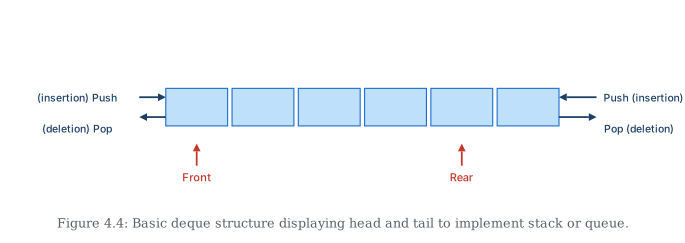
Drawn by us to help you understand the concept clearly, and verified to make sure it's accurate. For exams, practice from your NCERT textbook's own diagram.
A deque (double-ended queue) is a queue that relaxes the single-entry-point rule: insertion (Push) and deletion (Pop) are both allowed at EITHER end — the Front and the Rear — not just insert-at-rear/delete-at-front like an ordinary queue.
That's why the figure shows two separate arrows at each end: at the Front, one arrow for Push (adding an element there) and one for Pop (removing from there); the Rear end mirrors this with its own Push and Pop arrows. Because both ends support both operations, a deque is flexible enough to behave like a stack (if you only ever push/pop from one end) o …