Informatics Practices · Ch 5 — Internet and Web
Mesh Topology
Mesh Topology
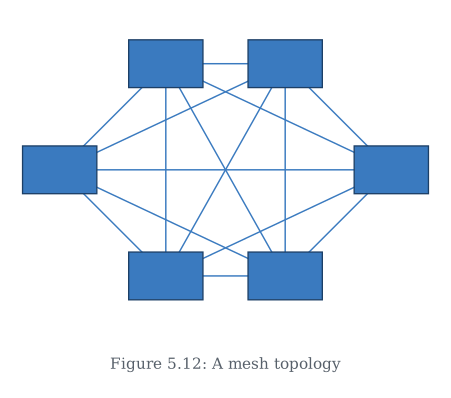
In a mesh topology, every device in the network is directly connected to every other device. This creates a web of point-to-point links, as shown in Figure 5.12 of the textbook. Because each node has a dedicated connection to every other node, the network can handle large amounts of traffic — multiple nodes can transmit data simultaneously without interfering with one another.
Reliability is a major strength of this design. If one node fails or goes down, the rest of the network continues to function without any break in transmission between the remaining nodes. There is no single point of failure. Security is also higher compared to other topologies, because each cable carries data meant only for the two specific nodes it connects — no other device on the network can intercept that data. …
Drawn by us to help you understand the concept clearly, and verified to make sure it's accurate. For exams, practice from your NCERT textbook's own diagram.
The diagram shows a set of circular nodes, each representing a communicating device (like a computer or a router). These nodes are arranged in a loose ring around the page, not in any strict geometric pattern — they are simply spread out so that the connections between them are visible.
From every single node, a separate cable is drawn directly to every other node. This means if there are, say, six nodes in the diagram, you would see five cables radiating from each node, each going to a different destination. The cables criss-cross the figure in a dense, web-like tangle. There is no central hub or switch; each link is a dedicated, point-to-point connection between exactly two devices.
What the figure teaches is the core idea of a mesh topology: full connectivity. Because every device has its own private link to every other device, data can travel along many different paths simultaneously. The diagram makes it visually clear why this topology is reliable — if one node fails, the rest of the network still has direct connections among themselves, so no single break stops all communication. It also shows why the topology is secure: each cable carries only the traffic meant for its two endpoints, so no other device can eavesdrop on that link. …