Physical Education · Ch 10 — Training in Sports
Introduction to Sports Training Cycle - Micro, Meso, Macro Cycle
Introduction to Sports Training Cycle - Micro, Meso, Macro Cycle
Sports training is never left to chance; it is organised through a family of planning systems. A sportsperson follows all of these to reach high performance in a chosen sport. The plans range from the long-term plan through the Olympic plan, annual plan and sectional plan down to the day's plan. Together they form one unified basis for training, and the pursuit of several years marks the main line of development. The shorter the plan, the more concrete and specific its content — and every short-duration plan is worked out to serve the requirements of the longer plans.
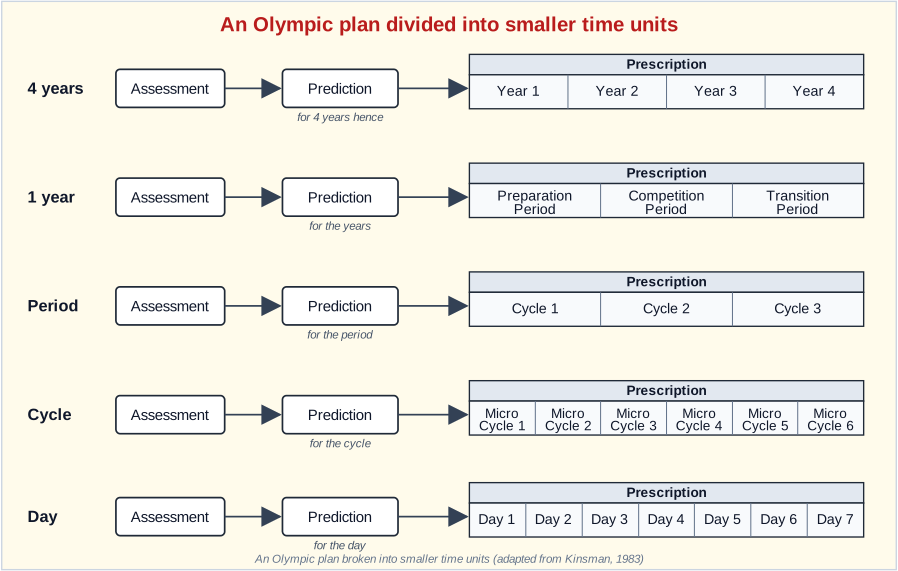
The long-term plan is the largest unit in the whole system of planned training. It runs for roughly 8 to 15 years, beginning with the sportsperson's basic training and continuing until they attain optimum performance in their specific sport. The figure below shows how an Olympic plan is broken down into progressively smaller time units, each with its own assessment, prediction and prescription.
Drawn by us to help you understand the concept clearly, and verified to make sure it's accurate. For exams, practice from your NCERT textbook's own diagram.
Five stacked rows, one per time unit (4 years, 1 year, period, cycle, day). In each row an 'Assessment' box leads to a 'Prediction' box, which leads to a 'Prescription' that lists the next smaller units: Year 1-4; then Preparation / Competition / Transition periods; then Cycle 1-3; then Micro …
A sectional plan is the planning layer most common in everyday training. Sectional plans are plans of phases, periods and weeks: the preparatory, competition and transitional periods of the training year, together with the micro, meso and macro cycles, are all sectional plans. They are prepared from the needs and recommendations of the annual plan, and because they are shorter, the training detail they carry is far more specific.
The three training cycles
(a) Micro Cycle. The shortest cycle, lasting 3 to 10 days (5 to 10 days for intermediate and high-performance athletes). The last day provides active recovery and relaxation to prepare the athlete for the next micro cycle. Although 5-10 days is too short to achieve most training tasks, it is an integral part of the whole process. Three proportions of high to medium-or-low load are commonly used:
- 1:1 — each high-load day is followed by a medium-load day.
- 2:1 — every two high-load days are followed by a medium-load day.
- 3:1 — every three high-load days are followed by a medium or low-load day.
(b) Meso Cycle. A medium-duration cycle of 3 to 6 weeks, used to tackle specific training tasks:
- learning and mastering skills;
- maintaining and stabilising performance;
- developing physical and motor-fitness components;
- preparing for a specific competition;
- attaining the optimal level of performance;
- preparing for the next mesocycle through recovery and relaxation.
A 4-week mesocycle is considered the best, because this is the minimum period within which a meaningful change occurs in the physiological and psychological factors. The last week is treated as a transitional phase that ensures recovery and relaxation.
(c) Macro Cycle. The longest cycle, running 3 to 12 months. Its purpose is to raise the sportsperson's performance capacity so they can produce an optimal performance at a specific target time during competition. A macrocycle is made up of several mesocycles, and its last mesocycle ensures recovery for a smooth transition into the following macrocycle. …