Biology · Ch 13 — Biodiversity and Conservation
How Many Species are there on Earth and How Many in India?
How Many Species are there on Earth and How Many in India?
The first question that arises when we study biodiversity is a simple one: how many species actually exist on Earth? We have published records of every species that has been discovered and formally named, so we know exactly how many have been documented so far. But the real challenge is estimating how many remain unknown.
According to the International Union for Conservation of Nature and Natural Resources (IUCN), as of 2004, the total number of plant and animal species described is slightly more than 1.5 million. That sounds like a lot, but it is only a fraction of what probably exists. No one knows the true number. Estimates vary wildly, and many are little more than educated guesses.
Why is it so hard to count? One major reason is that species inventories are far more complete for temperate regions than for tropical ones. Since the vast majority of undiscovered species are expected to be in the tropics, biologists use a clever method: they take a well-studied group of insects, compare its species richness in temperate versus tropical areas, and extrapolate that ratio to other groups of plants and animals. This gives a rough global estimate.
Some extreme estimates range from 20 to 50 million species. However, a more conservative and scientifically sound estimate, made by the biologist Robert May, places global species diversity at about 7 million.
What the current inventories tell us about Earth's biodiversity
- More than 70 per cent of all recorded species are animals. Plants (including algae, fungi, bryophytes, gymnosperms, and angiosperms) make up no more than 22 per cent of the total.
- Among animals, insects are the most species-rich group, accounting for more than 70 per cent of all animal species. In other words, out of every 10 animals on the planet, 7 are insects. This raises the fascinating question of why insects have diversified so enormously.
- The number of fungal species in the world exceeds the combined total of fishes, amphibians, reptiles, and mammals.
These figures do not include prokaryotes. Biologists are uncertain about the number of prokaryotic species because conventional taxonomic methods are unsuitable for identifying microbes, and many species simply cannot be cultured in a laboratory. If we use biochemical or molecular criteria to define species in this group, their diversity alone could run into millions.
India's share of global biodiversity
Although India occupies only 2.4 per cent of the world's land area, its share of global species diversity is an impressive 8.1 per cent. This is what makes India one of the 12 mega-diversity countries of the world.
Nearly 45,000 species of plants and twice as many animals have been recorded from India. But how many more are waiting to be discovered? If we accept Robert May's global estimate that only 22 per cent of all species have been recorded so far, and apply that proportion to India's figures, we get a startling picture:
| Group | Recorded so far | Estimated species yet to be discovered (additional to those already recorded) |
|-------|----------------|------------------------------------------| …
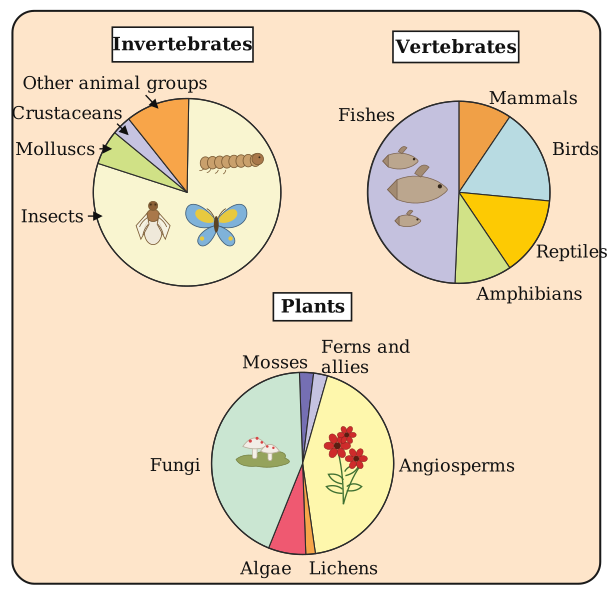
Drawn by us to help you understand the concept clearly, and verified to make sure it's accurate. For exams, practice from your NCERT textbook's own diagram.
The figure is three separate pie charts — Invertebrates, Vertebrates, and Plants — each broken into its own named sub-groups by proportionate number of species. It is not a single chart; the three groups are not shown relative to each other on the same pie.
Invertebrates is dominated by a single huge wedge for insects — consistent with the text's point that insects alone make up more than 70% of all animal species. The remaining, much smaller wedges are molluscs, crustaceans, and other animal groups.
Vertebrates is split into fishes (the largest wedge), birds, reptiles, mammals, and amphibians (the smallest).
Plants is split into fungi (technically not a plant, but grouped here as in the book), angiosperms, algae, lichens, mosses, and ferns and allies — with fungi and angiosperms together making up most of the wedge. …