Q.Define ecological pyramids and describe with examples, pyramids of number and biomass.
You're viewing a preview — the full solution, concept, methods & PYQ mapping are locked.
Start your 14-day free trial to unlock the full solution →Ecological pyramids are graphical representations illustrating the trophic structure and function of an ecosystem, showing the relationship between different trophic levels in terms of number, biomass, or energy.
Every ecosystem is characterised by the flow of energy and the cycling of nutrients. Organisms interact with each other and their physical environment, forming complex relationships. A fundamental aspect of these interactions is how energy is transferred from one organism to another, creating what we call food chains and food webs. To better understand these trophic relationships and the quantitative aspects of an ecosystem, ecologists use a concept known as ecological pyramids.
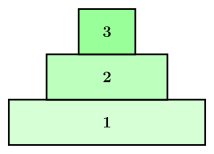
An ecological pyramid is a graphical representation that shows the relationship between different trophic levels in an ecosystem. The base of the pyramid always represents the producers (first trophic level), while the subsequent tiers represent primary consumers (herbivores), secondary consumers (primary carnivores), and tertiary consumers (secondary carnivores), moving upwards towards the apex. These pyramids were first introduced by Charles Elton in 1927. They help us visualise the quantitative differences in the number of individuals, biomass, or energy content at each successive trophic level.
The base of any ecological pyramid always represents the producers, and the apex represents the top consumers.
There are three main types of ecological pyramids:
- Pyramid of Number: Represents the number of individual organisms at each trophic level.
- Pyramid of Biomass: Represents the total mass of living organisms (biomass) at each trophic level.
- Pyramid of Energy: Represents the total energy content at each trophic level.
Let us delve into the pyramids of number and biomass with examples.
Pyramid of Number
A pyramid of number illustrates the count of individual organisms at each trophic level. The shape of this pyramid can vary depending on the specific ecosystem.
-
Upright Pyramid of Number:
In most ecosystems, particularly grasslands and pond ecosystems, the pyramid of number is upright. This means that the number of individuals decreases progressively at successive trophic levels. For instance, in a grassland ecosystem, there are numerous grasses (producers). These grasses support a smaller number of herbivores, such as rabbits or deer. In turn, these herbivores support an even smaller number of carnivores, like foxes or wolves. The number of organisms steadily declines from the base to the apex.
NoteAn upright pyramid of number is the most common type observed in nature, reflecting the general principle that a larger base of producers is needed to support fewer consumers.
-
Inverted Pyramid of Number:
In some cases, the pyramid of number can be inverted. A classic example is a single large tree ecosystem: consider one large tree (producer). This single producer can support a large number of insects feeding on it (primary consumers), and those insects, in turn, can support a smaller — but still greater-than-one — number of birds (secondary consumers) that feed on the insects. Because the base (one tree) is narrower than the level above it, the pyramid is inverted at its base, even though it may narrow again from insects to birds.
Pyramid of Biomass
A pyramid of biomass represents the total dry weight or total living organic matter (biomass) present at each trophic level at a particular time.
-
Upright Pyramid of Biomass:
In most terrestrial ecosystems, the pyramid of biomass is upright. This means that the total biomass of producers is much greater than that of the primary consumers, which in turn is greater than that of the secondary consumers, and so on. For example, in a forest ecosystem, the collective biomass of trees (producers) is enormous. This vast biomass supports a smaller total biomass of herbivores like deer and elephants. These herbivores, in turn, support an even smaller total biomass of carnivores like tigers or lions. The biomass decreases progressively at each higher trophic level.
-
Inverted Pyramid of Biomass: …
Unlock everything free for 14 days
- Full step-by-step solutions
- Concept-first explanations
- Methods, shortcuts & mistakes
- PYQ mapping + timed mock tests
Full access for 14 days. No credit card required.