Biology · Ch 11 — Organisms and Populations
Population Interactions
Population Interactions
In nature, no species lives alone. Even a plant that makes its own food cannot survive in isolation — it needs soil microbes to break down organic matter and return inorganic nutrients, and it needs animals for pollination. Every habitat is a web of interactions between populations of different species. These interactions between two species are called interspecific interactions, and they can be beneficial, harmful, or neutral for the species involved.
Biologists use a simple shorthand to describe the outcome for each species: a ‘+’ sign means the species benefits, a ‘–’ sign means it is harmed, and a ‘0’ means it is neither helped nor harmed. The table below summarises all the possible types of interaction.
| Effect on Species A | Effect on Species B | Name of Interaction |
|---|---|---|
| + | + | Mutualism |
| – | – | Competition |
| + | – | Predation |
| + | – | Parasitism |
| + | 0 | Commensalism |
| – | 0 | Amensalism |
Notice that in mutualism both species gain, and in competition both lose. In predation and parasitism, one species benefits (the predator or parasite) while the other is harmed (the prey or host). In commensalism, one benefits and the other is unaffected. In amensalism, one is harmed and the other is unaffected. Predation, parasitism, and commensalism share one feature: the interacting species live closely together.
(i) Predation
Predation is nature’s way of transferring the energy fixed by plants to higher trophic levels. When we think of a predator, the tiger and deer come to mind, but a sparrow eating a seed is also a predator. In a broad ecological sense, herbivores (animals that eat plants) are not very different from predators.
Roles of predators beyond energy transfer:
- They keep prey populations under control. Without predators, prey species could reach very high densities and destabilise the ecosystem.
- When an exotic species is introduced into a new area where it has no natural predators, it can become invasive. For example, the prickly pear cactus introduced into Australia in the early 1920s spread rapidly across millions of hectares of rangeland. It was brought under control only after a cactus-feeding moth from its natural habitat was introduced. This is the basis of biological control in agriculture.
- Predators help maintain species diversity in a community by reducing the intensity of competition among prey species. In a famous field experiment on the rocky intertidal coast of the American Pacific, when the starfish Pisaster (an important predator) was removed, more than ten species of invertebrates became extinct within a year due to interspecific competition.
Why predators are ‘prudent’: If a predator is too efficient and overexploits its prey, the prey may become extinct, and then the predator will also starve. So, in nature, predators do not usually wipe out their prey completely.
Defences of prey species:
- Cryptic colouration (camouflage): Many insects and frogs are coloured to blend with their surroundings, making them hard to detect.
- Poison or distastefulness: Some animals are poisonous and are avoided by predators. The Monarch butterfly is highly distasteful to birds because of a chemical it acquires as a caterpillar by feeding on a poisonous weed.
Defences of plants against herbivores: Plants cannot run away, so they have evolved an astonishing variety of defences.
- Morphological defences: Thorns (as in Acacia and cactus) are the most common.
- Chemical defences: Many plants produce chemicals that make herbivores sick, inhibit feeding or digestion, disrupt reproduction, or even kill them. For example, the weed Calotropis produces highly poisonous cardiac glycosides, which is why cattle and goats never browse on it. Many commercially extracted substances — nicotine, caffeine, quinine, strychnine, opium — are actually plant defences against grazers and browsers.
(ii) Competition
Darwin believed interspecific competition is a potent force in evolution. Competition is generally thought to occur when closely related species compete for the same limiting resources, but this is not entirely true.
Key points about competition:
- Totally unrelated species can also compete. For example, in some shallow South American lakes, visiting flamingoes and resident fishes compete for the same food — zooplankton.
- Resources need not be limiting for competition to occur. In interference competition, the feeding efficiency of one species is reduced simply by the interfering presence of another species, even if food and space are abundant.
- Competition is best defined as a process in which the fitness of one species (measured by its intrinsic rate of increase, r) is significantly lower in the presence of another species.
Evidence for competition in nature:
- Competitive exclusion: In laboratory experiments, when resources are limited, the competitively superior species eventually eliminates the other. In nature, strong circumstantial evidence exists. For example, the Abingdon tortoise in the Galapagos Islands became extinct within a decade after goats were introduced, apparently because goats were more efficient browsers.
- Competitive release: A species whose distribution is restricted by a competitively superior species will expand its range dramatically when the competing species is removed. Connell’s field experiments on the rocky coasts of Scotland showed that the larger barnacle Balanus dominates the intertidal zone and excludes the smaller Chthamalus.
Gause’s Competitive Exclusion Principle: This principle states that two closely related species competing for the same resources cannot co-exist indefinitely; the competitively inferior one will eventually be eliminated. This holds true when resources are limiting, but not otherwise.
Co-existence mechanisms: More recent studies show that species facing competition may evolve mechanisms that promote co-existence rather than exclusion. One such mechanism is resource partitioning — if two species compete for the same resource, they can avoid competition by choosing different times for feeding or different foraging patterns. MacArthur showed that five closely related species of warblers living on the same tree were able to co-exist due to behavioural differences in their foraging activities.
(iii) Parasitism
Parasitism is a mode of life that ensures free lodging and meals. It has evolved in many taxonomic groups, from plants to higher vertebrates.
Key features of parasites:
- Many parasites are host-specific — they can parasitise only a single species of host. This leads to co-evolution: if the host evolves mechanisms to resist the parasite, the parasite must evolve counter-mechanisms to remain successful.
- Parasites have evolved special adaptations: loss of unnecessary sense organs, presence of adhesive organs or suckers, loss of the digestive system, and high reproductive capacity.
- Life cycles are often complex, involving one or two intermediate hosts or vectors. For example, the human liver fluke (a trematode) depends on a snail and a fish as intermediate hosts. The malarial parasite needs a mosquito vector to spread.
Effects on the host: Most parasites harm the host — they reduce survival, growth, and reproduction, and may make the host more vulnerable to predation by weakening it.
Types of parasites:
- Ectoparasites: Feed on the external surface of the host. Examples: lice on humans, ticks on dogs, ectoparasitic copepods on marine fish. Cuscuta (a parasitic plant) grows on hedge plants, has lost its chlorophyll and leaves, and derives nutrition from the host. (Note: The female mosquito is not considered a parasite even though it needs blood for reproduction — can you explain why?)
- Endoparasites: Live inside the host body at different sites (liver, kidney, lungs, red blood cells, etc.). Their life cycles are more complex due to extreme specialisation. Their morphological and anatomical features are greatly simplified, while reproductive potential is emphasised.
Brood parasitism in birds: This is a fascinating example where a parasitic bird lays its eggs in the nest of a host bird and lets the host incubate them. Over evolution, the eggs of the parasitic bird have come to resemble the host’s eggs in size and colour, reducing the chance of detection. The cuckoo (koel) and crow interaction is a common example.
(iv) Commensalism
In commensalism, one species benefits and the other is neither harmed nor benefited.
Examples:
- An orchid growing as an epiphyte on a mango branch benefits from support, while the mango tree is unaffected.
- Barnacles growing on the back of a whale get a free ride and access to food, while the whale is unaffected.
- Cattle egrets forage close to grazing cattle. The cattle stir up and flush out insects from the vegetation, making them easier for the egrets to catch. The cattle derive no apparent benefit or harm.
- The sea anemone has stinging tentacles, and the clown fish lives among them. The fish gets protection from predators, while the anemone does not seem to benefit.
(v) Mutualism …
Drawn by us to help you understand the concept clearly, and verified to make sure it's accurate. For exams, practice from your NCERT textbook's own diagram.
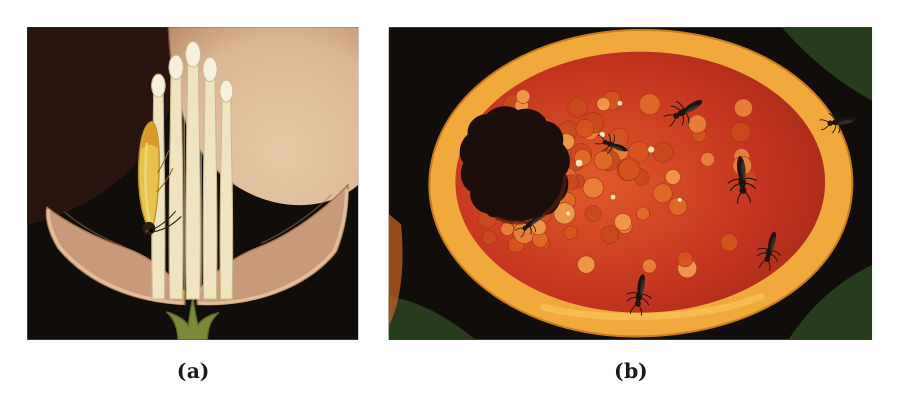
Figure 11.4 has two panels, (a) and (b), that together show the life cycle of the fig–wasp mutualism — one of the tightest one-to-one relationships in nature.
Panel (a) is labelled "Fig flower is pollinated by wasp." It shows a female wasp entering the fig inflorescence (the fig fruit is actually a hollow, inverted flower cluster). The wasp crawls inside through a small opening at the tip. As she moves around inside, she brushes against the male and female flowers lining the inner wall, transferring pollen she carried from her natal fig. This is the pollination event — the fig gets its pollen delivered, and the wasp gets nothing directly from this visit yet.
Panel (b) is labelled "Wasp laying eggs in a fig fruit." It shows the same female wasp, now inside the fig, using her ovipositor to lay eggs into some of the developing ovules (which will become seeds). The wasp is not just pollinating — she is also using the fig as an oviposition site. Her larvae will hatch inside those ovules and feed on the developing seed tissue. The fig sacrifices a portion of its seeds to nourish the wasp's offspring, while the rest of the seeds develop normally because they were pollinated by the wasp. …
Drawn by us to help you understand the concept clearly, and verified to make sure it's accurate. For exams, practice from your NCERT textbook's own diagram.
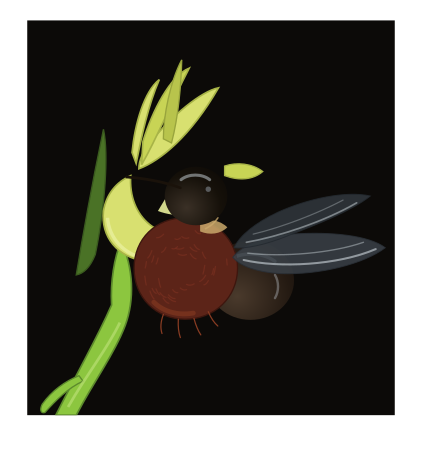
Figure 11.5 is a simple line drawing of a bee resting on an orchid flower. The bee is positioned on the flower's labellum (the large, showy lower petal), with its head near the reproductive column of the orchid. The drawing shows the bee's body making contact with the flower's anther (pollen-bearing structure) and stigma (pollen-receiving surface). No other objects, labels, arrows, or panels are present — just the bee and the orchid in close physical contact.
The figure illustrates the mutualistic relationship between orchids and their pollinators. Orchids have evolved highly specialised floral structures that force a visiting bee to brush against both the anther and the stigma in a specific sequence. As the bee probes for nectar, pollen from the orchid's anther sticks to its body. When the bee visits another flower of the same orchid species, that pollen is transferred to the stigma, achieving pollination. The bee benefits by obtaining nectar (or, in some cases, pollen) as a food reward.
This is a textbook example of co-evolution: the orchid's floral morphology has been shaped over generations to match the body size, shape, and behaviour of its specific bee pollinator. The tight fit between flower and insect ensures that pollen is carried only to another flower of the same species, minimising waste. The figure directly supports the text's point that "orchids show a bewildering diversity of floral patterns many of which have evolved to attract the right pollinator insect (bees and bumblebees) and ensure guaranteed pollination by it." …