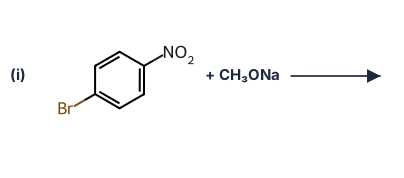
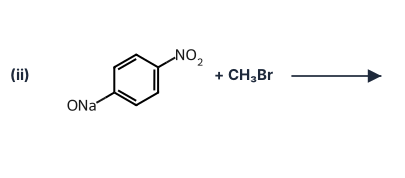
Q.Which of the following is an appropriate set of reactants for the preparation of 1-methoxy-4-nitrobenzene and why?
🔒You're viewing a preview — the full solution, concept, methods & PYQ mapping are locked.
🔒 Start your 14-day free trial to unlock the full solution →Concept understanding — Williamson Ether Synthesis
Williamson Ether Synthesis: From Intuition to Mechanism
Imagine you want to build a simple bridge between two carbon chains — an oxygen atom linking them together. That bridge is an ether (R−O−R′). The Williamson ether synthesis is the most reliable way to build that bridge in a lab.
The Core Idea
You have two pieces: an alkoxide ion (RO−) and an alkyl halide (R′X). The alkoxide is a strong nucleophile — it loves positive charge. The alkyl halide has a carbon attached to a halogen (like Cl, Br, I) that is slightly positive because the halogen pulls electrons away.
When you mix them, the alkoxide attacks that slightly positive carbon, kicks out the halide ion, and forms a new C−O bond. The result? An ether.
R−O−+R′−X⟶R−O−R′+X−
That's the entire reaction in one line. But the devil is in the details — especially which alkyl halide you choose.
The Mechanism (SN2)
This is a classic SN2 reaction — one step, no intermediates. The alkoxide approaches the carbon from the opposite side of the halogen. As the C−O bond forms, the C−X bond breaks. The halide leaves as a stable anion.
Because it's SN2, the reaction is sensitive to steric hindrance. The carbon being attacked must be accessible.
If the alkyl halide is tertiary (3°), the reaction will not work via SN2. The bulky carbon blocks the backside attack. Instead, the alkoxide will act as a base and cause elimination (forming an alkene). You'll get no ether.
The Practical Rule
| Alkyl halide | Works? | Why |
|---|---|---|
| Methyl (CH3X) | Yes | Least hindered, fastest SN2 |
| Primary (1°) | Yes | Clean SN2 |
| Secondary (2°) | Sometimes | Works if not too bulky; elimination competes |
| Tertiary (3°) | No | Elimination dominates |
| Aryl (e.g., bromobenzene) | No | SN2 impossible on sp2 carbon |
To make an ether like R−O−R′, always use the less hindered alkyl halide and the more hindered alkoxide. For example, to make CH3CH2−O−CH(CH3)2, use CH3CH2O− (primary alkoxide) + (CH3)2CHBr (secondary halide) — not the other way around.
How to Choose the Alkoxide
You can't just buy alkoxide ions in a bottle. You make them by reacting an alcohol with a strong base like sodium hydride (NaH) or sodium metal.
ROH+NaH⟶RO−Na++H2
The alkoxide is then used immediately with the alkyl halide.
A Common Exam Trap …
Why this formula?
Williamson Ether Synthesis: Why the Key Principles Hold
The Williamson Ether Synthesis is a classic method to prepare ethers. The core reaction is:
R-O−+R’-X→R-O-R’+X−
Where:
- R-O− is an alkoxide ion (strong nucleophile)
- R’-X is an alkyl halide (electrophile)
- X− is a halide ion (leaving group)
Let's break down why this works — the reasoning behind the key principles.
1. Why an Alkoxide (Not an Alcohol) is Needed
The Problem with Alcohols
Alcohols (R-OH) are weak nucleophiles. The oxygen has a partial negative charge, but the O–H bond is strong. If you mix an alcohol with an alkyl halide, the reaction is extremely slow or doesn't happen at all.
The Solution: Deprotonation
By treating the alcohol with a strong base (like NaH, Na, or KOH), you remove the proton:
R-OH+NaH→R-O−Na++H2
The alkoxide ion (R-O−) has a full negative charge on oxygen. This makes it:
- A much stronger nucleophile (higher electron density)
- More reactive toward the electrophilic carbon in the alkyl halide
Key takeaway: The alkoxide's full negative charge is what drives the reaction — it's not just about having oxygen, but about having a charged, electron-rich oxygen.
2. Why the Alkyl Halide Must Be Primary (or Methyl)
The Mechanism: SN2 is the Only Path
The Williamson synthesis proceeds exclusively via an SN2 mechanism (bimolecular nucleophilic substitution). This means:
- The nucleophile attacks the carbon from the backside
- The leaving group departs from the opposite side
- The reaction is concerted (one step, no intermediates)
Why Primary Halides Work Best
In SN2 reactions, the rate depends on steric hindrance:
| Alkyl Halide Type | Steric Hindrance | SN2 Reactivity |
|---|---|---|
| Methyl (CH3X) | Minimal | Very fast |
| Primary (RCH2X) | Low | Fast |
| Secondary (R2CHX) | Moderate | Slow |
| Tertiary (R3CX) | High | Does not occur |
Why Tertiary Halides Fail
With a tertiary halide, the bulky alkyl groups block the backside attack. Instead, the alkoxide (a strong base) will eliminate a proton from the halide, forming an alkene:
R-O−+R’3C-X→R-OH+alkene+X−
This is an E2 elimination — not the desired ether formation.
Key takeaway: The Williamson synthesis works only when the alkyl halide is primary or methyl because SN2 requires an unhindered backside.
3. Why the Leaving Group Must Be Good
The Role of the Halide
The halide (X−) must be a good leaving group — meaning it can stabilize the negative charge after departure.
| Halide | Leaving Group Ability | Reason |
|---|---|---|
| I− | Excellent | Large, polarizable, weak base |
| Br− | Good | Moderate size, weak base |
| Cl− | Fair | Smaller, stronger base |
| F− | Poor | Small, strong base, holds tightly |
Why Fluoride Fails
Fluoride is a strong base and a poor leaving group. The C–F bond is very strong, and F− does not depart easily. So alkyl fluorides are unreactive in Williamson synthesis.
Key takeaway: The leaving group must be weakly basic and polarizable — iodide and bromide are ideal.
--- …
The key idea is Williamson Ether Synthesis, which requires a good nucleophile (alkoxide or phenoxide) and a good electrophile (alkyl halide). The reaction proceeds via SN2, so the alkyl halide should be primary or methyl to avoid elimination.
Step 1: Identify the target ether: 1-methoxy-4-nitrobenzene is p−O2N−C6H4−OCH3. The ether oxygen is attached to an aryl ring and a methyl group.
Step 2: In Williamson synthesis, the aryl–O bond is best formed using a phenoxide ion (strong nucleophile) attacking an alkyl halide. Using an aryl halide with an alkoxide is poor because aryl halides do not undergo SN2 (no backside attack on sp² carbon).
Step 3: Evaluate options: …
The key idea is that Williamson ether synthesis works best when the nucleophile is the stronger one. Here, the phenoxide ion (p−O2N−C6H4−ONa) is a much better nucleophile than methoxide (CH3ONa) because the nitro group stabilises the negative charge on oxygen, making the phenoxide less basic but still a good nucleophile. The correct set is (ii).
To understand why, we need to revisit the Williamson ether synthesis — the most reliable method for making unsymmetrical ethers like 1-methoxy-4-nitrobenzene. The reaction is an SN2 displacement: an alkoxide (or phenoxide) ion attacks an alkyl halide. The trick is choosing which fragment becomes the nucleophile and which becomes the electrophile.
-
The target molecule: 1-methoxy-4-nitrobenzene is p−O2N−C6H4−OCH3. It has an aryl group (the nitrobenzene ring) and a methyl group attached to oxygen. So we have two possible disconnections:
- Break the C–O bond to give an aryl halide + methoxide: p−O2N−C6H4−Br+CH3ONa (option i)
- Break the O–CH3 bond to give a phenoxide + methyl halide: p−O2N−C6H4−ONa+CH3Br (option ii)
-
The SN2 constraint: Aryl halides (like bromobenzene derivatives) do not undergo SN2 reactions. The carbon attached to bromine is sp2-hybridised and the aromatic ring blocks backside attack. So option (i) is a non-starter — p−O2N−C6H4−Br will not react with CH3ONa via SN2 to give the ether. Even if you tried harsh conditions, you’d get nucleophilic aromatic substitution (which requires a strong electron-withdrawing group ortho or para and often gives different products), but that’s not Williamson ether synthesis. …
Method: Williamson Ether Synthesis (SN2 Pathway)
Williamson ether synthesis is an SN2 reaction between an alkoxide (or phenoxide) ion and a primary alkyl halide (or tosylate). The key rule: the alkoxide must be the nucleophile, and the alkyl halide must be the electrophile (the carbon bearing the leaving group).
Steps to decide the correct set:
-
Identify the target ether
Target: 1-methoxy-4-nitrobenzene
Structure:
p-O2N-C6H4-O-CH3
This is an aryl methyl ether — the oxygen is attached to an aromatic ring on one side and a methyl group on the other.
-
Recognize the SN2 limitation
In SN2, the carbon that gets attacked must be sp³-hybridized and sterically accessible.
- Aryl halides (like p-O2N-C6H4-Br) have sp² carbon — SN2 does not occur at an sp² carbon.
- Therefore, option (i) fails: the aryl bromide cannot be the electrophile in an SN2 reaction.
-
Check the viable route
- Option (ii): p-O2N-C6H4-ONa (sodium 4-nitrophenoxide) acts as the nucleophile.
- CH3Br (methyl bromide) has an sp³ carbon with a good leaving group (Br⁻).
- SN2 attack by the phenoxide on the methyl carbon gives the desired ether.
-
Why option (ii) works …
Common Mistakes in Williamson Ether Synthesis for 1-Methoxy-4-nitrobenzene
Mistake 1: Ignoring the Nature of the Alkyl Halide (SN1 vs SN2)
The error: Students often assume any alkyl halide works with any alkoxide. Here, they might pick option (i) without checking if the aryl halide (p-nitrobromobenzene) can undergo SN2.
Why it's wrong:
- Williamson ether synthesis is an SN2 reaction.
- Aryl halides (halogen directly on benzene ring) are extremely poor SN2 substrates — the C–Br bond is strong and the backside attack is blocked by the aromatic ring.
- Option (i) would not give the ether under normal conditions.
How to avoid:
- Always check: Is the carbon bearing the leaving group sp³ hybridized?
- If it's an aryl halide (sp²), SN2 is impossible unless strong electron-withdrawing groups (like –NO₂) are present ortho or para to activate the ring for nucleophilic aromatic substitution (SNAr) — but that's a different mechanism, not Williamson ether synthesis.
- For Williamson, the alkoxide must attack an sp³ carbon (methyl, primary, or secondary alkyl halide).
Mistake 2: Forgetting the "Best Nucleophile Attacks the Best Electrophile" Rule
The error: Students pick option (ii) but don't realize that p-nitrophenoxide is a phenoxide — a resonance-stabilized, weaker nucleophile than an alkoxide.
Why it's wrong:
- In option (ii), the nucleophile is p−O2N−C6H4−ONa (a phenoxide) and the electrophile is CH₃Br (a good SN2 substrate).
- This does work — the phenoxide attacks the methyl carbon, giving the desired ether.
- But students often think "any combination of alkoxide + alkyl halide works" — they miss that the alkoxide must be a strong nucleophile and the alkyl halide must be a good SN2 substrate.
How to avoid:
- Memorise: Phenoxides are weaker nucleophiles than alkoxides due to resonance delocalisation of the negative charge into the ring.
- However, they are still strong enough to attack methyl or primary halides — so option (ii) is correct.
- The key is: the alkyl halide must be methyl or primary (to avoid elimination), and the alkoxide can be any (even a phenoxide).
Mistake 3: Confusing Williamson Ether Synthesis with Nucleophilic Aromatic Substitution (SNAr)
The error: Students see the nitro group on the benzene ring and think "electron-withdrawing group activates the ring for substitution" — then pick option (i) thinking it's an SNAr.
Why it's wrong:
- SNAr requires a leaving group on the aromatic ring and a strong nucleophile (like CH₃ONa).
- While p-nitrobromobenzene can undergo SNAr with CH₃ONa, the product is 1-methoxy-4-nitrobenzene — but the mechanism is not Williamson ether synthesis.
- The question specifically asks for Williamson ether synthesis — which is an SN2 reaction, not SNAr.
How to avoid:
- Read the question carefully: "Williamson Ether Synthesis" is explicitly named.
- Williamson = SN2 = alkyl halide + alkoxide (both aliphatic).
- If the halogen is on an aromatic ring, it's not Williamson — it's SNAr or Ullmann, etc.
- So option (i) is wrong for Williamson, even if it might produce the same product via a different mechanism.
Mistake 4: Not Checking for Elimination Side Reactions
The error: Students assume any alkyl halide works, even secondary or tertiary ones.
Why it's wrong: …
- CBSE 2025Set A1 markQ.Write True or False: C2H5OCH3 is a symmetrical ether.
›Reveal solutionSolution
A symmetrical ether has two IDENTICAL alkyl/aryl groups on either side of the oxygen; here the two groups (ethyl, methyl) differ, so it is unsymmetrical.
Ethers are classified as:
- Simple/symmetrical ether: R–O–R, where both R groups are the same, e.g. C2H5–O–C2H5 (diethyl ether).
- Mixed/unsymmetrical ether: R–O–R′, where the two groups differ, e.g. C2H5–O–CH3 (ethyl methyl ether). …
- CBSE 2023Set A1 markQ.Match the following. Column A item: 'R-O-R'. Choose its correct match from Column B:(a) Ether(b) Primary amine(c) Lactose(d) C12H22O11(e) Glucose(f) Negative ions(g) C6H5SO2Cl(h) +7
›Reveal solutionSolution
The general formula R-O-R, where two alkyl/aryl groups are joined by an oxygen atom, represents an ether.
…
- CBSE 2023Set ANNUAL1 markMCQQ.Williamson's method is a very useful method for the preparation of ethers. However it will not work in the preparation of –(a) (CH3)2O(b) CH3OC2H5(c) C6H5OCH2CH3(d) C6H5OC6H5
›Reveal solutionSolution
Williamson synthesis needs an alkyl halide for the SN2 step; diphenyl ether would need an aryl halide instead, and aryl halides simply don't undergo this kind of substitution.
The Williamson ether synthesis works by an SN2 reaction: an alkoxide/phenoxide ion (the nucleophile) displaces a halide (leaving group) from an alkyl halide.
- (a) (CH3)2O: methoxide + methyl halide — both are simple, unhindered primary alkyl systems → works fine.
- (b) CH3OC2H5: methoxide/ethoxide + the other's alkyl halide (both primary) → works fine.
- (c) C6H5OCH2CH3 (phenetole): sodium phenoxide + ethyl halide (an alkyl halide) → works fine, since the halide being displaced is on the alkyl (ethyl) partner, not the aryl one. …
- CBSE 2020Set 56/1/11 markQ.Write the structures of the products formed when anisole is treated with HI.
›Reveal solutionSolution
Anisole undergoes ether cleavage with HI to yield phenol and methyl iodide; the mechanism involves nucleophilic attack by iodide on the less hindered carbon of the C–O bond.
Why HI cleaves ethers: the concept behind the reaction
Ethers are generally stable compounds, but hydrogen halides—especially HI—can break the C–O bond through nucleophilic substitution. The reaction works because HI is both a strong acid (protonating the ether oxygen) and a source of iodide, an excellent nucleophile.
In anisole (methoxybenzene, CX6HX5−O−CHX3), we have an aromatic ring attached to one side of the oxygen and a methyl group on the other. The key question is: which C–O bond breaks? The answer lies in understanding that iodide will attack the less hindered, more electrophilic carbon—in this case, the methyl carbon—because SXN2 attack on the aromatic ring is essentially impossible (the ring carbon is sp2 hybridized and the transition state would be impossibly strained).
Step-by-step mechanism and product formation
- Protonation of the ether oxygen HI donates a proton to the lone pair on oxygen, converting anisole into an oxonium ion:
CX6HX5−O−CHX3+HICX6HX5−O+H−CHX3+IX−
This protonation makes the C–O bonds more polar and the adjacent carbons more electrophilic.
- Nucleophilic attack by iodide The iodide ion (IX−) attacks the methyl carbon in an SXN2 fashion. The methyl group is unhindered and accessible, whereas the phenyl carbon is part of an aromatic system and cannot undergo backside attack:
CX6HX5−O+H−CHX3+IX−CX6HX5−OH+CHX3I
The C–O bond between oxygen and the methyl group breaks, and iodide forms a new bond with carbon.
- Product identification The two products are: …
- CBSE 2019Set ANNUAL1 markQ.How will you synthesize the isomeric ether of benzyl alcohol by Williamson synthesis?
›Reveal solutionSolution
Anisole (methoxybenzene), isomeric with benzyl alcohol, is made by Williamson synthesis from sodium phenoxide and methyl iodide.
Benzyl alcohol (C6H5CH2OH, C7H8O) has the isomeric ether anisole (methoxybenzene, C6H5−O−CH3, also C7H8O). By the Williamson ether synthesis, an alkoxide/phenoxide displaces a halide from an alkyl halide (SN2); here, sodium phenoxide reacts with methyl …
- CBSE 2018Set ANNUAL1 markMCQQ.Williamson Synthesis is used to prepare :(a) Alcohol(b) Amine(c) Ketone(d) Ether
›Reveal solutionSolution
Williamson synthesis is the reaction of a sodium alkoxide with an alkyl halide (SN2) to give an ether.
The Williamson ether synthesis proceeds as:
R-O−Na++R′-X⟶R-O-R′+NaX …
🎓Unlock everything free for 14 days
- ✓Full step-by-step solutions
- ✓Concept-first explanations
- ✓Methods, shortcuts & mistakes
- ✓PYQ mapping + timed mock tests
Full access for 14 days. No credit card required.