Chemistry · Ch 8 — Aldehydes, Ketones and Carboxylic Acids
Preparation of Ketones
Preparation of Ketones
1. From Acyl Chlorides
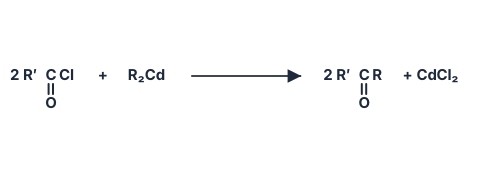
An acyl chloride reacts with a dialkylcadmium reagent to give a ketone. The dialkylcadmium itself is made first, by reacting a Grignard reagent with cadmium chloride.
Drawn by us to help you understand the concept clearly, and verified to make sure it's accurate. For exams, practice from your NCERT textbook's own diagram.
Redrawn from the NCERT page with the structures, printed labels (2 R′, C, Cl, R) and reagent placement exactly as the textbook prints them. Every element of this display was checked against the printed page during the sweep's blind-judge verification pass, so wha …
Dialkylcadmium is used here rather than the Grignard reagent itself, because it is mild enough to react with the acyl chloride and stop at the ketone, instead of over-adding and carrying the reaction on to a tertiary alcohol.
2. From Nitriles
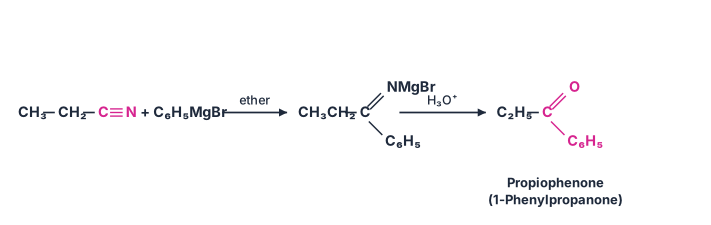
Treating a nitrile with a Grignard reagent, followed by hydrolysis, also yields a ketone. The Grignard reagent adds across the nitrile's triple bond to give a magnesium salt of an imine, and acidic hydrolysis of this imine salt then releases the ketone.
Drawn by us to help you understand the concept clearly, and verified to make sure it's accurate. For exams, practice from your NCERT textbook's own diagram.
Redrawn from the NCERT page with the structures, printed labels (CH₃, CH₂, C ≡ N, CH₃CH₂, C, C₂H₅) and reagent placement exactly as the textbook prints them. Every element of this display was checked against the printed page during the sweep's blind-judge verification pass, so …
Propanenitrile with phenylmagnesium bromide gives propiophenone (1-phenylpropan-1-one) by this route.
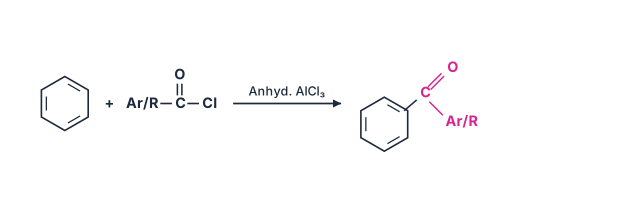
3. From Benzene or Substituted Benzenes — Friedel–Crafts Acylation …
Drawn by us to help you understand the concept clearly, and verified to make sure it's accurate. For exams, practice from your NCERT textbook's own diagram.
Redrawn from the NCERT page with the structures, printed labels (Ar/R, C, Cl) and reagent placement exactly as the textbook prints them. Every element of this display was checked against the printed page during the sweep's blind-judge verification pass, so wha …