Chemistry · Ch 10 — Biomolecules
Chemical Composition of Nucleic Acids
Chemical Composition of Nucleic Acids
What hydrolysis reveals
When a nucleic acid (DNA or RNA) is completely hydrolysed, it breaks down into three distinct types of simpler molecules:
- a pentose sugar
- phosphoric acid,
- nitrogen-containing heterocyclic compounds, called bases
These three building blocks — sugar, phosphate, and base — are the entire chemical alphabet from which every nucleic acid is constructed.
The pentose sugar: the DNA/RNA distinction starts here
The identity of the sugar is what fundamentally separates the two nucleic acids:
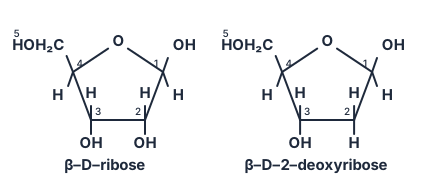
- DNA contains β-D-2-deoxyribose
- RNA contains β-D-ribose
Both are five-membered (furanose) rings made of four ring carbons and one ring oxygen, numbered (primed numbers, to keep them distinct from the numbering used on the bases).
Drawn by us to help you understand the concept clearly, and verified to make sure it's accurate. For exams, practice from your NCERT textbook's own diagram.
Redrawn from the NCERT page with the structures and reagent placement exactly as the textbook prints them. Every element of this display was checked against the printed page during the sweep's blind-judge verification pass, so what you …
β-D-Ribose (the RNA sugar):
| Position | Substituent |
|---|---|
| (this is the position where a base attaches) | |
| ring carbon, bonded to | |
| exocyclic (this is the position where phosphate attaches) |
β-D-2-Deoxyribose (the DNA sugar):
| Position | Substituent |
|---|---|
| only — no oxygen at this carbon | |
| ring carbon, bonded to | |
| exocyclic |
The only structural difference between the two sugars is at : ribose carries a hydroxyl there, while deoxyribose carries only a hydrogen — it has been "de-oxygenated" at that one carbon. This single missing is the reason DNA is chemically far more stable than RNA and is the molecule entrusted with long-term storage of genetic information.
The nitrogen bases
Hydrolysis also liberates nitrogen-containing heterocyclic bases. These fall into two structural families:
DNA vs RNA at a glance
| DNA | RNA | |
|---|---|---|
| Sugar | β-D-2-deoxyribose (no at ) | β-D-ribose (has at ) |
| Bases | Adenine, Guanine, Cytosine, Thymine | Adenine, Guanine, Cytosine, Uracil |
| Strandedness | Double-stranded helix | Usually single-stranded (may fold back on itself) |
The sugar and the fourth base (thymine vs uracil) are the two features that distinguish DNA from RNA at the molecular level.
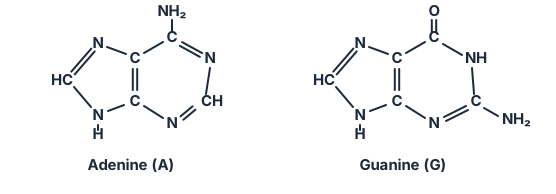
Purines — a fused bicyclic ring system (a six-membered ring fused to a five-membered ring):
- Adenine (A) — carries an group; present in both DNA and RNA
- Guanine (G) — carries an group and a ring ; present in both DNA and RNA
Drawn by us to help you understand the concept clearly, and verified to make sure it's accurate. For exams, practice from your NCERT textbook's own diagram.
Redrawn from the NCERT page with the structures, printed labels (NH2, CH, HC, NH) and reagent placement exactly as the textbook prints them. Every element of this display was checked against the printed page during the sweep's blind-judge verification pass, so wha …
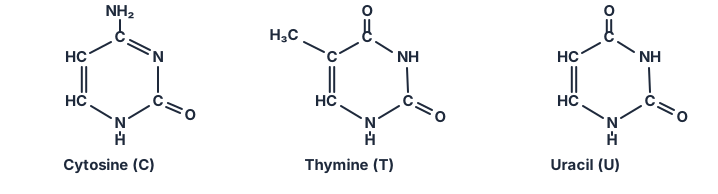
Pyrimidines — a single six-membered ring:
- Cytosine (C) — carries an group and a ring ; present in both DNA and RNA …
Drawn by us to help you understand the concept clearly, and verified to make sure it's accurate. For exams, practice from your NCERT textbook's own diagram.
Redrawn from the NCERT page with the structures, printed labels (NH2, HC, NH, H3C) and reagent placement exactly as the textbook prints them. Every element of this display was checked against the printed page during the sweep's blind-judge verification pass, so wha …