Chemistry · Ch 5 — Coordination Compounds
Definitions of Some Important Terms Pertaining to Coordination Compounds
Definitions of Some Important Terms Pertaining to Coordination Compounds
Coordination Entity
At the heart of coordination chemistry is the coordination entity: a central metal atom or ion held together with a fixed set of surrounding ions or molecules. Take — here the cobalt centre is held by three ammonia molecules and three chloride ions, all as one bonded unit. The same idea shows up in , , and — in every case, a metal atom/ion sits at the centre with a definite number of groups attached to it.
Central Atom or Ion
Inside a coordination entity, the atom or ion that anchors a fixed number of surrounding groups in a definite geometric pattern is the central atom or ion. In , and , the central species are , and respectively. Because these central atoms/ions accept electron pairs from the surrounding groups, they are also classified as Lewis acids.
Ligands
The ions or molecules directly attached to the central atom/ion are called ligands. They range widely in size and complexity — from a simple ion like , to small neutral molecules such as or , to larger organic molecules like or , all the way up to macromolecules such as proteins.
Ligands are classified by how many points of attachment (donor atoms) they use to bond to the metal:
- Unidentate — attaches through a single donor atom, e.g., , , .
- Didentate — attaches through two donor atoms at once, e.g., ethane-1,2-diamine (, commonly abbreviated en) or the oxalate ion ().
- Polydentate — carries several donor atoms within a single ligand molecule, e.g., .
The ethylenediaminetetraacetate ion () is a standout example of a polydentate ligand — it is hexadentate, binding through two nitrogen atoms and four oxygen atoms simultaneously to one central metal ion.
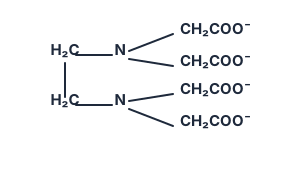
Drawn by us to help you understand the concept clearly, and verified to make sure it's accurate. For exams, practice from your NCERT textbook's own diagram.
Redrawn from the NCERT page with the structures, printed labels (H2C, CH2COO⁻) and reagent placement exactly as the textbook prints them. Every element of this display was checked against the printed page during the sweep's blind-judge verification pass, so wha …
When a di- or polydentate ligand wraps around and binds a single metal ion through two or more of its donor atoms at the same time, it is called a chelate ligand, and the resulting complex is a chelate complex. The count of donor atoms a ligand uses this way is its denticity. Chelate complexes are generally more stable than comparable complexes built from unidentate ligands.
A ligand that has two different kinds of donor atoms, either of which can bind the metal (though not both at once), is called an ambidentate ligand. Two classic examples:
- The nitrite ion, , can coordinate either through its nitrogen atom (giving a nitrito-N linkage) or through one of its oxygen atoms (giving a nitrito-O linkage).
- The thiocyanate ion, , can coordinate either through its sulphur atom (thiocyanato-S) or through its nitrogen atom (thiocyanato-N).
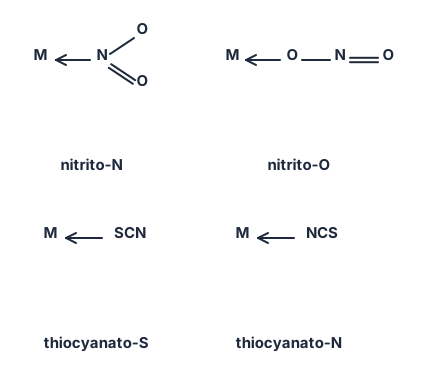
Drawn by us to help you understand the concept clearly, and verified to make sure it's accurate. For exams, practice from your NCERT textbook's own diagram.
Redrawn from the NCERT page with the structures, printed labels (SCN, NCS) and reagent placement exactly as the textbook prints them. Every element of this display was checked against the printed page during the sweep's blind-judge verification pass, so what …
Coordination Number
The coordination number (CN) of a metal ion in a complex counts the number of ligand donor atoms directly bonded to that metal. In and , the coordination numbers of Pt and Ni are 6 and 4 respectively. In and , both Fe and Co have a coordination number of 6 — not 3 — because each didentate ligand ( or en) contributes two donor atoms, not one.
Only sigma bonds between the ligand and the central atom/ion count toward the coordination number. Any pi bonds formed alongside them are not counted.
Coordination Sphere and Counter Ions
The central atom/ion together with the ligands bonded to it is written inside square brackets and referred to as the coordination sphere. Any ionisable groups that lie outside this bracket are called counter ions. For , the coordination sphere is , and is the counter ion balancing its charge.
Coordination Polyhedron
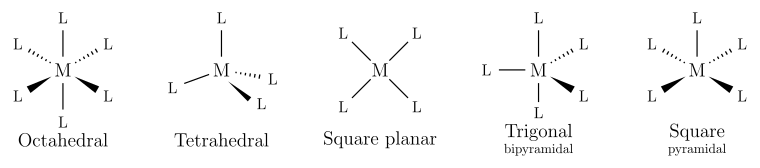
The three-dimensional arrangement of the ligand donor atoms directly bonded to the central atom/ion traces out a shape known as the coordination polyhedron. The most frequently seen coordination polyhedra are octahedral, tetrahedral and square planar — for instance, is octahedral, is tetrahedral, and is square planar. (Fig. 5.1 catalogues these shapes — octahedral, tetrahedral, square planar, trigonal bipyramidal, and square pyramidal — for a central atom M surrounded by unidentate ligands L.)
Drawn by us to help you understand the concept clearly, and verified to make sure it's accurate. For exams, practice from your NCERT textbook's own diagram.
Fig. 5.1 is a schematic diagram showing five different coordination polyhedra — the three-dimensional shapes formed by the positions of the ligand atoms directly bonded to the central metal atom/ion (M). Each polyhedron is drawn with M at the centre and unidentate ligands (L) at the vertices. Solid wedge bonds indicate ligands coming out of the plane of the page toward the viewer; dashed wedge bonds indicate ligands going behind the plane.
The five polyhedra shown are:
- Octahedral — 6 ligands arranged at the corners of a regular octahedron. This is the most common geometry for coordination number 6.
- Tetrahedral — 4 ligands at the corners of a tetrahedron. Common for coordination number 4 with small central ions or bulky ligands.
- Square planar — 4 ligands in a single plane, at the corners of a square. Typical for metal ions like or with strong-field ligands.
- Trigonal bipyramidal — 5 ligands: three in a plane (equatorial) and two above and below (axial). Coordination number 5.
- Square pyramidal — 5 ligands: four in a square plane and one above the plane. Also coordination number 5, less common than trigonal bipyramidal.
The figure teaches that the coordination number (number of sigma bonds from ligands to M) determines the shape of the coordination polyhedron. The textbook emphasises that only sigma bonds count toward coordination number — pi bonds are not included.
The key formula developed with this figure is the relationship between coordination number and geometry:
For example:
- Coordination number 6 → octahedral …