Q.Name the instrument used for measuring the angle by which the plane polarised light is rotated.
🔒You're viewing a preview — the full solution, concept, methods & PYQ mapping are locked.
🔒 Start your 14-day free trial to unlock the full solution →Concept understanding — Optical Isomerism and Enantiomers
Optical Isomerism and Enantiomers
A carbon atom that is bonded to four different groups is called an asymmetric or chiral carbon. A molecule containing such a carbon is not superimposable on its mirror image, just as a left hand is not superimposable on a right hand. The two non-superimposable mirror-image forms are called enantiomers, and the property of existing as such pairs is optical isomerism.
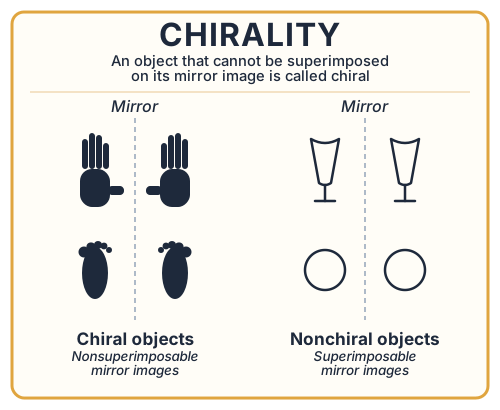
Enantiomers are identical in most physical properties (melting point, boiling point, density) and in ordinary chemical reactions, but they differ in one striking way: each rotates the plane of plane-polarised light by an equal angle in opposite directions. The form that rotates it clockwise is dextrorotatory (+); the one that rotates it anticlockwise is laevorotatory (−).
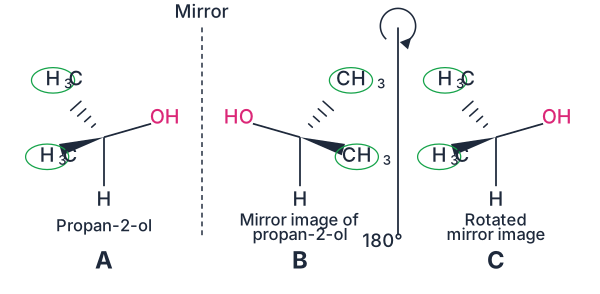
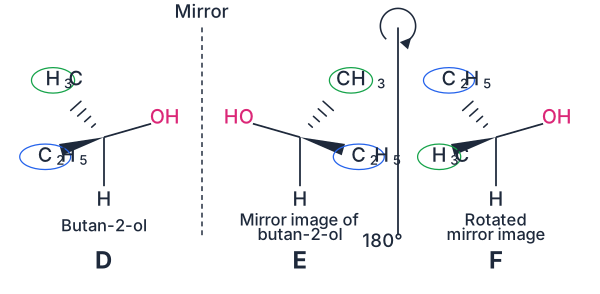
To compare three-dimensional structures, chemists use wedge-and-dash drawings (a solid wedge points toward the viewer, a dashed wedge points behind the plane). Two drawings of the same four groups on one chiral carbon are enantiomers if one is the mirror image of the other and no rotation can make them coincide. A practical test is to interchange any two groups on the reference structure: a single swap converts a molecule into its enantiomer, while two successive swaps return the original configuration.
For example, propan-2-ol — whose carbon carries two identical CH₃ groups — gives a mirror image that a simple 180° rotation brings back onto the original:
Contrast that with butan-2-ol, whose carbon carries four different groups (CH₃, C₂H₅, OH, H) — its rotated mirror image never coincides with the original:
Concept: Optical rotation and its measurement
Plane-polarized light passing through certain optically active substances (like sugar solutions, quinine, tartaric acid) has its plane of polarization rotated by a characteristic angle. This phenomenon is called optical rotation or optical activity.
The instrument designed to measure this angle of rotation is a polarimeter. It consists of two Nicol prisms (or polaroids) — one as polarizer and the other as analyzer — with a tube containing the optically active sample placed between them. By rotating the analyzer until extinction (minimum intensity) is observed, the angle through which the plane of polariza …
The instrument that measures the angle of rotation of plane-polarised light is the polarimeter; it exploits the optical activity of certain substances to determine rotation angles and, often, concentrations.
The concept: optical activity and its measurement
When plane-polarised light passes through certain substances—particularly chiral molecules in solution (like sugars, amino acids, or many organic compounds)—the plane of polarisation rotates by a measurable angle. This phenomenon is called optical activity, and the angle of rotation depends on the substance's nature, its concentration, the path length through the sample, and the wavelength of light used.
To quantify this rotation, we need an instrument that can:
- produce plane-polarised light,
- pass it through the optically active sample, and
- measure the angle through which the plane has been rotated.
That instrument is the polarimeter.
How a polarimeter works
A polarimeter consists of a few essential components arranged in sequence:
-
Light source: Usually monochromatic light (commonly the sodium D-line at 589nm) to ensure consistent measurements.
-
Polariser: The first polarising element (often a Nicol prism or polarising filter) converts unpolarised light into plane-polarised light.
-
Sample tube: A glass tube of known length containing the optically active substance (solution or pure liquid).
-
Analyser: A second polarising element (identical to the polariser) that can be rotated. The observer looks through this.
-
Scale: A circular graduated scale attached to the analyser to read the angle of rotation directly. …
Showing the 12 most recent of 18 on this concept.
- CBSE 2026Set 56/1/11 markMCQQ.Which of the following is ‘not’ true about enantiomers ? (A) They have the same chemical reactivity. (B) They have the same specific rotation. (C) They have the same melting or boiling point. (D) They have the same refractive index.
›Reveal solutionSolution
Enantiomers are non-superimposable mirror images that differ only in how they rotate plane-polarized light — they have opposite specific rotations. The answer is (B).
Enantiomers are stereoisomers that stand as mirror images of each other, like your left and right hands. Because they have identical connectivity and the same functional groups in the same spatial arrangement (just reflected), most of their physical and chemical properties are identical. The one property that must differ is their interaction with plane-polarized light.
When plane-polarized light passes through a solution of a chiral molecule, the molecule rotates the plane of polarization. Enantiomers rotate light by the same magnitude but in opposite directions: one clockwise (dextrorotatory, +), the other counterclockwise (levorotatory, −). This is the defining optical difference.
Let's examine each statement:
-
Chemical reactivity (A): Enantiomers have identical chemical reactivity in an achiral environment. They react at the same rate with achiral reagents because the transition states formed are also mirror images with equal energy. In biological systems or with chiral reagents, reactivity can differ — but the statement as written (without qualification) is generally considered true for standard achiral conditions.
-
Specific rotation (B): Specific rotation [α] is defined as the observed rotation per unit concentration and path length. For a pair of enantiomers, if one has [α]=+50°, the other has [α]=−50°. They have equal magnitude but opposite sign. The statement claims they have "the same" specific rotation, which is false — they have opposite specific rotations. …
-
- CBSE 2026Set 56/2/11 markMCQQ.Which of the following molecules is chiral in nature ? (A) Propan-2-ol (B) Butan-2-ol (C) 1-Bromobutane (D) 2-Bromopropane
›Reveal solutionSolution
A molecule is chiral if it has a carbon atom bonded to four different groups. Among the given options, only Butan-2-ol has such a carbon, making it the chiral molecule.
The Concept: What Makes a Molecule Chiral?
Chirality in organic chemistry is a property of "handedness" — a molecule is chiral if it is not superimposable on its mirror image. For most simple organic compounds (like the ones in this question), chirality arises from the presence of a stereocenter (often called a chiral centre or asymmetric carbon). This is a carbon atom that is bonded to four different substituents.
If a carbon has even two identical groups attached, its mirror image can be rotated to match the original — it is achiral. So the task is to check each molecule for a carbon with four distinct groups.
Watch outA common mistake is to look for any carbon with four bonds and assume it's a chiral centre. The key is four different groups — not just four bonds. A carbon with two identical groups (like two hydrogens) is never a chiral centre.
Step-by-Step Analysis
Let's examine each molecule one by one.
1. Propan-2-ol — Structure: CH3−CH(OH)−CH3
The central carbon (the one with the -OH group) is bonded to:
- A hydrogen atom (H)
- A hydroxyl group (-OH)
- A methyl group (CH3)
- Another methyl group (CH3)
Since two of the groups are identical (both are CH3), this carbon is not a chiral centre. The molecule is achiral.
2. Butan-2-ol — Structure: CH3−CH(OH)−CH2−CH3
Look at the carbon that carries the -OH group (the second carbon in the chain). Its four bonds go to:
- A hydrogen atom (H)
- A hydroxyl group (-OH)
- A methyl group (CH3)
- An ethyl group (CH2CH3)
Are all four groups different? Yes — H, -OH, CH3, and CH2CH3 are all distinct. This carbon is a stereocenter, so Butan-2-ol is chiral.
TipButan-2-ol is a classic example of a chiral alcohol. In fact, it is often used in textbooks to introduce optical isomerism because it has exactly one chiral centre and no symmetry.
3. 1-Bromobutane — Structure: CH3−CH2−CH2−CH2Br
Scan each carbon: …
- CBSE 2026Set ANNUAL1 markMCQQ.Which of the following is optically active?(a) CH3CH2Cl(b) CH3CHClCH3(c) CH2ClCH2Cl(d) CH3CH2CHClCH3
›Reveal solutionSolution
A compound is optically active only if it has a chiral carbon — one bonded to four different substituents. Only 2-chlorobutane qualifies here.
Optical activity requires the molecule to be chiral, most commonly recognised by the presence of an asymmetric (stereogenic) carbon atom — a carbon attached to four DIFFERENT groups. Checking each option:
- (a) CH3CH2Cl: the carbon bearing Cl is attached to H, H, Cl, CH3 — two H's are identical, not chiral.
- (b) CH3CHClCH3 (2-chloropropane): the C-Cl carbon is attached to Cl, H, and two identical CH3 groups — not chiral.
- (c) CH2ClCH2Cl: neither carbon has four different groups — not chiral. …
- CBSE 2026Set ANNUAL1 markQ.The stereoisomers related to each other as non-superimposable mirror images are called ______ (fill in the blank).
›Reveal solutionSolution
Stereoisomers that are related as object and mirror image, and cannot be superimposed on one another, are called enantiomers.
Such molecules are chiral (possess a stereocentre with four different groups, most commonly), rotate plane-polarised light in equal but opposite directions, and are otherwise ide …
- CBSE 2026Set ANNUAL1 markQ.Arrange the following compounds in increasing order of reactivity towards SN2 reaction: CH3-CH2-CH(Br)-CH3 , CH3-C(CH3)(Br)-CH3 , CH3-CH2-CH2-CH2-Br
›Reveal solutionSolution
SN2 reactions proceed via a back-side nucleophilic attack through a crowded transition state, so reactivity decreases sharply as more alkyl groups (steric bulk) surround the C-Br carbon: primary > secondary > tertiary.
- CH3-CH2-CH2-CH2-Br is a primary halide (1-bromobutane) - least hindered, most reactive towards SN2.
- CH3-CH2-CH(Br)-CH3 is a secondary halide (2-bromobutane) - intermediate. …
- CBSE 2026Set ANNUAL1 markMCQQ.Assertion (A): Among the structural isomers of C₄H₉Br, only 2-bromobutane is optically active. Reason (R): It contains one asymmetric carbon and exists in two enantiomeric forms.(a) Both A and R are true and R is the correct explanation of A.(b) Both A and R are true but R is not the correct explanation of A.(c) A is true but R is false.(d) A is false but R is correct.
›Reveal solutionSolution
2-Bromobutane is the only C₄H₉Br isomer with a chiral carbon, so it alone is optically active and exists as two enantiomers; A and R are both true and R explains A — option (A).
The structural isomers of C4H9Br are: 1-bromobutane, 2-bromobutane, 1-bromo-2-methylpropane, and 2-bromo-2-methylpropane.
A molecule is optically active if it contains an asymmetric (chiral) carbon — a carbon attached to four different groups.
- In 2-bromobutane, CH3−CHBr−CH2−CH3, carbon C2 carries H, Br, −CH3 and −CH2CH3: four different groups. So C2 is a chiral centre.
- The other three isomers each have a carbon bearing at least two identical groups, so none is chiral. …
- CBSE 2025Set 56/4/11 markMCQQ.Out of 2-Bromobutane, 1-Bromobutane, 2-Bromopropane and 1-Bromopropane, the molecule which is chiral in nature is : (A) 2-Bromobutane (B) 1-Bromobutane (C) 2-Bromopropane (D) 1-Bromopropane
›Reveal solutionSolution
A chiral molecule must have a carbon atom bonded to four different substituents. Only 2-Bromobutane has such a carbon (the second carbon), making it the only chiral molecule among the four. The correct option is (A).
The Concept: What Makes a Molecule Chiral?
Chirality in organic chemistry is all about asymmetry. A molecule is chiral if it cannot be superimposed on its mirror image — like your left and right hands. The most common cause is a chiral centre (or stereocentre): a carbon atom bonded to four different groups.
The key test: look for a tetrahedral carbon where no two substituents are identical. If you find one, the molecule is almost certainly chiral. If every carbon has at least two identical groups attached, the molecule is achiral.
Let’s apply this to each compound.
Step-by-Step Analysis
1. 2-Bromobutane
Structure: CH3−CHBr−CH2−CH3
Focus on carbon-2 (the one with the bromine). Its four bonds go to:
- a hydrogen atom (H)
- a bromine atom (Br)
- a methyl group (CH3−)
- an ethyl group (CH3CH2−)
Are all four different? Yes — H, Br, CH3, and CH3CH2 are all distinct. This carbon is a chiral centre. Therefore, 2-bromobutane exists as a pair of enantiomers and is chiral.
2. 1-Bromobutane
Structure: CH2Br−CH2−CH2−CH3
Check each carbon:
- Carbon-1: bonded to two hydrogens, one bromine, and one carbon chain — two hydrogens are identical, so not chiral.
- Carbon-2: bonded to two hydrogens, one CH2Br group, and one CH2CH3 group — again two identical hydrogens.
- Carbons-3 and -4: similarly have at least two identical substituents.
No carbon has four different groups. The molecule is achiral.
3. 2-Bromopropane
Structure: CH3−CHBr−CH3
Carbon-2 is bonded to: one hydrogen, one bromine, and two methyl groups (CH3). The two methyl groups are identical. So this carbon has only three different substituents — not a chiral centre. The molecule is achiral.
4. 1-Bromopropane …
- CBSE 2025Set 56/5/11 markMCQQ.Which of the following molecules is chiral in nature ? (A) 1-chloropropane (B) 2-chloropropane (C) 1-chlorobutane (D) 2-chlorobutane
›Reveal solutionSolution
A molecule is chiral if it has a carbon atom bonded to four different groups. Among the given options, only 2-chlorobutane has such a carbon, making it the chiral molecule.
The key idea is the chirality centre (also called an asymmetric carbon or stereocentre). A carbon is chiral if it is sp³-hybridised and carries four different substituents. If any two substituents are the same, the molecule is achiral (it can be superimposed on its mirror image).
Let’s check each option systematically.
-
1-chloropropane (CH3CH2CH2Cl)
The carbon atoms are:
- C1 (bonded to Cl, H, H, CH₂CH₃) — two H atoms → not chiral.
- C2 (bonded to H, H, CH₃, CH₂Cl) — two H atoms → not chiral.
- C3 (bonded to H, H, H, CH₂CH₂Cl) — three H atoms → not chiral. No carbon has four different groups. Achiral.
-
2-chloropropane (CH3CHClCH3)
The central carbon (C2) is bonded to Cl, H, CH₃, and CH₃. Two of the groups are identical methyl groups. So it has a plane of symmetry and is achiral.
-
1-chlorobutane (CH3CH2CH2CH2Cl)
All carbons are either primary or secondary with at least two identical substituents (usually two H atoms). No carbon has four different groups. Achiral.
-
2-chlorobutane (CH3CHClCH2CH3)
Look at C2: it is bonded to
- Cl
- H
- CH₃ (methyl)
- CH₂CH₃ (ethyl) …
-
- CBSE 2025Set ANNUAL1 markQ.What are enantiomers?
›Reveal solutionSolution
Enantiomers are mirror-image molecules of each other that cannot be superimposed, arising from a chiral centre.
Enantiomers are a pair of stereoisomers whose three-dimensional structures are related as an object and its mirror image, and which are not superimposable on one another (in the same way that a left hand and a right hand are mirror images but cannot be perfectly overlapped).
…
- CBSE 2024Set A11 markMCQQ.The stereoisomers related to each other as non-superimposable mirror images are called ;(a) Enantiomers(b) Diastereomers(c) Anomers(d) Racemic mixture
›Reveal solutionSolution
Stereoisomers that are non-superimposable mirror images are enantiomers — option (a).
Enantiomers are a pair of stereoisomers that are mirror images of each other and cannot be superimposed (they are chiral, arising from an asymmetric carbon). Diastereomers are stereoisomers that are NOT mirror images; anomers are a special kind of diastereomer of sugars; and a r …
- CBSE 2024Set ANNUAL1 markQ.Draw the structures of the possible enantiomers of 3-methylpent-1-ene.
›Reveal solutionSolution
C3 is bonded to four different substituents, making it a stereocentre; swapping any two groups at C3 gives the mirror-image (enantiomeric) structure.
In CH₂=CH–CH(CH₃)–CH₂CH₃, the C3 carbon is attached to four different groups — a vinyl group (–CH=CH₂), a methyl group (–CH₃), an ethyl group (–CH₂CH₃), and a hydrogen atom — so C3 is a chiral centre (stereocentre). This gives rise to two enantiomers, which are non-superimposable mirror images of each other, differing only in the 3-D spatial arrangement of these four groups around C3 (assigned as R or S by CIP priority rules): (R)-3-methylpent-1-ene and (S)-3-methylpent-1-ene. Both have the identical connectivity/constitution and identical physical properties (e.g. same boilin …
- CBSE 2023Set 56/3/11 markMCQQ.Which of the following is not true about enantiomers? (A) They have the same density. (B) They have the same melting or boiling point. (C) They have the same specific rotation. (D) They have the same chemical reactivity.
›Reveal solutionSolution
Enantiomers are mirror-image molecules that are identical in most physical properties (density, melting/boiling points) and react identically with achiral reagents, but they rotate plane-polarised light in opposite directions — so they do not have the same specific rotation. The false statement is (C).
Enantiomers are like your left and right hands — mirror images that cannot be superimposed. In chemistry, this “handedness” (chirality) leads to a fascinating split: most physical properties are identical, but interaction with polarised light is opposite. That’s the key to spotting the wrong option here.
Let’s check each statement one by one.
-
Density — Enantiomers have the same density.
Density depends on molecular mass and packing in the bulk state. Since enantiomers are identical in every way except spatial arrangement at a chiral centre, their crystals or liquids pack identically. So density is the same. Option (A) is true.
-
Melting or boiling point — Again, these are bulk physical properties.
In a pure sample, enantiomers have identical melting and boiling points. (A mixture of equal amounts, a racemate, may have a different melting point — but the question asks about enantiomers themselves, not their mixture.) So (B) is true.
-
Specific rotation — This is the trick.
Specific rotation [α] measures how much a compound rotates plane-polarised light. Enantiomers rotate light by exactly the same magnitude but in opposite directions — one is (+) and the other is (−). So they do not have the same specific rotation; they have equal but opposite values. Option (C) is false — and that’s what we’re looking for.
-
Chemical reactivity — This needs a careful nuance. …
-
🎓Unlock everything free for 14 days
- ✓Full step-by-step solutions
- ✓Concept-first explanations
- ✓Methods, shortcuts & mistakes
- ✓PYQ mapping + timed mock tests
Full access for 14 days. No credit card required.