Q.(a) is diamagnetic whereas is paramagnetic. Justify the statement. [Atomic number of Co = 27]
You're viewing a preview — the full solution, concept, methods & PYQ mapping are locked.
Start your 14-day free trial to unlock the full solution →The difference in magnetic behaviour arises because is a strong field ligand causing large splitting () leading to pairing, while is a weak field ligand with small splitting () favouring high-spin configuration. For a ion with , the configuration is (low-spin).
The Core Idea: Crystal Field Splitting and the "Pairing Energy" Battle
The magnetic behaviour of a coordination complex — whether it is diamagnetic (all electrons paired) or paramagnetic (some unpaired electrons) — depends entirely on how the -electrons of the central metal ion arrange themselves in the presence of ligands. This is governed by Crystal Field Theory (CFT).
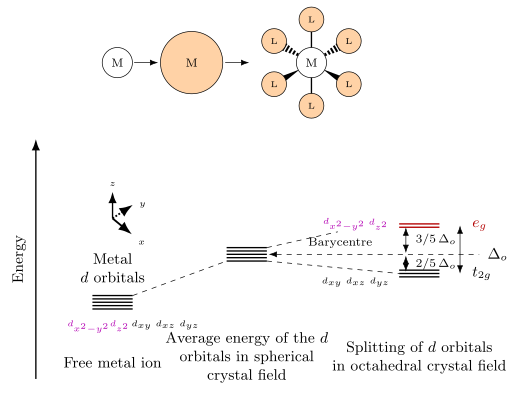
When ligands approach a metal ion, the five degenerate -orbitals split into two sets: the lower-energy set () and the higher-energy set (). The energy gap between them is called (crystal field splitting energy for octahedral complexes).
Now, here's the crucial question: when you place a , , , or electron into this split set, do the electrons pair up in the lower orbitals, or do they occupy the higher orbitals first? The answer depends on a tug-of-war between two energies:
- — the energy cost to promote an electron from to .
- (Pairing Energy) — the energy cost to force two electrons into the same orbital (due to electron-electron repulsion).
The rule is simple:
- If : Electrons prefer to pair in → Low-spin complex (more paired, less paramagnetic).
- If : Electrons prefer to occupy orbitals singly first → High-spin complex (more unpaired, more paramagnetic).
The value of is determined by the nature of the ligand. Ligands that cause a large splitting are called strong field ligands (e.g., , , ). Ligands that cause a small splitting are called weak field ligands (e.g., , , ).
Part (a): Comparing and
Let's apply this to the two complexes.
Step 1: Determine the oxidation state and -electron count of Cobalt.
Atomic number of Co = 27. Ground state configuration: .
- For : is neutral. So, . Co is in +3 state.
- : Remove 3 electrons (2 from 4s, 1 from 3d). Configuration: .
- For : has charge -1. So, . Co is also in +3 state.
- : Again, .
Both complexes have a metal ion. The difference lies entirely in the ligand.
Step 2: Identify the ligand field strength and predict the spin state.
-
: is a strong field ligand. It causes a large . For , is so large that .
- Consequence: The six -electrons will all pair up in the three orbitals before any electron goes to .
- Configuration: .
- Magnetic Behaviour: All electrons are paired. The complex has zero unpaired electrons. Therefore, it is diamagnetic (weakly repelled by a magnetic field).
-
: is a weak field ligand. It causes a small . For , is small enough that .
- Consequence: The electrons will follow Hund's rule of maximum multiplicity. They will first occupy all five -orbitals singly before pairing.
- Configuration: Following the aufbau principle for the split orbitals: . (First, 3 electrons go into singly, the 4th pairs in , and the 5th and 6th go singly into ).
- Magnetic Behaviour: There are 4 unpaired electrons (2 in and 2 in ). Therefore, it is paramagnetic (strongly attracted by a magnetic field). …
Unlock everything free for 14 days
- Full step-by-step solutions
- Concept-first explanations
- Methods, shortcuts & mistakes
- PYQ mapping + timed mock tests
Full access for 14 days. No credit card required.