Chemistry · Ch 1 — Solutions
Abnormal Molar Masses
Abnormal Molar Masses
All four colligative properties studied so far — relative lowering of vapour pressure, elevation of boiling point, depression of freezing point, and osmotic pressure — depend only on the number of solute particles present in solution, not on their nature. Each one therefore lets us work back to the molar mass of the solute. But this back-calculation quietly assumes that the solute stays as the same particles in solution as it was as a solid: that it neither breaks apart nor sticks together. When that assumption fails, the molar mass we obtain from experiment does not match the true (formula-based) molar mass. Such a value is called an abnormal molar mass.
Why the particle count changes in solution
The whole idea rests on a simple fact: colligative properties count particles. If a dissolved substance produces more particles than we assumed, or fewer, every colligative property shifts accordingly, and the molar mass we deduce is thrown off.
There are two ways this happens.
Dissociation (ionic solutes give more particles). Ionic compounds split into ions when they dissolve in water. Dissolving one mole of KCl (74.5 g), for instance, releases one mole of and one mole of — two moles of particles from what looks like one mole of solute. Ignoring inter-ionic attractions, one mole of KCl in 1 kg of water would raise the boiling point by roughly , twice what a single mole of particles would give. If we were unaware of the dissociation, we would wrongly conclude that the observed effect came from 2 mol of "KCl particles", and so calculate the mass of one mole as about half the real value — near 37.25 g instead of 74.5 g.
When a solute dissociates into ions, the experimentally determined molar mass comes out lower than the true value, because the solution holds more particles than the formula suggests.
Association (some molecules join together). The opposite can also occur: molecules can combine into larger aggregates in solution, cutting the particle count. A classic case is ethanoic (acetic) acid in benzene. Because benzene has a low dielectric constant, two ethanoic acid molecules pair up through hydrogen bonding into a dimer:
The two molecules are held together by a pair of O–H⋯O hydrogen bonds, forming a closed ring:
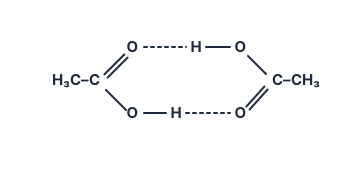
Drawn by us to help you understand the concept clearly, and verified to make sure it's accurate. For exams, practice from your NCERT textbook's own diagram.
Redrawn from the NCERT page with the structures, printed labels (H3C–C, C–CH3) and reagent placement exactly as the textbook prints them. Every element of this display was checked against the printed page during the sweep's blind-judge verification pass, so wha …
If every acid molecule dimerised, the number of independent particles would halve, and so would and . A colligative measurement would then report only half the expected effect — and the molar mass calculated from it would be about twice the true value.
A molar mass that turns out either lower or higher than the expected (normal) value — from dissociation or association respectively — is what we mean by an abnormal molar mass.
The van't Hoff factor,
To handle both situations with a single quantity, van't Hoff (1880) introduced a correction factor , called the van't Hoff factor, which measures the extent of dissociation or association. It can be written in three equivalent ways:
Here the abnormal molar mass is the experimentally measured one, and the calculated colligative property is the value we would predict assuming the non-volatile solute is neither associated nor dissociated.
Reading these definitions tells us at a glance what is happening in solution:
- Dissociation produces more particles than assumed, so the observed colligative property is larger and . For KCl in water, is close to 2.
- Association produces fewer particles, so the observed colligative property is smaller and . For ethanoic acid in benzene, is nearly 0.5.
The degree of dissociation or association depends on concentration; measured values for common strong electrolytes at different dilutions (and their limiting values for complete dissociation) are summarised in the accompanying van't Hoff factor table.
| Salt | i (0.1 m)* | i (0.01 m)* | i (0.001 m)* | i for complete dissociation |
|---|---|---|---|---|
| NaCl | 1.87 | 1.94 | 1.97 | 2.00 |
| KCl | 1.85 | 1.94 | 1.98 | 2.00 |
| 1.21 | 1.53 | 1.82 | 2.00 | |
| 2.32 | 2.70 | 2.84 | 3.00 |
As the printed values in the table show, dilution pushes toward its
complete-dissociation limit: for KCl, NaCl and MgSO the measured
approaches 2 as the solution becomes very dilute, and for KSO
(three ions per formula unit) it climbs toward 3 — exactly as expected.
Colligative properties corrected with
Since captures the real number of particles, we simply insert it into each colligative-property equation. This gives the corrected relations that apply to dissociating or associating solutes.
Relative lowering of vapour pressure of the solvent:
…