Q.Find the area enclosed by the circle x2+y2=a2
Concept understanding — Area Under Curve
Area Under a Curve
How do you measure the area of a region whose top edge is curved rather than a straight line? For rectangles and triangles we have formulas, but a shape bounded above by y=f(x) has no simple side lengths to plug in. The definite integral is the tool built exactly for this.
The core idea: area as a limit of strips
Take the region under y=f(x) (with f(x)≥0), above the x-axis, between x=a and x=b. Slice it into many thin vertical strips. A strip at position x with tiny width dx is almost a rectangle of height f(x), so its area is about f(x)dx. Add up all the strips and let their width shrink to zero: the sum becomes the definite integral
Area=∫abf(x)dx.
This is why the integral is the area — it is the exact total of infinitely many infinitesimally thin rectangles.
How to compute it
Find an antiderivative F(x) (so F′(x)=f(x)) and evaluate at the two limits — the Fundamental Theorem of Calculus:
∫abf(x)dx=F(b)−F(a).
For example, the area under y=x2 from 0 to 1 is [3x3]01=31.
Cases you must handle carefully
The integral gives signed area. Where the curve dips below the x-axis, f(x)<0 and ∫fdx comes out negative. For the geometric (positive) area of such a stretch, integrate the absolute value or take the magnitude of that piece: Area=∫ab∣f(x)∣dx.
If a curve crosses the x-axis inside [a,b], split the integral at each crossing and add the sizes of the parts.
Area with respect to the y-axis
When the region is bounded by a curve x=g(y) and the y-axis between y=c and y=d, slice horizontally instead:
Area=∫cdg(y)dy.
Always sketch the region first. The sketch tells you the correct limits, whether the curve dips below the axis, and whether it is cleaner to integrate in x or in y.
The single big idea: any area with a curved boundary is the sum of infinitely many thin strips, and that sum is precisely a definite integral.
Students searching "Area Under Curve formula and examples" or "Application of Integrals class 12 important questions" will find this the core idea tested throughout NCERT's Application of Integrals chapter, a mainstay of the CBSE Class 12 Maths syllabus and JEE Main/Advanced. Mastering the sign convention for regions below the x-axis is one of the most frequently asked concepts in board and competitive exam papers alike.
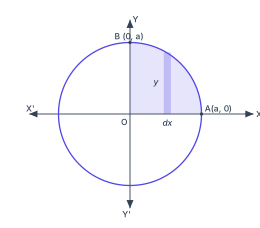
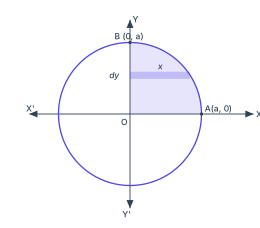
The key idea is that the area of a circle is a special case of the area of an ellipse, or can be found directly by integration.
Step 1: The circle x2+y2=a2 is symmetric about both axes. The area in the first quadrant is one-fourth of the total area.
Step 2: In the first quadrant, y=a2−x2 for 0≤x≤a. The area of one quadrant is:
AreaQ1=∫0aa2−x2dx
Step 3: This integral evaluates to 4πa2 (using the standard formula ∫a2−x2dx=2xa2−x2+2a2sin−1ax+C, or by recognising it as a quarter-circle).
Step 4: Total area is 4×4πa2=πa2.
The area enclosed is πa2.
The area enclosed by the circle x2+y2=a2 is found by integrating the upper semicircle from x=−a to x=a and doubling. The result is πa2.
The problem asks for the area inside a circle of radius a centered at the origin. This is a classic result, but deriving it from first principles using integration is a great way to build intuition for how area works in Cartesian coordinates.
The equation x2+y2=a2 describes a circle. If you solve for y, you get y=±a2−x2. The positive square root gives the upper half of the circle; the negative gives the lower half. The circle is symmetric about the x-axis, so the total area is twice the area of the upper half.
The key idea: the area under a curve y=f(x) from x=a to x=b is ∫abf(x)dx. Here, the upper semicircle runs from x=−a to x=a. So the area of the upper half is ∫−aaa2−x2dx. The total area is twice that.
- Set up the integral for the total area. The total area A is:
A=2∫−aaa2−x2dx.
The integrand a2−x2 is an even function (symmetric about x=0), so we can simplify:
A=4∫0aa2−x2dx.
This avoids dealing with negative limits.
-
Use a trigonometric substitution.
The expression a2−x2 suggests the substitution x=asinθ. Why? Because a2−a2sin2θ=a1−sin2θ=acosθ, which is simpler.
When x=0, θ=0. When x=a, θ=2π. Also, dx=acosθdθ.
Substitute into the integral:
A=4∫0π/2a2−a2sin2θ⋅(acosθdθ)=4∫0π/2acosθ⋅acosθdθ=4a2∫0π/2cos2θdθ.
- Evaluate the cos2θ integral. Use the identity cos2θ=21+cos2θ:
A=4a2∫0π/221+cos2θdθ=2a2∫0π/2(1+cos2θ)dθ.
Integrate term by term:
∫0π/21dθ=2π,∫0π/2cos2θdθ=[2sin2θ]0π/2=2sinπ−2sin0=0.
So:
A=2a2⋅2π=πa2.
A faster way: the area of a circle is πr2. Here r=a, so the answer is πa2 directly. The integration above confirms this geometrically obvious result.
A common mistake is to forget the factor of 2 when doubling the semicircle area, or to incorrectly handle the limits after substitution. Always check that the substitution's limits match the original variable's range.
The area enclosed by the circle is πa2.
Method: Area of a full circle via the first-quadrant quarter
Use this to derive the area enclosed by x2+y2=a2 from integration — compute one symmetric quadrant and scale up.
Steps
Step 1: Use symmetry to reduce the work.
The circle is symmetric about both axes, so the total area is 4× the first-quadrant area (where x,y≥0).
Step 2: Express the arc and set up the quadrant integral.
In the first quadrant, y=a2−x2, so
Area=4∫0aa2−x2dx.
Step 3: Evaluate with the substitution x=asinθ.
Then a2−x2=acosθ and dx=acosθdθ, giving 4a2∫0π/2cos2θdθ. Using cos2θ=21+cos2θ yields 4π for the integral, so
Area=4a2⋅4π=πa2.
Keep the factor of 4 (or 2, if you halve) explicit — dropping it is the classic error.
Common Mistakes
Mistake 1: Dropping the symmetry factor.
Why it's wrong: ∫0aa2−x2dx is only one quarter of the circle (4πa2); reporting that as the whole area misses the factor of 4. Correct approach: total area =4∫0aa2−x2dx=πa2.
Mistake 2: Mishandling the substitution limits.
Why it's wrong: with x=asinθ, x=0→θ=0 and x=a→θ=2π; carrying over the old x-limits corrupts the cos2θ integral. Correct approach: change the limits with the variable, then 4a2⋅4π=πa2.
- CBSE 2026Set 65/3/11 markMCQQ.The area of the shaded region of the circle given below (see figure) is equal to: (A) ∫139−y2dy (B) 2∫139−y2dy (C) ∫039−x2dx (D) 2∫039−x2dx
›Reveal solutionSolution
The problem asks for the integral representing the area of a shaded region of a circle. Assuming the shaded region is the quarter circle in the first quadrant of x2+y2=9, its area is given by ∫039−x2dx.
The core concept here is using definite integrals to calculate the area under a curve. When we have a region bounded by a curve y=f(x), the x-axis, and vertical lines x=a and x=b, the area is given by ∫abf(x)dx. Similarly, if the region is bounded by a curve x=g(y), the y-axis, and horizontal lines y=c and y=d, the area is ∫cdg(y)dy.
The expressions in the options, 9−x2 and 9−y2, immediately point to the equation of a circle. The general equation of a circle centered at the origin with radius r is x2+y2=r2. Comparing this with 9−x2 or 9−y2, we see that r2=9, which means the radius r=3.
For the upper half of this circle, we can express y as a function of x: y2=9−x2⟹y=9−x2 (taking the positive root for the upper half).
For the right half of this circle, we can express x as a function of y: x2=9−y2⟹x=9−y2 (taking the positive root for the right half).
Since the figure is not provided, we must infer the shaded region from the given options. Options (C) and (D) involve integration from 0 to 3, which is the radius of the circle. This strongly suggests that the shaded region is either a quarter circle or a semi-circle.
-
Identify the circle's equation and radius:
The terms 9−x2 and 9−y2 indicate that the circle has the equation x2+y2=9. This is a circle centered at the origin (0,0) with a radius r=3.
-
Interpret the shaded region based on options:
- Option (C) is ∫039−x2dx. This integral represents the area under the curve y=9−x2 (the upper semi-circle) from x=0 to x=3. This region is precisely the quarter circle located in the first quadrant.
- Option (D) is 2∫039−x2dx. This would be twice the area of the quarter circle, meaning it represents the area of the entire upper semi-circle (from x=−3 to x=3, or by symmetry, 2× area from x=0 to x=3).
- Option (A) is ∫139−y2dy. This represents the area under the curve x=9−y2 (the right semi-circle) from y=1 to y=3. This is a specific segment of the quarter circle, not the entire quarter circle.
- Option (B) is 2∫139−y2dy. This would be twice the area in (A), representing a horizontal strip of the circle symmetric about the y-axis.
Given that "the shaded region" is singular and the options include a simple quarter-circle integral, the most reasonable assumption for the shaded region, in the absence of a figure, is the quarter circle in the first quadrant. This is a very common setup in such problems.
-
Set up the integral for the quarter circle:
To find the area of the quarter circle in the first quadrant, we can integrate the function for the upper half of the circle, y=9−x2, with respect to x. The x-values for this region range from 0 to 3 (the radius).
The area A under a curve y=f(x) from x=a to x=b is given by:
A=∫abf(x)dx
Applying this formula, the area of the shaded quarter circle is:
A=∫039−x2dx
-
Compare with the given options:
This integral matches option (C).
Watch outIt is crucial to correctly identify the limits of integration and the function to be integrated. Integrating 9−x2 from 0 to 3 gives the area of the quarter circle. Integrating 29−x2 from 0 to 3 would give the area of the entire upper semi-circle. Similarly, integrating 9−y2 from 0 to 3 would also give the area of the quarter circle (but with respect to y).
The correct option is (C).
✓Final answerThe area of the shaded region, assuming it is the quarter circle in the first quadrant, is equal to ∫039−x2dx.
-
- CBSE 2026Set ANNUAL1 markMCQQ.Write the area of the curve y=sinx between x=0 and x=π in sq units.(a) 3(b) 4(c) 2(d) 5
›Reveal solutionSolution
The area under one arch of y=sinx from x=0 to x=π is 2 square units.
Since sinx≥0 throughout [0,π], the area is simply the definite integral:
A=∫0πsinxdx=[−cosx]0π
Evaluate:
A=(−cosπ)−(−cos0)=−(−1)−(−1)=1+1=2
✓Final answerThe correct option is (c) 2 sq units.
- CBSE 2026Set ANNUAL1 markQ.Find the area of the circle x2+y2=a2.
›Reveal solutionSolution
By symmetry, the area of the full circle is 4 times the area in the first quadrant, which is found by integration.
Area =4∫0aa2−x2dx=4[2xa2−x2+2a2sin−1ax]0a=4(2a2⋅2π)=πa2.
✓Final answerArea =πa2 square units.
- CBSE 2025Set 65/4/11 markMCQQ.The area of the region enclosed by the curve y=x and the lines x=0 and x=4 and x-axis is : (A) 916 sq. units (B) 932 sq. units (C) 316 sq. units (D) 332 sq. units
›Reveal solutionSolution
The region is the area under y=x from x=0 to x=4, which is a standard definite integral. The area equals 316 square units, so the correct option is (C).
The problem asks for the area enclosed by the curve y=x, the vertical lines x=0 and x=4, and the x-axis. This is a classic "area under a curve" problem — the region is bounded above by the curve, below by the x-axis, and on the sides by two vertical lines. The key idea is that the area between a curve y=f(x) and the x-axis from x=a to x=b is given by the definite integral ∫abf(x)dx, provided f(x)≥0 on that interval. Here, x is non-negative for x≥0, so we can directly integrate.
Watch outA common mistake is to confuse the area under y=x with the area under y=x2 or to misapply the power rule. Always check the exponent: x=x1/2, not x2.
Let’s work through the calculation step by step.
- Set up the integral. The region is bounded by x=0 on the left and x=4 on the right. The curve is y=x, and the lower boundary is the x-axis (y=0). So the area A is:
A=∫04xdx
- Rewrite the integrand. Recall that x=x1/2. This makes the power rule for integration straightforward:
A=∫04x1/2dx
- Apply the power rule. The power rule states ∫xndx=n+1xn+1+C for n=−1. Here n=21, so n+1=23:
A=[3/2x3/2]04=[32x3/2]04
- Evaluate at the limits. First, at x=4: 43/2=(41/2)3=23=8. So 32×8=316. At x=0: 03/2=0, so the lower limit contributes 0. Therefore:
A=316−0=316
TipYou can also think of 43/2 as 43=64=8, which is sometimes easier to compute mentally.
The area is 316 square units, which matches option (C).
✓Final answerThe area is 316 square units, so the correct option is (C).
- CBSE 2025Set ANNUAL1 markMCQQ.What is the area of the region bounded by y=ex, X-axis, x=1 and x=3 in square unit?(i) e(e2−1)(ii) e3−1(iii) e(1−e2)(iv) e2(1−e)
›Reveal solutionSolution
Area under y=ex from x=1 to x=3 is ∫13exdx.
Since y=ex>0 throughout [1,3], the region between the curve and the X-axis has area:
A=∫13exdx=[ex]13=e3−e1=e(e2−1)
✓Final answer(i) e(e2−1) square units.
- CBSE 2025Set ANNUAL1 markMCQQ.The area bounded by x-axis, y-axis, y=cosx, 0≤x≤2π will be -(a) 1(b) 0(c) −1(d) 2
›Reveal solutionSolution
The required area is ∫0π/2cosxdx.
Area=∫0π/2cosxdx=[sinx]0π/2=sin2π−sin0=1−0=1
✓Final answerThe correct option is (a) 1 square unit.
- CBSE 2025Set ANNUAL1 markQ.Find the area lying in the first quadrant and bounded by the circle x2+y2=4.
›Reveal solutionSolution
The full circle x2+y2=4 has radius 2; the first-quadrant portion is one quarter of the full circle.
Full circle area =πr2=π(2)2=4π.
Area in the first quadrant =41×4π=π.
(Equivalently, ∫024−x2dx=[2x4−x2+2sin−12x]02=2sin−1(1)=2⋅2π=π.)
✓Final answerπ square units.
- CBSE 2024Set ANNUAL1 markMCQQ.The area enclosed by circle x2+y2=2 is equal to:(a) 4π sq. units(b) 22π sq. units(c) 4π2 sq. units(d) 2π sq. units
›Reveal solutionSolution
2π sq. units — option (d).
The circle x2+y2=2 has radius R=2 (comparing with x2+y2=R2).
Area of a circle =πR2=π(2)2=2π sq. units.
✓Final answer2π sq. units — option (d).
- CBSE 2022Set ANNUAL1 markMCQQ.Write the area of the region bounded by y=x, X-axis, x=1 and x=3.(a) 8 sq. units(b) 4 sq. units(c) 2 sq. units(d) 1 sq. unit
›Reveal solutionSolution
The area under a straight line y=x between two vertical lines is a definite integral, here it also equals the area of a trapezium.
Area =∫13xdx=[2x2]13=29−21=28=4 sq. units.
✓Final answer(b) 4 sq. units.
- CBSE 2022Set ANNUAL1 markQ.The area bounded by the curve y = 2x between x = 0, x = 2 and x-axis is ...
›Reveal solutionSolution
Integrate y = 2x from x = 0 to x = 2 to get the area under the line.
The curve y=2x is a straight line through the origin. The area bounded by it, the x-axis, and the ordinates x=0 and x=2 is
Area=∫022xdx=[x2]02=4−0=4 square units.
(This matches the geometric check: it's a right triangle with base 2 and height y(2)=4, area =21×2×4=4.)
✓Final answerArea =4 square units.
- CBSE 2020Set HE8231 markQ.Fill in the blank: Area lying in the first quadrant and bounded by the circle x2+y2=4 and the lines x=0 and y=2 is ______.
›Reveal solutionSolution
The required area is π square units — a quarter of the circle x2+y2=4.
The circle x2+y2=4 has centre (0,0) and radius 2. In the first quadrant, y=4−x2 for 0≤x≤2. The line y=2 touches this circle at the single point (0,2) (it is tangent there, since the circle's topmost point is (0,2)), so bounding the region additionally by y=2 and x=0 does not remove or add any area beyond the quarter-disc that already lies between the curve and the two axes.
Area =∫024−x2dx=[2x4−x2+24sin−12x]02
=(220+2sin−1(1))−(0+2sin−1(0))=2⋅2π−0=π.
✓Final answerArea =π square units.
- CBSE 2018Set ANNUAL1 markMCQQ.Area between the x-axis and the curve y=sinx, from x=0 to x=2π is(a) 2(b) −1(c) 1(d) None of these
›Reveal solutionSolution
∫0π/2sinxdx=1.
The area under y=sinx from 0 to 2π is ∫0π/2sinxdx.
=[−cosx]0π/2=−cos2π+cos0=0+1=1.
✓Final answer(c) 1.
🎓Unlock everything free for 14 days
- ✓Full step-by-step solutions
- ✓Concept-first explanations
- ✓Methods, shortcuts & mistakes
- ✓PYQ mapping + timed mock tests
Full access for 14 days. No credit card required.