Q.Find the area bounded by the curve between and
You're viewing a preview — the full solution, concept, methods & PYQ mapping are locked.
Start your 14-day free trial to unlock the full solution →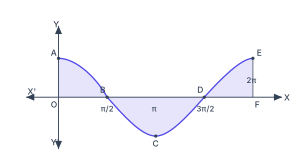
The area bounded by from to is square units. Because the curve dips below the x‑axis, we must split the interval and take absolute values — the net signed area is zero, but the geometric area is .
Why area under a curve isn’t always “just integrate”
When a student first sees “area bounded by the curve”, the reflex is to compute . That integral evaluates to , which is true for the signed area — but the question asks for the geometric area, the actual region enclosed between the curve and the x‑axis. The curve crosses the x‑axis at and , so parts of it lie below the axis. Area is always positive, so we must take the absolute value of each piece.
A common mistake is to compute and conclude the area is zero. That gives the net signed area, not the total geometric area. Always check where the curve is above or below the axis.
Step‑by‑step solution
1. Identify the zeroes of in
when and . These split the interval into three parts:
, , .
2. Determine the sign of on each subinterval
- On : (starts at , falls to ).
- On : (goes from to and back to ).
- On : (rises from to ).
3. Write the area as a sum of absolute integrals
The total geometric area is:
4. Evaluate each integral
- First piece: . …
Unlock everything free for 14 days
- Full step-by-step solutions
- Concept-first explanations
- Methods, shortcuts & mistakes
- PYQ mapping + timed mock tests
Full access for 14 days. No credit card required.