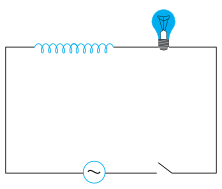
Q.A light bulb and an open coil inductor are connected to an ac source through a key as shown in Fig. 7.9.
You're viewing a preview — the full solution, concept, methods & PYQ mapping are locked.
Start your 14-day free trial to unlock the full solution →Inserting an iron rod into the inductor increases its inductance, which raises the inductive reactance and reduces the current — so the bulb glows dimmer. The correct answer is (b) decreases.
Why this approach works — the concept first
The key idea here is that an inductor in an AC circuit opposes changes in current through a property called inductive reactance, . Unlike a resistor, which opposes current steadily, an inductor's opposition depends on how quickly the current is changing — and that's set by the AC frequency. But the inductor's design also matters: its inductance depends on the core material.
When you slide an iron rod into the coil, you're changing the core from air (low permeability) to iron (high permeability). That dramatically increases . And since , the reactance jumps up. With a fixed AC voltage source, more reactance means less current — and the bulb, which glows based on the power it dissipates (), gets dimmer.
A common mistake is to think the iron rod "conducts" current or somehow helps the bulb. It doesn't — the rod is insulated or just a solid piece; it only changes the magnetic properties of the coil. The bulb's brightness depends on current, not on magnetic field strength directly.
Step-by-step reasoning
1. Identify the circuit elements and their roles.
The bulb is a resistive load (its filament has resistance ). The open-coil inductor is a pure inductor (ideally, zero resistance) with inductance . They're in series with an AC source of fixed voltage and fixed frequency . The total impedance of the series combination is:
2. Understand what inserting the iron rod does.
The inductance of a coil depends on the magnetic permeability of the core material:
where is the number of turns, is the cross-sectional area, and is the length. Air has (permeability of free space). Iron has a relative permeability that can be hundreds or thousands — so becomes huge. Therefore, increases dramatically.
3. Trace the effect on current.
The RMS current in the circuit is:
When increases, increases, so increases. Since and are fixed, decreases.
4. Connect current to bulb brightness. …
Unlock everything free for 14 days
- Full step-by-step solutions
- Concept-first explanations
- Methods, shortcuts & mistakes
- PYQ mapping + timed mock tests
Full access for 14 days. No credit card required.