Q.S is the surface of a lump of magnetic material.
🔒You're viewing a preview — the full solution, concept, methods & PYQ mapping are locked.
🔒 Start your 14-day free trial to unlock the full solution →Concept understanding — Magnetic Field Lines
Magnetic Field Lines
A magnet or a current-carrying wire fills the space around it with a magnetic field. We cannot see this field, so we picture it using magnetic field lines — continuous curves that map both the direction and the strength of the field at every point.
What a field line represents
The tangent to a field line at any point gives the direction of the magnetic field B there. If you place a tiny compass needle at that point, it aligns along the tangent, its north pole pointing the way the line runs. The density of the lines (how closely packed they are) represents the magnitude of B: crowded lines mean a strong field, widely spaced lines mean a weak field.
Key properties (exam essentials)
- Outside a magnet the lines run from the north pole to the south pole, but they are continuous closed loops — inside the magnet they run south to north, so every line closes on itself.
- Two field lines never intersect. If they did, a compass at the crossing point would have to point in two directions at once, which is impossible.
- Lines are crowded where the field is strong (near the poles) and spread out where it is weak.
- They form smooth, continuous curves with no free ends.
The fact that magnetic field lines always close on themselves is deep: it means there are no isolated magnetic poles (monopoles). This is Gauss's law for magnetism:
∮B⋅dA=0
The net magnetic flux through any closed surface is zero — every line that enters the surface also leaves it.
Contrast with electric field lines
Electric field lines start on positive charges and end on negative charges — they are open curves. Magnetic field lines have no such start or end; they are always closed loops. This single difference reflects that isolated electric charges exist, but isolated magnetic poles do not.
Uniform field …
Why this formula?
Magnetic Field Lines
A magnetic field line is an imaginary curve we draw to picture an invisible field. Its purpose is to encode two things at once: the direction of the field B (the tangent to the line at any point) and the strength of the field (how densely the lines are packed). They are a map, not physical objects.
The four defining rules
1. The tangent gives the field direction. At every point, B points along the tangent to the field line through that point. A compass needle placed on the line aligns with it.
2. Field lines form closed loops. Unlike electric field lines, which begin and end on charges, magnetic field lines never start or stop. This is Gauss's law for magnetism:
∮B⋅dA=0
The net flux through any closed surface is zero because isolated magnetic poles (monopoles) do not exist — every north pole is paired with a south pole. So for a bar magnet the lines emerge from the north pole outside, curve around to the south pole, and continue through the interior of the magnet back to the north, closing the loop.
3. Field lines never cross. If two lines crossed, the tangent — and hence B — would have two directions at that point. Since the field has a single, unique direction everywhere, crossings are impossible. …
The field B obeys ∇⋅B=0 everywhere, so its normal component is continuous and its lines are always continuous (closed) across the surface S (a correct, b wrong). But H=B/μ0−M, and M jumps to zero outside the material, so the surface acts like a magnetic-pole layer where H's normal component is discontinuous — the H lines cannot all be continuous (d c …
Because ∇⋅B=0 always, B-lines are continuous across the surface of a magnetic lump. But H is sourced by magnetic poles at that surface, so H-lines cannot all be continuous. Correct options: (a) and (d).
Concept understanding. The two magnetic fields obey
∇⋅B=0,B=μ0(H+M),∇⋅H=−∇⋅M.
The first says B has no sources or sinks: its field lines are always closed loops and its normal component is continuous across any boundary,
Bn,in=Bn,out.
Inside the material M=0; just outside M=0. So M drops abruptly across S, and this jump acts as an effective surface pole density σm=M⋅n^. From H=B/μ0−M, the normal component of H jumps:
Hn,out−Hn,in=Mn=M⋅n^.
Testing each option.
- (a) Lines of B are necessarily continuous across S (normal component continuous; B-lines are closed). Correct. …
Method: Boundary Conditions for B and H at a Material Surface
Use this method for any question asking whether field lines of B or H are continuous across the surface of a magnetised material.
Steps
Step 1: Start from the two governing relations
∇⋅B=0,H=μ0B−M
The first is universal — always true, everywhere, for any magnetic field, with no exceptions.
Step 2: Apply Gauss's law for magnetism at the boundary
Because ∇⋅B=0 never fails, the normal component of B is always continuous across any surface: Bn,in=Bn,out. So B field lines are always continuous — they close on themselves and never terminate anywhere, including at a material boundary.
Step 3: Track what happens to M across the boundary …
- CBSE 2026Set ANNUAL1 markQ.The tangent drawn to the magnetic field line at any point represents the direction of the net ______ at that point.
›Reveal solutionSolution
Magnetic field lines are drawn precisely so that the tangent at any point along a line gives the direction of B at that point.
A magnetic field line is defined as a continuous curve such that the tangent drawn at any point on it gives the direction of the resultant (net) magnetic field B at that …
- CBSE 2026Set ANNUAL1 markMCQQ.The magnetic lines of force inside a bar magnet(a) do not exist(b) depend on area of cross-section of the bar magnet(c) are from N-pole to S-pole of the magnet(d) are from S-pole to N-pole of the magnet
›Reveal solutionSolution
Magnetic field lines always form closed loops: outside a bar magnet they go from N to S, and INSIDE the magnet they continue from S back to N to close the loop.
Unlike electric field lines (which start on positive charges and end on negative charges, because isolated electric charges exist), magnetic field lines have no starting or ending point - they form continuous closed loops, because isolated magnetic monopoles do not exist (Gauss's law for magnetism: the net magnetic flux through any closed surface is always zero). Outside a bar magnet, the field lines emerge from the N-pole and curve around …
- CBSE 2025Set A1 markQ.Fill in the blank with appropriate word: The ______ to the field line at a given point represents direction of resultant magnetic field at that point.
›Reveal solutionSolution
The direction of the magnetic field at any point on a field-line map is given by the tangent to the field line at that point.
Magnetic field lines are drawn such that at every point along the line, the direction of the line (i.e., the tangent to the curve at that point) represents the direction of the net magnetic field B at that point, and the density of the lines (how closely packed they are) represents the magnitude/strength of the field. This is exactly analogous to how electric field lines repre …
- CBSE 2025Set A1 markQ.Write True or False: Magnetic field lines always form closed loops.
›Reveal solutionSolution
The statement is True: unlike electric field lines, magnetic field lines never have a start or end point — they always close on themselves.
Electric field lines begin on positive charges and end on negative charges (since isolated + and – charges exist). Magnetic field lines, however, form continuous closed loops — outside a bar magnet they go from the North pole to the South pole, and inside the magnet they continue from the South pole back to the North pole, forming an …
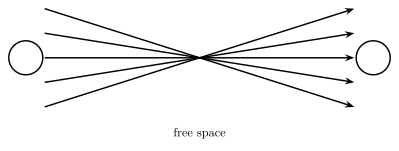
- CBSE 2025Set ANNUAL1 markQ.In this given diagram the magnetic field lines are shown wrongly (labelled 'free space'). Point out what is wrong with this.
›Reveal solutionSolution
Two magnetic field lines can never cross, because the field at any point has one unique direction — the tangent to the field line there.
A magnetic field line is defined such that the tangent to it at any point gives the direction of B at that point. If two field lines were to intersect, then at the point of intersection there would have to be two different tangent directions — meaning the magnetic field would have two different directions at the same point simultaneously, which is physically impossible (the net field at a point is a single, unique vector obtained by vector-adding all contributions).
…
- CBSE 2024Set ANNUAL1 markMCQQ.The magnetic lines of force inside a bar magnet(a) do not exist(b) depend on area of cross-section of the bar magnet(c) are from N-pole to S-pole of the magnet(d) are from S-pole to N-pole of the magnet
›Reveal solutionSolution
Magnetic field lines form closed loops; outside a bar magnet they go from N to S, and to close the loop they must run from S to N inside the magnet.
Unlike electric field lines (which start on positive charges and end on negative charges, since isolated charges exist), magnetic field lines have no beginning or end - they always form closed continuous loops, because isolated magnetic monopoles do not exist. Outside a bar magnet, the field lines emerge from the North pole and curve around to enter the South pole. For these to form closed loops, inside the body of the magnet the field lines must continue from the South pole to the North pole, completing the circuit. So th …
- CBSE 2023Set ANNUAL1 markMCQQ.Which of the following is not correct about the magnetic field lines?(1) The magnetic field lines of a magnet form continuous closed loops(2) The tangent to the field lines at a given point represents the direction of the net magnetic field at that point(3) The larger the number of field lines crossing per unit area, the stronger is the magnitude of the magnetic field B(4) The magnetic field lines may intersect each other in certain conditions
›Reveal solutionSolution
All three of (1), (2), (3) are true properties of magnetic field lines; only (4) is false, since two field lines can never cross.
Magnetic field lines: form continuous closed loops (a, true), the tangent at any point gives the net field direction there (b, true), and their density (lines per unit area) represents field strength (c, true). Two field lines can never intersect — at an intersection point the field would have two directions at o …
- CBSE 2023Set ANNUAL1 markMCQQ.The magnetic lines of force inside a bar magnet(1) are from N-pole to S-pole of the magnet(2) are from S-pole to N-pole of the magnet(3) depends on area of cross-section of bar magnet(4) do not exist
›Reveal solutionSolution
Magnetic field lines form closed loops: outside a bar magnet they go from N to S, and inside the magnet they continue from S back to N to close the loop.
Outside the magnet, field lines emerge from the N-pole and enter the S-pole. Since field lines must form continuous closed loops (no beginning or end, unlike electric field lines which start/end on c …
🎓Unlock everything free for 14 days
- ✓Full step-by-step solutions
- ✓Concept-first explanations
- ✓Methods, shortcuts & mistakes
- ✓PYQ mapping + timed mock tests
Full access for 14 days. No credit card required.